Electronegativity is a fundamental chemical property that explains how atoms compete for shared electrons in covalent bonds. Understanding electronegativity allows us to predict bond dipoles, molecular geometry, and the origin of intermolecular forces such as hydrogen bonding.


Defining Electronegativity
Official A-Level Specification Definition:
Electronegativity is the power of an atom to attract the bonding pair of electrons in a covalent bond towards itself.
Electronegativity is quantified using the Pauling scale, a dimensionless relative scale ranging from 0.7 to 4.0:
- Fluorine (F) is the most electronegative element, assigned the maximum value of 4.0.
- Cesium (Cs) and Francium (Fr) are the least electronegative, with values around 0.7.
| Element | Symbol | Pauling Electronegativity Value |
|---|---|---|
| Fluorine | F | 4.0 |
| Oxygen | O | 3.5 |
| Nitrogen | N | 3.0 |
| Chlorine | Cl | 3.0 |
| Bromine | Br | 2.8 |
| Carbon | C | 2.5 |
| Hydrogen | H | 2.1 |
Key Concept: Noble gases (Group 0 / 18) are omitted from the standard Pauling scale because their full valence shells mean they do not form covalent bonds under standard conditions.
Factors Determining Electronegativity
An atom's electronegativity depends on the net electrostatic attraction exerted by its positively charged nucleus on the shared pair of valence electrons:
- Nuclear Charge (Proton Number): More protons in the nucleus create a stronger positive electrostatic pull on the bonding pair.
- Atomic Radius: In smaller atoms, the bonding electrons sit closer to the nucleus, experiencing a stronger pull.
- Inner Shell Shielding: Full inner electron shells repel outer bonding electrons, partially masking the nuclear charge. Fewer inner shells mean less shielding and higher electronegativity.
| Variable | Structural Change | Impact on Electronegativity | Mechanism |
|---|---|---|---|
| Nuclear Charge | Increases | Increases | Greater positive charge attracts shared electrons more strongly. |
| Atomic Radius | Decreases | Increases | Bonding electrons lie closer to the attraction of the nucleus. |
| Shielding | Decreases | Increases | Fewer inner energy levels screen the outer bonding electrons. |
Trends Across the Periodic Table
Electronegativity follows distinct, predictable patterns across periods and down groups.
Across a Period (Left to Right)
Electronegativity increases across a period.
- Proton number increases: Nuclear charge grows stronger from element to element.
- Shielding remains constant: Electrons fill the same outer principal energy level.
- Atomic radius decreases: The stronger nuclear charge draws the outer shell inward.
- Overall Effect: The nucleus exerts a significantly stronger pull on bonding electron pairs.
Down a Group (Top to Bottom)
Electronegativity decreases down a group.
- Inner shielding increases: Additional principal quantum shells are added at each step down the group.
- Atomic radius expands: The distance between the nucleus and the bonding electrons increases.
- Nuclear charge increases: Although proton count increases, this effect is outweighed by the increased distance and shielding.
- Overall Effect: The electrostatic pull on shared electron pairs weakens.
The Bonding Continuum & Bond Polarity
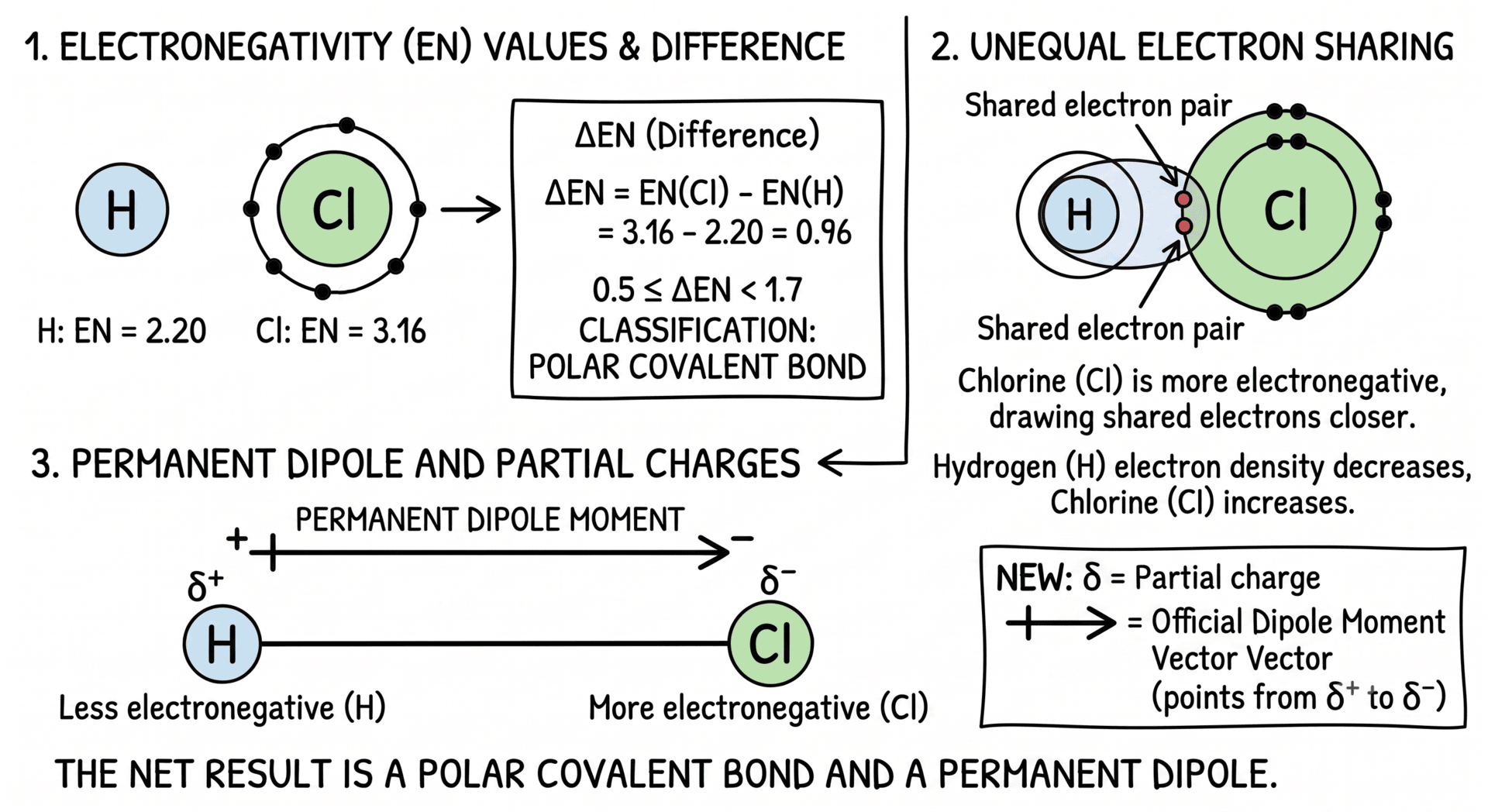
Chemical bonding is not strictly binary (purely covalent vs. purely ionic). Instead, it exists along a continuous spectrum governed by the electronegativity difference () between bonded atoms.
Classifying Bonds by Electronegativity Difference
- Non-Polar Covalent Bond ():
- Formed between identical non-metal atoms (e.g., , ) or atoms with near-identical electronegativities (e.g., , where ).
- Shared electron density is distributed symmetrically between nuclei.
- Polar Covalent Bond ():
- Formed between non-metals with different electronegativities (e.g., , ).
- The more electronegative atom pulls electron density toward itself, acquiring a partial negative charge ().
- The less electronegative atom is left electron-deficient, acquiring a partial positive charge ().
- This permanent separation of charge creates a bond dipole moment.
- Ionic Bond ():
- Formed when the electronegativity difference is very large (e.g., , ).
- Electron transfer is virtually complete, yielding discrete positive cations and negative anions held together by electrostatic forces.
Polar Bonds vs. Polar Molecules
A molecule containing polar bonds is not automatically a polar molecule. The overall dipole moment of a molecule depends on both individual bond dipoles and 3D molecular symmetry (VSEPR theory).
Symmetrical Molecules (Non-Polar Overall)
If polar bonds are arranged symmetrically, individual bond dipoles cancel out vectorially, resulting in a net dipole moment of zero.
- Carbon Dioxide (): Linear shape (). Two opposing bond dipoles cancel out completelyNon-polar molecule.
- Tetrachloromethane (): Tetrahedral shape (). Four identical dipoles cancel out in 3D space Non-polar molecule.
- Boron Trifluoride (): Trigonal planar shape (). Three identical dipoles cancel out in a plane Non-polar molecule.
Unsymmetrical Molecules (Polar Overall)
If a molecule lacks symmetry or contains different terminal atoms, individual dipoles do not cancel out, creating a permanent molecular dipole.
- Water (): Bent / non-linear shape () due to two lone pairs on oxygen. The two dipoles reinforce each other Polar molecule.
- Trichloromethane (): Tetrahedral, but the single bond dipole differs from the three dipoles Polar molecule.
Exam Pitfalls & Specification Keywords
Exam Tip 1: Always include "Covalent Bond" & "Pair of Electrons"
Defining electronegativity as "the ability of an atom to attract electrons" will be penalised in A-Level mark schemes. You must explicitly state that it attracts the bonding pair of electrons in a covalent bond.
Exam Tip 2: Distinguish Electronegativity from Electron Affinity
- Electronegativity is a unitless relative value describing electron attraction within a shared bond.
- First Electron Affinity is an enthalpy change () for adding an electron to a gaseous atom:
BF3
Exam-Style Practice Questions & Answers
Explain why nitrogen is more electronegative than phosphorus.
- Atomic Radius: Nitrogen has fewer electron shells than phosphorus (2 principal energy levels vs. 3), giving it a smaller atomic radius.
- Shielding: Nitrogen has less inner-shell electron shielding than phosphorus.
- Electrostatic Attraction: Bonding electrons in nitrogen sit closer to the nucleus, experiencing a stronger electrostatic pull despite phosphorus having a higher nuclear charge.
Explain why boron trifluoride ( ) is a non-polar molecule, whereas ammonia (
 ) is a polar molecule, despite both containing polar covalent bonds.
- Boron Trifluoride Geometry: Boron trifluoride has a trigonal planar shape ($120^\circ$ bond angles) with no lone pairs of electrons on the central boron atom.
- Boron Trifluoride Dipole Cancellation: The three symmetrical boron–fluorine bond dipoles cancel out completely in 3D space, yielding zero net dipole moment.
- Ammonia Geometry: Ammonia has a trigonal pyramidal shape ($107^\circ$ bond angles) due to one lone pair of electrons on the central nitrogen atom.
- Ammonia Net Dipole: Because ammonia is unsymmetrical, the three nitrogen–hydrogen bond dipoles do not cancel out, creating a permanent molecular dipole across the molecule.
Arrange the following bonds in order of increasing covalent character: K-Cl, H-Br, I-I, C-O. Explain your reasoning.
Order: K-Cl Explanation:
Related Articles:
Continue your A-Level Chemistry Revision with the following articles:
Summarise with AI:
Did you like this article? Rate it!

 Loading...