Hydrogen bonding is the strongest type of intermolecular force. It accounts for the anomalous properties of water, the high boiling points of alcohols and carboxylic acids, and the structural stability of proteins and DNA.


What is a Hydrogen Bond?
Mark Scheme Definition:
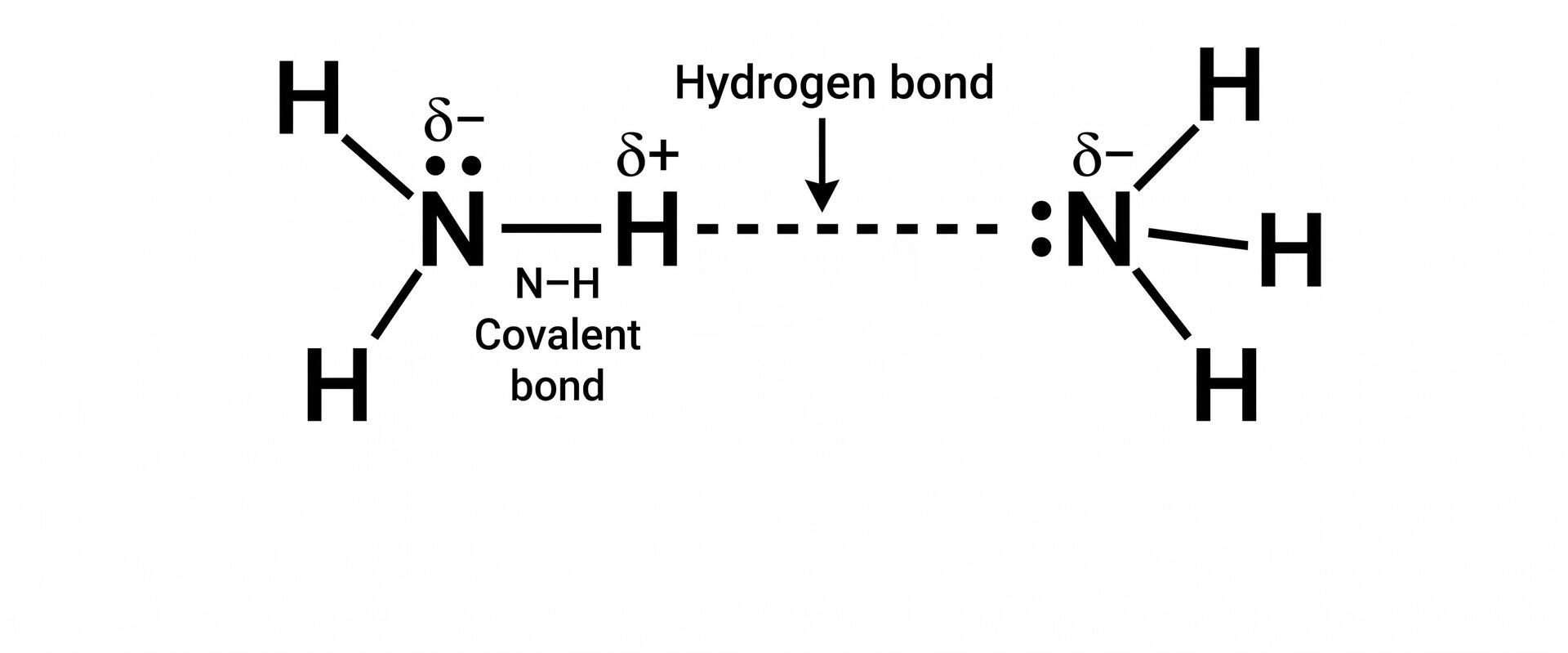
A hydrogen bond is the electrostatic attraction between a hydrogen atom bonded to a highly electronegative atom (N, O or F) and a lone pair of electrons on an electronegative atom (N, O or F) of an adjacent molecule.
Drawing Hydrogen Bonds for Exams
To gain full marks in diagram questions, ensure you include all four key features:
- Partial charges: Label and across the polar bonds.
- Lone pairs: Clearly draw the lone pair on the acceptor atom (N, O or F).
- Dashed line: Draw a dashed/dotted line extending directly from the lone pair to the atom.
- Linear geometry: The bond angle must be approximately .
Anomalous Properties of Water
- Unusually High Boiling Point: Water has a much higher boiling point () than other Group 6 hydrides (e.g., at ) because significant thermal energy is required to overcome strong hydrogen bonds which are diminished as the molecules become larger down the group. It also has an optimal 1:1 ratio of hydrogen atoms to oxygen lone pairs (2 hydrogen atoms and 2 lone pairs per molecule of water).
- Ice is Less Dense than Liquid Water: When water freezes, molecules fix into an open, tetrahedral 3D crystal lattice. The rigid hydrogen bonds hold molecules further apart than in liquid water, lowering its density.
Exam Pitfalls & Key Tips
Common Error #1: Stating that "covalent bonds break when water boils." Only the intermolecular hydrogen bonds break; intramolecular covalent bonds stay intact.
Common Error #2: Assuming forms hydrogen bonds. Even though chlorine has an electronegativity of 3.0, its atomic radius is too large and its charge density is too diffuse to form true hydrogen bonds.
Worked Example
Comparing Isomers
Question: Explain why ethanol () has a boiling point of , while methoxymethane () boils at .
Solution:
- Both have the same molecular formula () and equal electron counts (), giving similar London forces.
- Ethanol has an group and forms intermolecular hydrogen bonds.
- Methoxymethane has no bonded directly to , forming only weaker permanent dipole–dipole forces.
- Hydrogen bonds require more thermal energy to break, resulting in a higher boiling point for ethanol.
Practice Questions and Solutions
Explain why propanone,  , cannot form hydrogen bonds with itself, but can form hydrogen bonds with water.
Pure propanone: Contains a C=O group but lacks an H directly bonded to O, so it has no H donor atom.
In water: Water provides the H donor, which is electrostatically attracted to the lone pair on propanone's carbonyl oxygen 
Explain why solid ice floats on liquid water.
In ice, water molecules form a fixed, open tetrahedral lattice held by four hydrogen bonds per molecule.
The rigid hydrogen bonds hold molecules further apart than in liquid water.
This increases the volume for a given mass, making ice less dense than liquid water.
Propylamine,  , and trimethylamine
  are structural isomers with the molecular formula
Propylamine has a boiling point of 48°C, whereas trimethylamine boils at 3°C.
Explain the difference in boiling points between propylamine and trimethylamine in terms of their intermolecular forces.
Propylamine contains hydrogen atoms covalently bonded directly to nitrogen, allowing it to form intermolecular hydrogen bonds (as well as London dispersion and dipole–dipole forces).
Trimethylamine has no hydrogen atoms bonded directly to nitrogen (nitrogen is bonded only to carbon atoms). Therefore, it cannot form hydrogen bonds with itself and experiences only weaker permanent dipole–dipole forces and London dispersion forces.
Hydrogen bonds between propylamine molecules are significantly stronger than the dipole–dipole forces in trimethylamine, requiring more thermal energy to overcome.
Related Articles:
Continue your A-Level Chemistry Revision with the following articles:
Summarise with AI:
Did you like this article? Rate it!

 Loading...