Whether you are studying GCSE Mathematics (Coordinate Geometry) or A-Level Pure Maths (Conic Sections), understanding the parabola is a fundamental milestone. This curve is not just a shape on a graph; it is a mathematical powerhouse that describes everything from the path of a cricket ball to the way satellite dishes beam data into your home.


What is a Parabola?
At its simplest, a parabola is a U-shaped symmetrical curve. However, in higher-level mathematics, we define it in two specific ways:
- The Locus Definition: A parabola is the set of all points in a plane that are equidistant from a fixed point (the focus) and a fixed straight line (the directrix).
- The Conic Section Definition: It is the curve obtained when a right circular cone is intersected by a plane parallel to its side (generating line).
Parts of a Parabola
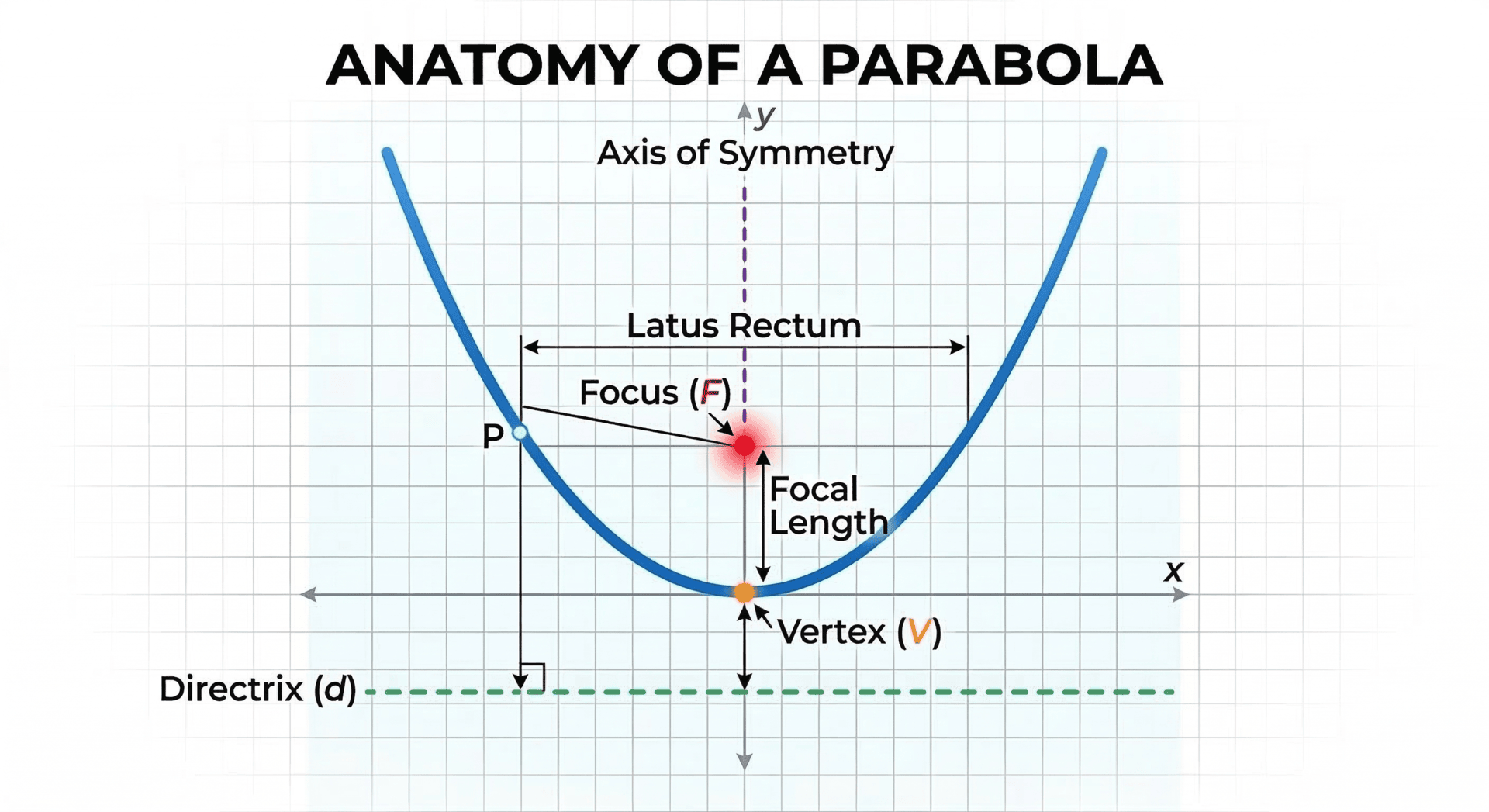
To fully describe a parabola, you must be able to identify its core components.
The Vertex (V)
The vertex is the "turning point" of the parabola. It is either the highest point (maximum) or the lowest point (minimum) on the curve.
The Focus (F)
The focus is a fixed point located on the interior side of the curve. It lies on the axis of symmetry. The focus is critical for the "reflective property" of parabolas—any ray traveling parallel to the axis of symmetry will reflect through this point.
The Directrix (d)
The directrix is a straight line located outside the parabola. It is perpendicular to the axis of symmetry. Every point on the parabola is equidistant from the focus and the directrix.
The Axis of Symmetry
This is the imaginary line that passes through the vertex and the focus, splitting the parabola into two mirror-image halves.
Focal Length and Parameter (p)
The focal length is the distance from the vertex to the focus (or the vertex to the directrix). In coordinate geometry, we often use the value p to represent this distance. The focal parameter is the total distance between the focus and the directrix (which is 2p).
The Latus Rectum
The latus rectum is a chord that passes through the focus, stays parallel to the directrix, and has both endpoints on the parabola. Its total length is always equal to 4p.
Equations of a Parabola
Depending on your exam board (AQA, OCR, Edexcel), you may see parabolas in different forms:
1. Standard Form (Polynomial)
- If a is positive, it opens up.
- If a is negative, it opens down.
2. Vertex Form
- Directly gives you the vertex at (h, k).
3. Conic Form (Geometric)
- This form is best for identifying the focus and directrix.
Worked Examples
Upward Opening Parabola
Problem: Find the vertex, focus, and directrix for the parabola:

1. Find the Vertex (h, k): By comparing the equation to the conic form:

we identify:


Vertex = (-4, 2)
2. Find the Focal Length (p):


3. Determine Direction and Parts: Since x is squared and 4p is positive, the parabola opens upward. The focus is p units above the vertex:

Focus = (-4, 5)
The directrix is a horizontal line p units below the vertex:

Directrix: y = -1
Sideways Opening Parabola
Problem: Identify the properties of the parabola:

1. Find the Vertex (h, k): Note that h is always associated with x and k with y.


Vertex = (1, 5)
2. Find the Focal Length (p):


The absolute distance is 4, but the negative sign indicates the parabola opens to the left.
3. Determine Direction and Parts: Since y is squared and 4p is negative, the parabola opens to the left. The focus is 4 units to the left of the vertex:

Focus = (-3, 5)
4. The directrix is a vertical line 4 units to the right of the vertex:

Directrix: x = 5
Real-World Application
Problem: A satellite dish is designed in the shape of a paraboloid. The cross-section follows the equation:

where x and y are measured in centimeters. If the signal receiver must be placed at the focus to capture signals effectively, how far above the vertex should it be positioned?
1. Identify the Equation Form: The equation is in the form:

Since there are no h or k values, the vertex is at the origin: Vertex = (0, 0)
2. Solve for the Focal Length (p):


3. Conclusion: The focal length represents the distance from the vertex to the focus. To maximize signal reception, the receiver should be placed exactly at the focus. Height above vertex = 5 cm
Need more help? Find a maths tutor here.
Real-World Applications
- Projectile Motion: Any object thrown in the air (a football, a stone, or a projectile) follows a parabolic path due to the constant pull of gravity.
- Satellite Dishes: The parabolic shape ensures that all incoming signals are reflected to a single point—the focus—where the receiver is placed.
- Architecture: The parabolic arch is one of the strongest structures in engineering because it distributes weight efficiently without needing internal supports (e.g., the Gateway Arch).
- Searchlights: By placing a light source at the focus of a parabolic mirror, the light reflects out in perfectly parallel beams.
GCSE and A Level Curriculum Application
- GCSE Maths: Focuses on quadratic functions, identifying the vertex (turning point) through completing the square, and solving for roots.
- A-Level Pure Maths: Requires the use of the focus-directrix definition, sketching conics, and deriving equations from geometric properties.
- A-Level Further Maths / Physics: Explores the Reflecting Property and the use of parabolas in projectile motion under gravity.
Summary Table
| Part | Symbol | Mathematical Property | Visual Description |
|---|---|---|---|
| Vertex | V | (h k) | The turning point; halfway between focus and directrix. |
| Focus | F | Distance 'p' from vertex | Fixed point on the interior; dictates curve width. |
| Directrix | d | Distance 'p' from vertex | Fixed line on the exterior; perpendicular to axis. |
| Axis of Symmetry | - | Perpendicular to directrix | Imaginary line through vertex and focus. |
| Focal Length | p | p = 1 / (4a) | Distance from vertex to focus or directrix. |
| Latus Rectum | LR | Length = 4p | Chord through the focus parallel to the directrix. |
| Eccentricity | e | e = 1 | The defining ratio for all parabolic curves.Part |
Summarise with AI:
Did you like this article? Rate it!


 Loading...
Good.