What is a Line
Lines in space sounds like a complex topic. Let’s break it down to its most basic unit: a line. When we talk about lines, it is usually easier to put that line on a graph. A graph usually looks like the following. 
| Property 1 | Four quadrants going counter-clockwise |
| Property 2 | Two axes: the x-axis and y-axis |
| Property 3 | The two axes form a right triangle |
| Property 4 | There are only two directions corresponding to each axis |
When we draw a line on a graph, we only need two things: two points. In fact, any two points can form a line, no matter how close or far apart they are. 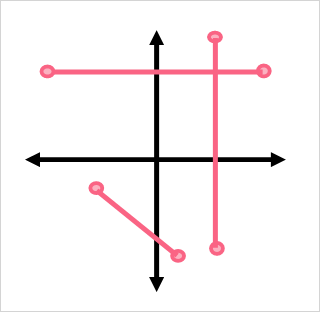
A Line in Two Dimensions
The cartesian plane is an example of two dimensions. While two dimensional geometry sounds a bit complex, it’s actually quite simple. It will make more sense with the definition of a 2 dimensional plane.
| Definition | Example | |
| Two-Dimensional | A space that only has two directions | Cartesian plane |
A line in two dimensional space is simply any line on a cartesian plane. This is where the idea of quadrants really comes in handy. When you have any coordinate on a cartesian plane, you can locate them by going in only two directions. 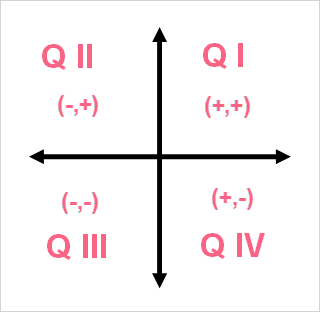
| Quadrant 1 | (+,+) | (right, up) |
| Quadrant 2 | (-,+) | (left, up) |
| Quadrant 3 | (-,-) | (left, down) |
| Quadrant 4 | (+,-) | (right, down) |
As you can see, in any given quadrant, you can only go in two directions to locate a coordinate. A line can be thought of as two points, but you can also think about the infinite amount of points that you can fit in between those two points. 
The 3 Equations of a Line
When you have a line in two-dimensional plane, you actually have three different formulas you can work with. Take a look at them below. 
| Standard From | Slope-Intercept | Point-Slope Formula |
 |  |  |
| -3x + 7y = 14 | y= x+2 | y-5 = * (x - 7) |
Slope Intercept
The slope intercept form is the simplest of the three. This is because it is the most common. Let’s break it down to its elements.
| y | The y value that the formula gives when we plug in the x coordinate. We can also rearrange the formula so it gives us the x-value for any y-value: |
| x | The x value that we can plug in. This is the x coordinate. |
| m | The slope of the line. This slope tells us how sharp or subtle the incline or decline is. |
| b | The y-intercept, which is the value of the y coordinate where the line crosses the y-axis. In other words, the point where the x coordinate is zero. |
| Point 1 |  |
| Point 2 |  |
| The vertical length |  |
| The horizontal length |  |
| The slope |  |
Standard Form
In order to understand the standard form, let’s see how we get to the standard form from the slope-intercept form. Keep in mind that one line can be written in any of the three ways we presented. Let’s take our example form earlier. \[ y = \dfrac{3}{7}x+2 \] In the standard form, the x and y values are on the same side. So, what we need to do is try to get rid of the fraction.
| Step 1 | Get rid of the fraction |  |
| Step 2 | Simplify | 7y = 3x + 14 |
| Step 3 | Get x and y to the same side | 7y - 3x = 14 |
| Step 4 | Arrange into standard form | -3x + 7y = 14 |
| A | B | C |
| -3 | 7 | 14 |
In order to find the x and y intercept, you should follow these rules.
| Rule | Example | |
| x-intercept |  |  = -4.67 |
| y-intercept |  |  = 2 |
Point-Slope Formula
The last formula is the point-slope formula. Typically, when we have the slope-intercept form, we have to know these two things:
| Known 1 | Slope |
| Known 2 | y-intercept |
However, we often have to find the y-intercept in order to use the formula. This is the scenario where the point-slope formula is most useful. For the point-slope formula, we only need these two things.
| Known 1 | Slope |
| Known 2 | A point |
Let’s take our example again, only this time, let’s say that you only know the slope and a point.
| Known 1 | Slope | |
| Known 2 | A point | (7,5) |
| Step 1 | Get the point slope formula |  |
| Step 2 | Replace the slope and the point into the formula |  |
| Step 1 | Start with point-slope form |  |
| Step 2 | Multiply the slope to both numbers |  |
| Step 3 | Get the y by itself |  |
| Step 4 | Simplify |  |
Summarise with AI:
Did you like this article? Rate it!


 Loading...