Before you step into your school laboratory, you need to learn about the apparatus. Apparatus is designed and used for special purposes. There can be exceptions, however, the purpose of this resource is to identify the types of apparatus and their purpose.









Types of Apparatus
In slang language, you can call them your tools. You require these tools to perform experiments. Suppose your teacher asked you to make a boiling curve of water with the help of an experiment, what would be the first thing that will come to your mind? What tools do you require to conduct this experiment? Don't worry, we will tell you how you can conduct this experiment with the help of the list of apparatus below.
Pipette
A pipette is a liquid transferring instrument that is used to displace a fixed amount of liquid. A pipette can displace 25 cm3 volume. Below is a rough picture of a pipette.
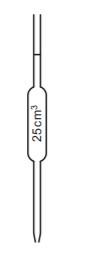
It is usually used to take out samples for further study. Let's talk about its geometric structure. There are two ends of pipettes, one is bending to a small opening which is placed in the fluid for the suction and the other is a flat circular opening from where the vacuum will be created for suction. There are two ways for creating a vacuum, the traditional way is to suck from your mouth which can be dangerous and we don't recommend you to do that. The second way is to use the pipet filler which is more safe and easy to displace liquid. Below the flat circular opening, you will see a red circle mark. If the liquid level reaches that mark that indicates the pipette contains 25 cm3 liquid. Your goal is to fill the liquid up to that mark.
Measuring Cylinder
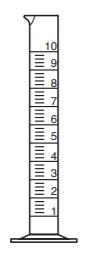
A measuring cylinder is a measuring instrument that is used to measure the volume of the liquid. Measuring cylinder comes in various sizes. It ranges from 10 ml to 1000 ml. If you want to note the volume of the liquid just pour in the measuring cylinder and then use the markings written on the wall of the measuring cylinder to note the volume of the liquid.
Burette
A burette is an advanced version of a measuring cylinder. On the wall of the burette, you can see the volume marking. A burette can be filled up to 100 ml. Below is a picture of the burette.
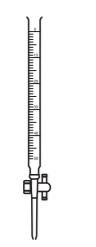
Burettes are commonly used in titration experiments. The common procedure of a burette is to first wet the wall of the burette using the solution that you want to place in the burette. Make sure you cover every spot of the internal wall of your burette. Drain the liquid and then refill it with the solution up to a mark of 50 cm3. Before the bottom tip, there is a stopcock which is used to control the flow of the liquid from the burette.
Beaker
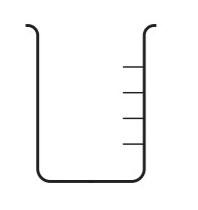
Beaker is a common apparatus in every laboratory. Its function is to hold the liquid. Some beakers are also labelled with measurements that can be used to measure the volume of the liquid, however, we don't use beakers to measure liquids, we always use a measuring cylinder to measure the liquid.
Test Tube
Beakers are used for a big amount of liquid but if you are working with a small amount of liquid, you can use a test tube too. Test tubes are also used in various laboratory instruments.

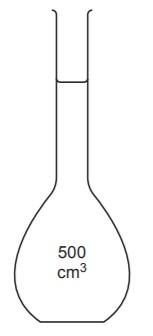
Volumetric Flask
A Volumetric flask is designed for the dilution of chemicals. It contains 250 cm3 of volume. It is commonly used in an acid-base titration experiment.
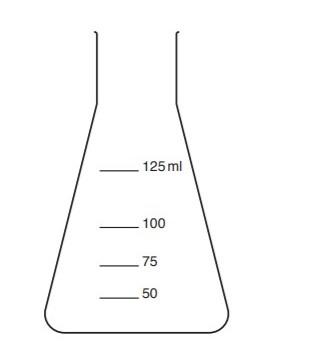
Conical Flask
A conical flask is used to collect liquid from any kind of experiment. The shape of this flask is cone type and that is why it is called a conical flask.
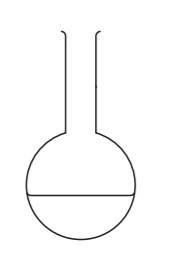
Round-Bottom Flask
As the word describes a flask that is round at the bottom. It is used in different sets of experiments but is mainly used in distillation experiments.
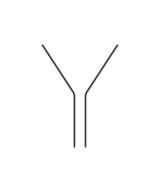
Filter Funnel
A filter funnel is a special type of apparatus which is especially used for the filtration process. It is a v-shape cup that has an opening at the vertex.
Piston
A piston is a gas measuring apparatus that generates negative pressure to suck gas and measure its volume. Like measuring cylinders, pistons come with different volumes.

Conclusion
The above list is the list of apparatus that you can find in any laboratory. In your GCSE Chemistry exam, you will be given a picture and you will be asked to name the apparatus. That is why you need to memorize apparatus names with their pictures. Furthermore, in some previous papers, students were also asked to write their volumes too, for specific apparatus such as pipette, burette, etc. Therefore, it is better you also memorize the volumes for specific instruments such as volumetric flask, burette etc.
Summarise with AI:
Did you like this article? Rate it!


 Loading...