In GCSE Chemistry, reactions taking place in aqueous solutions are fundamentally driven by the interactions of individual charged particles called ions. While a standard balanced molecular equation displays every compound as an intact unit, it often masks the true chemical changes occurring in the test tube.
An ionic equation simplifies a chemical equation by focusing exclusively on the specific ions, atoms, or molecules that actively participate in the reaction. Mastering the creation of ionic and half-equations is an essential skill for exam success across all major exam boards.


Theory
Dissociation in Solution
When a soluble ionic compound dissolves in water to form an aqueous solution (aq), its giant ionic lattice breaks apart. The individual positive and negative ions separate and become surrounded by water molecules. This process is called dissociation.
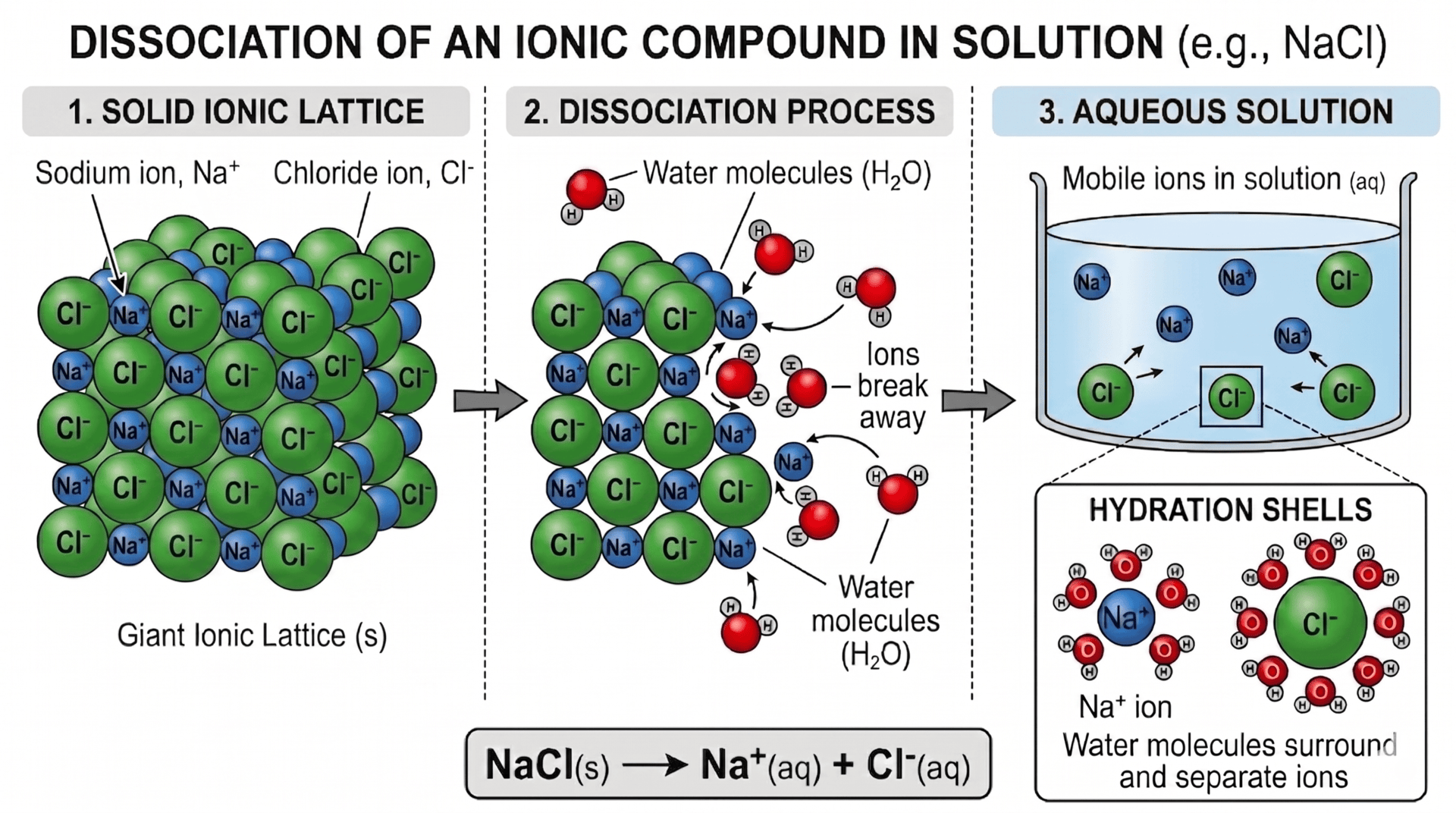
For example, when solid sodium chloride dissolves, it does not exist as isolated \text{NaCl} molecules; instead, it splits into free-moving ions:
Molecular vs. Ionic Equations
- Molecular Equation: Shows the complete chemical formulas of all reactants and products, showing them as intact compounds regardless of their physical state.
- Complete Ionic Equation: Shows all soluble ionic substances explicitly broken down into their individual dissolved, hydrated ions.
- Spectator Ions: Ions that are present in the reaction mixture but do not take part in the chemical reaction. They remain dissolved in the solution and appear identical on both the reactant and product sides of the equation.
- Net Ionic Equation: The final, cleaned equation that remains after all spectator ions have been completely crossed out. It shows only the species changing their state or electronic configuration.
Solubility Rules and State Symbols
To accurately determine whether a compound should be split into individual ions, you must know its physical state. Soluble ionic compounds in an aqueous environment (aq) must be split. Insoluble ionic compounds remaining as a solid precipitate (s), pure liquids (l), and gases (g) must never be split.
The core GCSE solubility rules dictate how you assign these states:
| Compound Group | Solubility Status | Exceptions |
|---|---|---|
| Nitrates | Always Soluble | None |
| Group 1 | Always Soluble | None |
| Ammonium | Always Soluble | None |
| Halides | Soluble | Insoluble when paired with Silver or Lead |
| Sulfates | Soluble | Insoluble when paired with Barium, Calcium, or Lead |
| Carbonates | Insoluble | Soluble ONLY when paired with Group 1 ions or Ammonium |
| Hydroxides | Insoluble | Soluble ONLY when paired with Group 1 or Ammonium. Calcium hydroxide is slightly soluble. |
Core GCSE Reaction Categories
Most exam questions will ask you to construct net ionic equations for three primary types of chemical transformations:
1. Neutralization Reactions
An acid releases H+ ions into solution, while an alkali releases OH- ions. When mixed, these ions react to produce neutral water molecules. For any strong acid reacting with a strong alkali, the spectator ions always cancel out to reveal the exact same net ionic equation:
2. Precipitation Reactions
When two clear aqueous solutions are mixed together, a chemical exchange can form an insoluble solid compound that drops out of the solution. This solid is known as a precipitate.
3. Reactions with Solids, Liquids, or Gases
If a reactant starts as a solid metal or a solid carbonate, it is not dissociated into the solution at the start. Therefore, it must be kept fully intact on the reactant side of your equation.
This law states that matter cannot be created or destroyed during a chemical reaction. Instead, the chemical bonds holding the reactants together are broken, and the atoms simply swap partners to form new products.
Because no new atoms can appear and no existing atoms can vanish, you must ensure that:
The total mass of the reactants is exactly equal to the total mass of the products.
The total number of atoms for each individual element is exactly the same on both sides of the chemical equation.
GCSE Example: Making Water
If you mix hydrogen gas and oxygen gas together, they react to produce water. If we write this down as an unbalanced equation, it looks like this:
Let's count the individual atoms on each side of the arrow:
- Reactants (Left Side): 2 x Hydrogen atoms, 2 x Oxygen atoms
- Products (Right Side): 2 x Hydrogen atoms, 1 x Oxygen atom
Looking at this unbalanced version, it appears that one oxygen atom has completely disappeared. This is physically impossible according to the Law of Conservation of Mass.
To fix this, we change the coefficients (the big numbers written in front of the chemical formulas). We can never change the small subscript numbers, as that would alter the actual substance itself. By adding coefficients, we balance the equation:
Let's recount the atoms now:
- Reactants (Left Side): 4 x Hydrogen atoms, 2 x Oxygen atoms
- Products (Right Side): 4 x Hydrogen atoms, 2 x Oxygen atoms
The number of atoms on both sides matches perfectly. The mass has been conserved, and the equation is now scientifically accurate for your GCSE exam.
Half-Equations
While net ionic equations show the overall chemical change in solution, half-equations focus strictly on what happens to one specific element or ion. They explicitly show the transfer of electrons (e-) and are heavily utilized in the study of electrolysis and redox reactions.
- Oxidation: Electrons are lost and written on the right-hand side (product side).
- Reduction: Electrons are gained and written on the left-hand side (reactant side).
Worked Example
Problem: Write the balanced net ionic equation for the displacement reaction between aqueous chlorine gas and aqueous potassium iodide solution.
Step-by-step Solution:
Step 1: Write the fully balanced molecular equation
Ensure all formulas are correct and contain the necessary state symbols.
Step 2: Expand into a Complete Ionic Equation
Identify the soluble ionic compounds (aq) and split them into separate ions. Leave diatomic elements like chlorine and iodine intact as they are covalent molecules, not ions in a lattice.
Step 3: Eliminate the Spectator Ions
Identify the ions that appear unchanged on both sides. The potassium ions, 2K+, match perfectly on both sides. Cross them out to leave the net ionic equation:
Practice Questions & Solutions
Write the net ionic equation for the precipitation reaction between aqueous silver nitrate and aqueous sodium chloride.
The full balanced molecular equation is:

Breaking all soluble aqueous ionic compounds into their separate dissociated ions yields:

Cancelling the sodium and nitrate spectator ions on both sides leaves the final net ionic equation:

Deduce the balanced net ionic equation for the displacement reaction between solid zinc metal and aqueous copper(II) sulfate solution.
Write out the balanced molecular equation including all state symbols:

Expand the soluble aqueous compounds into separate ions, leaving the solid metals fully intact:

Eliminate the sulfate ion from both sides as it acts purely as a spectator ion:

Construct the net ionic equation for the reaction of solid calcium carbonate with dilute hydrochloric acid to produce aqueous calcium chloride, water, and carbon dioxide gas.
Write the fully balanced molecular equation:

Separate the soluble ionic reactants and products into independent ions, leaving solids, liquids, and gases alone:

Cross out the matching chloride spectator ions to obtain the final net ionic equation:

Write the balanced half-equation showing the oxidation of aqueous bromide ions into a diatomic bromine molecule during an electrolysis reaction.
Two negatively charged bromide ions lose a total of two electrons to form a neutral liquid bromine molecule:

Write the balanced half-equation for the reduction of molten aluminium ions into neutral liquid aluminium metal during industrial smelting.
A single aluminium ion with a positive three charge must gain three negative electrons to balance its total net charge:

Summarise with AI:
Did you like this article? Rate it!

 Loading...