Positioned on the far right of the periodic table, just to the left of the noble gases in Group 0, sits Group 7—also known as the halogens.
While Group 1 alkali metals are soft, silvery metals that lose electrons vigorously, Group 7 elements are colourful non-metals that gain electrons to form essential compounds like table salt (NaCl) and water disinfectants.
Understanding the physical trends, displacement reactions, and underlying atomic explanations of Group 7 is a core requirement across all major GCSE Chemistry specifications (AQA, Edexcel, and OCR).
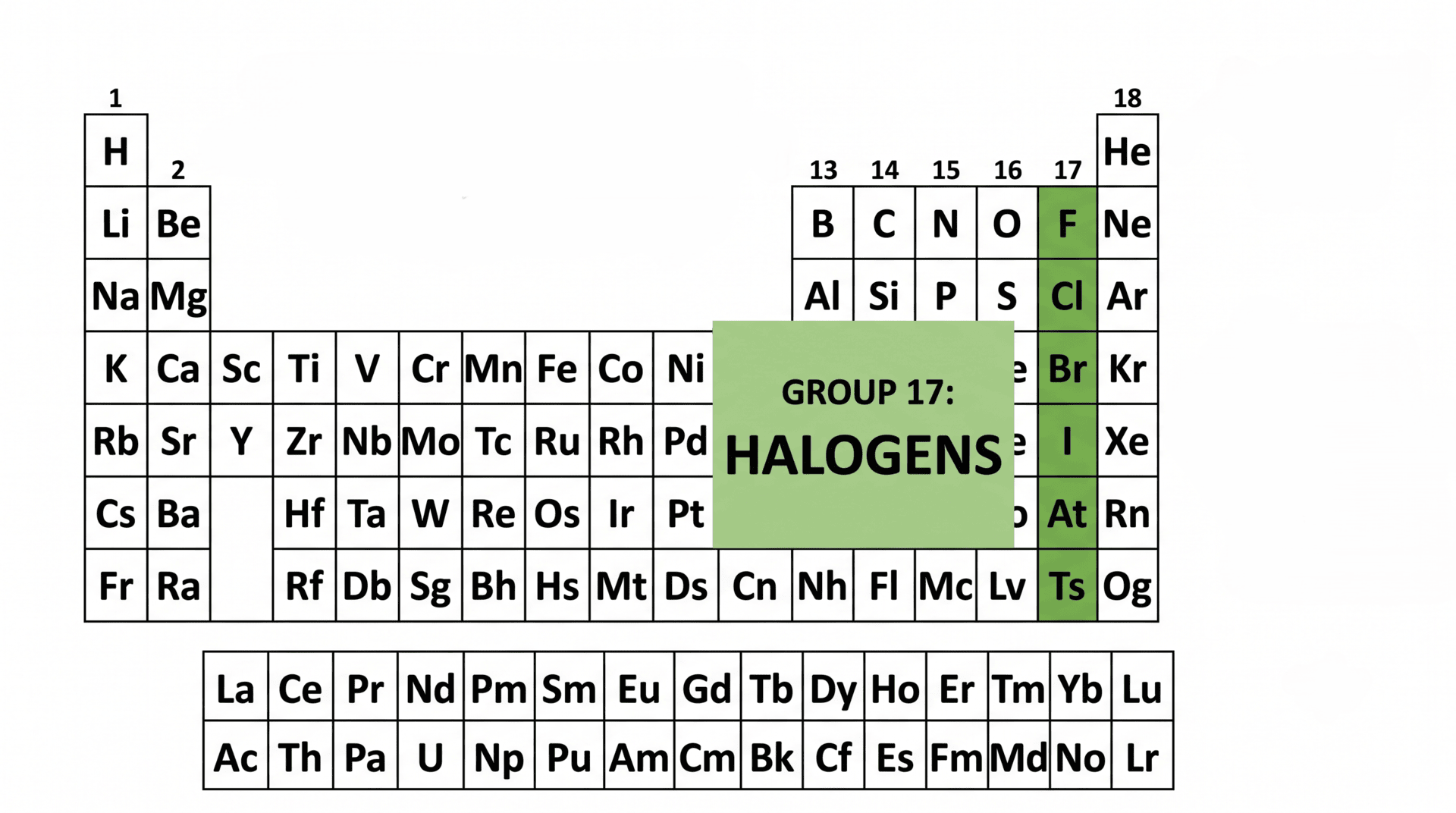







What Are the Halogens?
The name "halogen" comes from the Greek words halos (salt) and genein (to produce), meaning "salt-former." When halogens react with metals, they form ionic salts known as halides.
Every element in Group 7 has 7 electrons in its outer electron shell. To achieve a stable, full outer shell (a noble gas configuration), a halogen atom needs to gain 1 additional electron.
Unlike noble gases that exist as individual atoms, halogens exist naturally as diatomic molecules. This means two halogen atoms share a pair of electrons in a single covalent bond to form pairs such as , , , and .
Physical Properties & Trends Down Group 7
As you move down Group 7 from fluorine at the top to astatine at the bottom, the elements follow clear, predictable trends in their appearance, state, and physical constants.
| Halogen | Symbol & Formula | State at Room Temp (20°C) | Colour | Melting & Boiling Points |
|---|---|---|---|---|
| Fluorine |  | Gas | Pale yellow | Extremely low |
| Chlorine |  | Gas | Pale green | Low |
| Bromine |  | Liquid | Red-brown (forms orange vapour) | Moderate |
| Iodine |  | Solid | Dark grey (sublimes to purple vapour) | High |
| Astatine |  | Solid | Black / Dark grey | Very high |
Key Physical Trends to Remember for Exams:
- Physical State Shift: At room temperature, the elements transition from gas (fluorine, chlorine) to liquid (bromine) to solid (iodine, astatine).
- Colour Darkening: The intensity of the element's colour gets noticeably darker going down the group (from pale yellow to pitch black).
- Melting and Boiling Points Increase: Going down the group, the relative molecular mass increases and the molecules get larger. Larger molecules have stronger intermolecular forces (van der Waals forces) between them, requiring more thermal energy to break.
Chemical Properties & Reactions
Because every halogen atom needs to gain one electron, they all exhibit similar chemical properties. When a halogen atom gains an electron, it forms a negatively charged ion with a charge, known as a halide ion (e.g., fluoride , chloride , bromide , iodide ).
1. Reaction with Metals
Halogens react vigorously with metals to form ionic salts. The metal loses electrons to form a positive metal ion, while the halogen gains those electrons to form a negative halide ion.
- Example (Sodium + Chlorine):
- Example (Iron + Bromine):
Reaction with Non-Metals
Halogens react with non-metals (such as hydrogen) to form covalent molecular compounds called hydrogen halides.
- Example (Hydrogen + Chlorine):
When hydrogen halides dissolve in water, they ionise completely to form acidic solutions (e.g., hydrogen chloride dissolves in water to form hydrochloric acid, ).
Halogen Displacement Reactions
A displacement reaction occurs when a more reactive element takes the place of a less reactive element in a compound.
The Golden Rule of Halogen Displacement: A more reactive halogen will displace a less reactive halide ion from an aqueous solution of its salt.
Worked Examples of Displacement
Scenario A: Chlorine Water + Potassium Bromide Solution
Chlorine is higher in Group 7 than bromine, so chlorine is more reactive. Chlorine displaces the bromide ions from the solution:
- Observational Change: The colourless potassium bromide solution turns orange/red-brown because free elemental bromine () is liberated into the solution.
Scenario B: Bromine Water + Potassium Iodide Solution
Bromine is higher in Group 7 than iodine, so bromine is more reactive. Bromine displaces the iodide ions:
- Observational Change: The solution turns dark brown due to the formation of free dissolved iodine ().
Scenario C: Iodine Solution + Sodium Chloride Solution
Iodine is lower in Group 7 than chlorine, making iodine less reactive.
- Observational Change: No reaction occurs because iodine cannot displace the more reactive chlorine from its salt.
Explaining the Reactivity Trend (Higher Tier Focus)
Unlike Group 1 metals (where reactivity increases down the group), the reactivity of Group 7 halogens decreases down the group.
Why does fluorine react explosively while iodine reacts sluggishly?
- Atomic Radius Expands: As you move down Group 7, each element has an additional shell of electrons, so the outer shell is further away from the nucleus.
- Shielding Increases: More inner electron shells shield the positively charged nucleus from the incoming electron.
- Weaker Nuclear Attraction: Because the outer shell is further away and more shielded, the electrostatic attraction between the nucleus and an incoming electron is much weaker.
- Harder to Gain an Electron: It becomes significantly harder for the atom to attract and capture the 1 extra electron needed to complete its outer shell. Therefore, reactivity decreases down the group.
Key Term Glossary
- Halogen: An element belonging to Group 7 of the periodic table, possessing 7 valence electrons.
- Halide: A binary compound or ion formed when a halogen gains an electron (e.g., , ).
- Diatomic Molecule: A molecule consisting of two atoms bonded together covalently (e.g., ).
- Displacement Reaction: A chemical reaction where a more reactive element displaces a less reactive element from its solution.
- Intermolecular Forces: Weak attractive forces between separate molecules that dictate melting and boiling points.
Practice Questions & Answers
Explain why the boiling points of the halogens increase as you move down Group 7 from fluorine to iodine.
As you move down Group 7, the relative molecular mass and size of the molecules increase.
This leads to stronger intermolecular forces (attractions between the diatomic molecules).
Consequently, more thermal energy is required to overcome these stronger forces and separate the molecules during boiling.
A student adds chlorine water to a test tube containing aqueous sodium iodide.
a) Describe the colour change observed in the test tube.
b) Write a balanced symbol equation for the reaction, including state symbols.
a) The colourless solution turns dark brown because chlorine displaces the iodide ions to produce free elemental iodine ().
b) The balanced symbol equation is:

Explain why chlorine is more reactive than bromine. Refer to electronic configurations and atomic structure in your answer.
A chlorine atom has a smaller atomic radius than a bromine atom and has fewer inner electron shells (less shielding).
Therefore, the positively charged nucleus of chlorine exerts a stronger electrostatic attraction on an incoming electron than the nucleus of bromine.
This makes it easier for chlorine to attract and gain the 1 electron needed to achieve a full outer shell.
As a result, chlorine reacts more readily than bromine.
Summarise with AI:
Did you like this article? Rate it!

 Loading...