Definition of a Fraction
Fractions are numbers that look like

where

because division by

is meaningless.

is the top of the fraction and is called the numerator.

is the bottom of the fraction and is called the denominator.
Examples
All of these numbers are fractions


Division: Fractions as Quotients
A fraction
is also known as a quotient of
to
. A quotient of
to
tells us to split the number
into
parts and it is equivalent to division. We may also say that
is broken into
parts or that we divide the number
by
.
Example
Split

into

parts or perform the division of
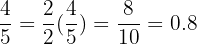
 split into
  parts is equivalent to saying
  or
or  where
where 

Rational Numbers: Ratio of Integers
Many fractions are also Rational numbers. The Rational Numbers

are a special case of fractions where
is any integer and
is any integer besides
. The Integers

are the positive and negative whole numbers along with
, like on a number line.

The Rational in Rational number means that there is a ratio between the two numbers
and
. The big
stands for quotient. The big
for the Integers is from the German word for numbers 'zahlen'. There are many fractions that are not rational, not the ratio of 2 integers. These numbers are called irrational numbers and have a decimal value that is never-ending (infinite) and non-repeating. We will be sticking to fractions that are Rational numbers throughout these lessons.
Negative Fractions
If a fraction is negative, we put the negative sign in the numerator or out in front of the fraction itself

If the negative sign happens to be in the denominator, don't write

. Move the negative sign up top or out front

Fractional Units
A fractional unit is 'one part  numerator' of the 'whole'.
The 'whole' is the number that we 'split the number  into', which is the denominator.
Example


parts. The 'whole' thing would be

.
Example
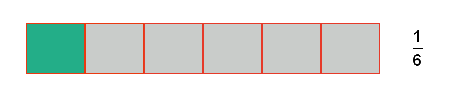
unit out of

total units that make up the 'whole' thing. There are
of these fractional units

that make up the object.
Fractional Values
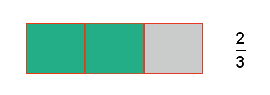
Example
The green boxes represent

of the whole amount or

parts out of
. 
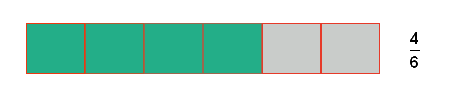
Example
The green boxes represent

of the whole amount or
parts out of
. 
Fractions of a Number
We can take fractional amounts of numbers other than . We can look at it as a multiplication exercise, a division exercise or a mixture of both.
Example
What is

of

? Multiplication
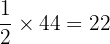
Division
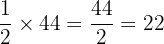
Example
What is
of

?

or

Fractions: Ratios and Proportions
When comparing different amounts or types of the same thing, you can form fractions from the ratios or proportions.
Example
Suppose we have

crayons:
blue
red
green
yellow. The
crayons can be placed in a

ratio of blue : red : green : yellow. We can form 4 fractions: 1 for the amount that each color of crayon is of the whole amount of crayons
 are blue
 are red
 are green
 are yellow
Proper Fractions
Proper fractions have the values of their numerators less than the value of their denominators. They have a value greater than
and less than
if positive
and greater than

if negative


Mixed Numbers
A mixed number is the union of an integer and a fractional amount less than
. They are equivalent to their improper fractional form.
Example
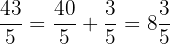
Express

as a mixed number. Divide the numerator

by the denominator
to obtain the highest whole number amount that will divide into it evenly. Here it is

because

. The remainder
is then the numerator of the fraction less than
that we attach next to the whole number,

.
Decimal Fractions
Decimal fractions have a power of
in the denominator.
Example

Equivalent Fractions
2 fractions
and

are equivalent if and only if the product of the extremes equals the product of the means
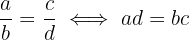
and

are known as the extremes, while
and

are known as the means
Example
Determine whether

is equivalent to

 and
and 
 and
and 
Simplifying Fractions
Most often we want fractions to be in simplest form. This means that the fraction is in lowest terms. Lowest terms means that the numerator and denominator have no common factors or are relatively prime.
Example
 and
and  are not in lowest terms but are all equal to .
Both the numerators and denominators of each fraction have a common factor.
In  , both the and the have as a common factor.
In  , both the and the have as a common factor.
In , both the and the have as a common factor.
The simplified form of each of these fractions is .
Example
Is

in lowest terms?
In  , both
  and have the common factor of at least .
Actually, they both have the factor
in common
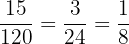
We first factored out a
to make

and then factored out another
to make

and

.
Example
Is

in lowest terms?
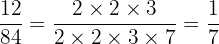
We took the Prime Factorization of both

and

and cancelled out the common factors of

and
.
Irreducible Fractions
Irreducible fractions are those that cannot be simplified any further (the numerator and denominator are in lowest terms). The numerator and denominator do not have any common factors and are called co-prime.
Examples
All of these fractions are irreducible or in lowest terms


Summarise with AI:
Did you like this article? Rate it!


 Loading...