


1. From Secant to Tangent
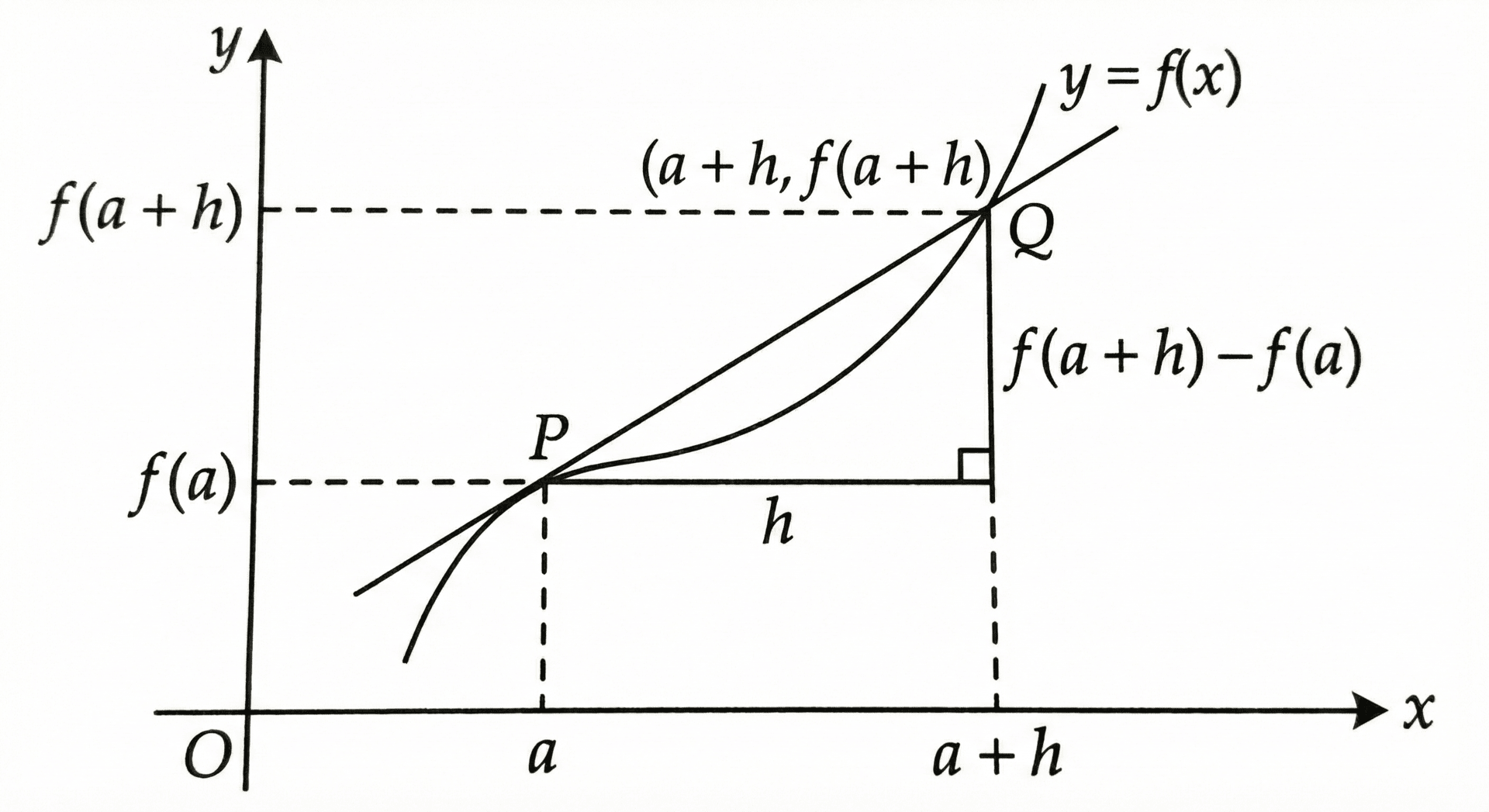
To understand a derivative geometrically, we start with a secant line. A secant line is a straight line that joins two distinct points, P and Q, on a curve.
- Point P has coordinates (a, f(a)).
- Point Q is a small distance, h, away, with coordinates (a + h, f(a + h)).
The slope of this secant line represents the average rate of change between those two points.
2. The Limit Definition
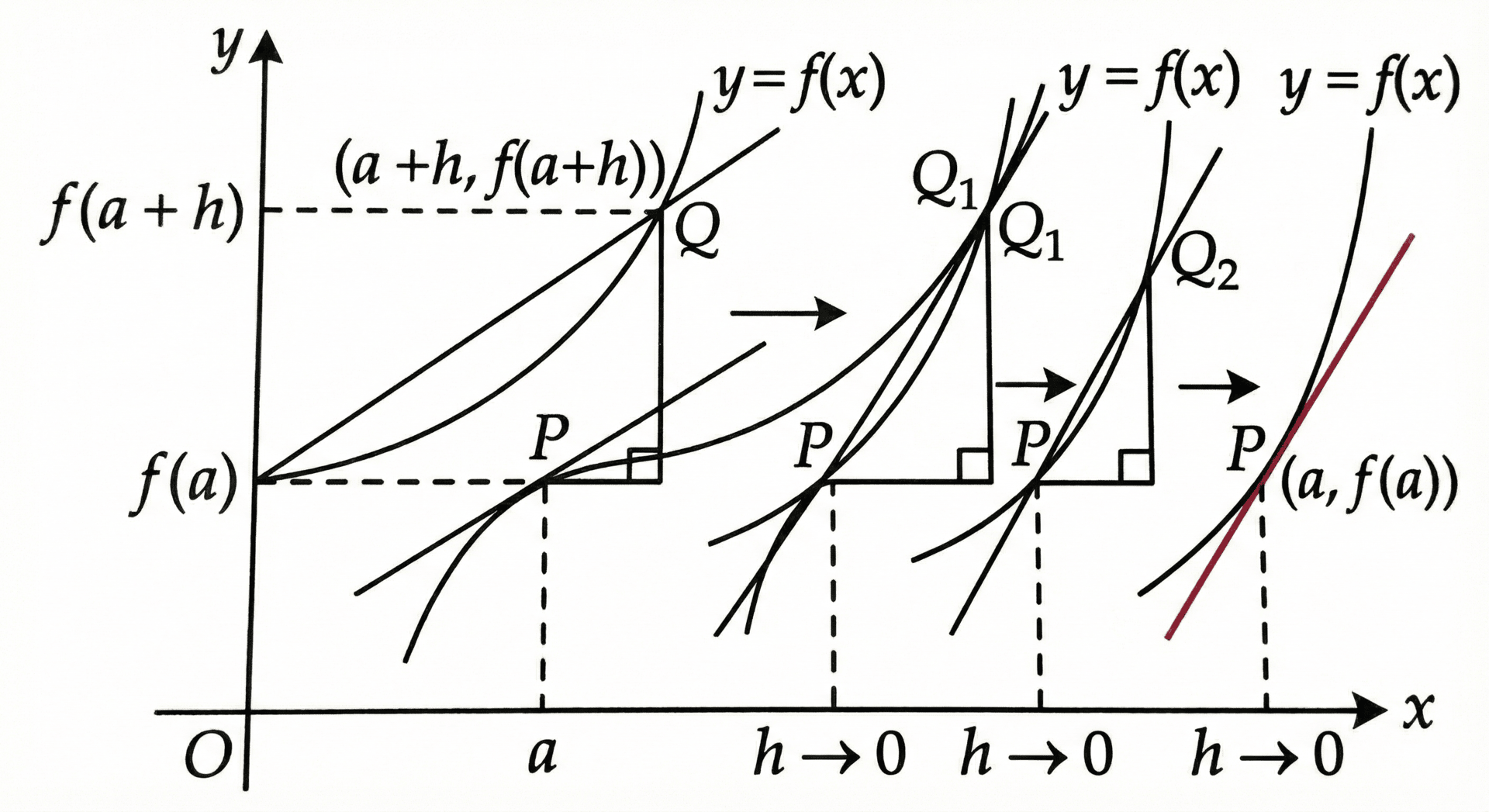
As we move point Q closer and closer to point P (making the distance h approach zero), the secant line begins to pivot. When Q eventually "merges" with P, the secant line becomes a tangent line.
A tangent line is a straight line that just touches the curve at a single point, perfectly matching the direction of the curve at that exact moment. Mathematically, this is the limit of the secant slope: f'(a) = limit as h approaches 0 of [f(a + h) - f(a)] / h
3. The Slope of the Tangent
The value of the derivative f'(a) is exactly equal to the gradient (slope) of this tangent line.
- If f'(a) is positive, the tangent lines slopes upwards, and the function is increasing.
- If f'(a) is negative, the tangent line slopes downwards, and the function is decreasing.
- If f'(a) = 0, the tangent line is perfectly horizontal, often indicating a peak (maximum) or valley (minimum) on the graph.
Worked Examples
1. Finding the Gradient at a Point
Find the gradient of the tangent to the curve f(x) = x² at the point where x = 3.
1. Find the general derivative: f'(x) = 2x.
2. Substitute x = 3 into the derivative: f'(3) = 2(3) = 6.
3. Interpretation: The slope of the tangent line touching the parabola at (3, 9) is 6.
2. Finding the Equation of the Tangent
Find the equation of the tangent line to f(x) = x³ - 4x at the point (2, 0).
1. Find the slope: Differentiate the function: f'(x) = 3x² - 4.
2. Substitute x = 2: f'(2) = 3(2)² - 4 = 12 - 4 = 8. The slope (m) is 8.
3. Use the line equation: y - y1 = m(x - x1) y - 0 = 8(x - 2) y = 8x - 16.
4. Interpretation: The line y = 8x - 16 is tangent to the curve at (2, 0).
3. Horizontal Tangents
At what point(s) does the curve f(x) = x² - 6x + 5 have a horizontal tangent?
A horizontal tangent occurs when f'(x) = 0.
1. Differentiate: f'(x) = 2x - 6.
2. Set to zero: 2x - 6 = 0, so x = 3.
3. Find the y-coordinate: f(3) = (3)² - 6(3) + 5 = -4.
4. Interpretation: The curve has a horizontal tangent at the vertex (3, -4).
Summarise with AI:
Did you like this article? Rate it!


 Loading...
Like the explanation, want to rearn more. Really enjoying the documents received.