In basic geometry, finding the area of flat shapes with straight boundaries—like rectangles, triangles, and trapeziums—is straightforward. But how do you calculate the exact area under a smooth, curved boundary, such as a parabolic arch or a sine wave?
The answer lies in definite integration.
In physics and engineering, calculating the area under a curve allows us to measure physical quantities such as the total distance travelled from a velocity-time graph or the work done by a varying force. In business and economics, it helps measure consumer and producer surplus.
Mastering the process of setting up and evaluating definite integrals to find bounded areas is a core requirement across GCSE and A-Level Mathematics specifications.


How Integration Calculates Area
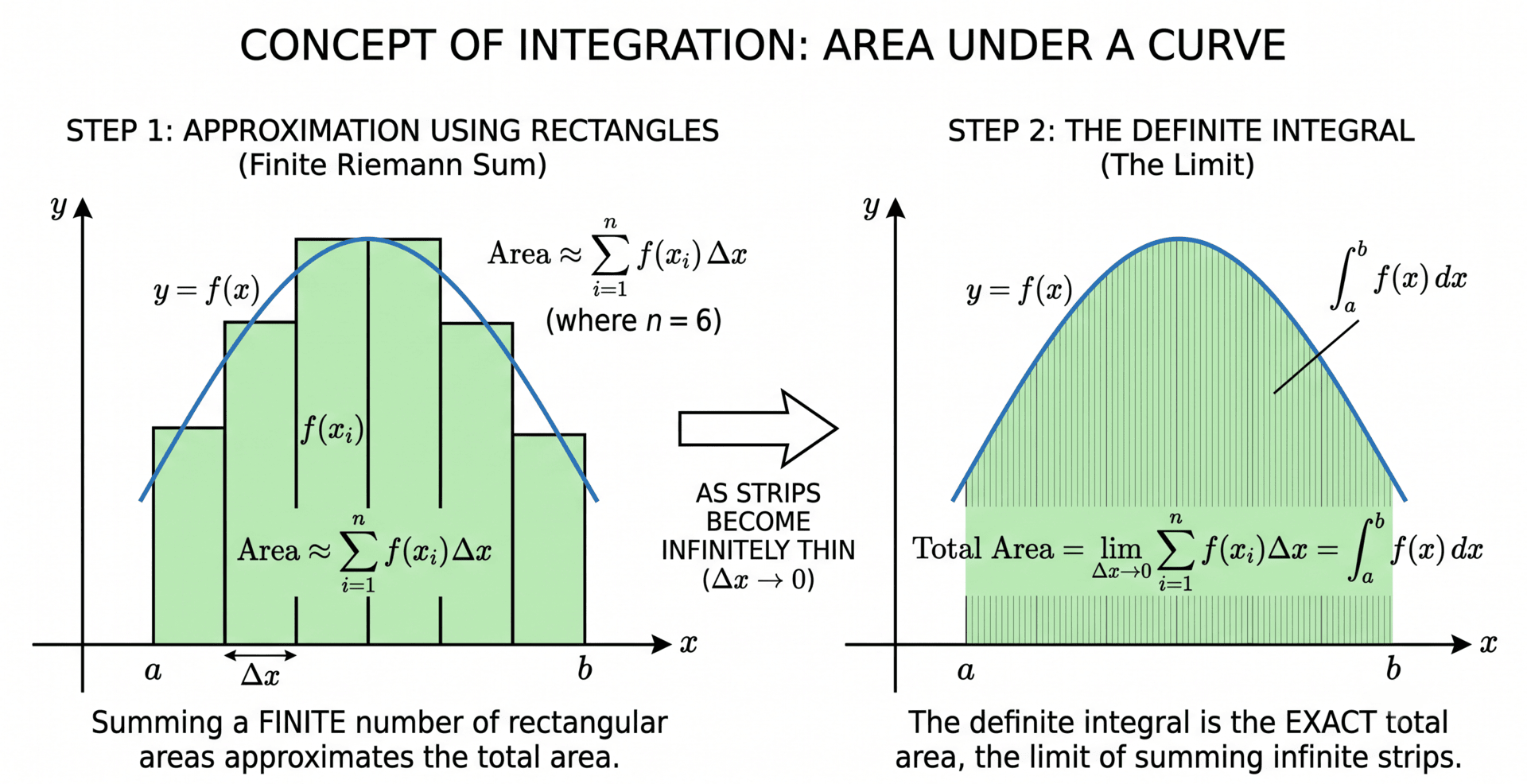
To understand why integration gives us area, imagine dividing the region underneath a function f(x) between two boundary lines, x = a and x = b, into a series of thin vertical strips.
Each strip behaves roughly like a tall, thin rectangle with height f(x) and width dx. The area of a single strip is:
By taking the definite integral from x = a to x = b, we are effectively summing an infinite number of these infinitely thin rectangular strips together:
Calculating Area for Positive Functions
When a curve sits entirely above the x-axis on the closed interval [a, b], the function values f(x) are positive. The definite integral directly yields the exact physical area of the enclosed region.
Example 1: Parabola Bounded by the x-Axis
Question: Calculate the area bounded by the curve and the horizontal x-axis.
Step-by-Step Solution:
Sketch the Graph: The curve is an inverted parabola () with a y-intercept at (0, 9).
Find the Boundaries (a and b): The region is enclosed where the curve crosses the x-axis (y = 0). Set the function equal to zero to find the roots:
Therefore, our lower boundary is a = -3 and our upper boundary is b = 3.
Set Up the Definite Integral:
Integrate and Evaluate: First, find the integral:
Now apply the Fundamental Theorem of Calculus:
Calculating Area for Negative Functions
When a curve lies entirely below the x-axis on the interval [a, b], the height values f(x) are negative. Consequently, evaluating the definite integral directly produces a negative value.
Because physical area can never be negative, you must take the absolute value (magnitude) of the integral result:
Example 2: Parabola Below the x-Axis
Question: Find the physical area bounded by the curve and the x-axis.
Step-by-Step Solution:
Find the x-Intercepts: Set y = 0
The boundaries are a = 0 and b = 4.
Check the Region Orientation: The parabola opens upwards () with roots at 0 and 4. Between x = 0 and x = 4, the curve sits entirely below the x-axis.
Set Up and Integrate:
Evaluate the Limits:
Convert to Physical Area:
The Split Integration Trap (Mixed Regions)
Exam Warning: If a curve crosses the x-axis within your integration interval, evaluating a single integral from the far left to the far right will cause the positive area (above the axis) and negative area (below the axis) to cancel each other out!
To find the true total geometric area of a curve that crosses the x-axis:
- Find all x-intercepts where f(x) = 0 inside your interval.
- Split the integral into separate individual sub-regions.
- Calculate the integral for each section separately.
- Take the absolute value of any negative sections and add all positive magnitudes together.
Practice Questions and Answers
Calculate the area under the curve:

bounded by the vertical lines x = 1, x = 3, and the x-axis.
Step 1: The curve is strictly positive for all real x.
Step 2: Boundaries are a = 1 and b = 3.
Step 3: Set up integral:
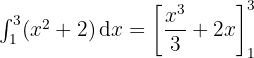
Step 4: Evaluate limits:



Find the total area enclosed between the quadratic curve:

and the x-axis.
Step 1: Find boundaries by setting y = 0:

Step 2: The parabola opens downwards above the x-axis between x = -2 and x = 2.
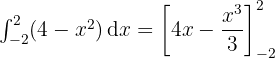
Step 3: Evaluate integral:



Calculate the total physical area enclosed by the cubic curve:
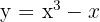
and the x-axis between x = -1 and x = 1.
Step 1: Find roots by setting the function equal to zero:

Step 2: Identify sub-regions:
From x = -1 to x = 0, function is above x-axis.
From x = 0 to x = 1, function is below x-axis.
Step 3: Calculate Area 1 ([-1, 0]):

Step 4: Calculate Area 2 ([0, 1]):


Step 5: Sum the positive areas:

Summarise with AI:
Did you like this article? Rate it!


 Loading...