This guide covers the integration of exponential functions from first principles through to A2-level substitution techniques, with 12 graded examples and full solutions. Each solution includes mark scheme annotations so you can see exactly where method marks and accuracy marks are awarded.
Learning Objectives
By the end of this article you should be able to:
- State and apply the result
 and explain why
  is unique in this regard (AO1)
 - Integrate expressions of the form
 using the reverse chain rule (AO1)
 - Use integration by substitution to integrate composite exponential functions of the form
 (AO1, AO2)
 - Integrate general exponential functions of the form
 (AO1)
(AO1) - Select the appropriate technique — constant multiple rule, reverse chain rule, or substitution — without being prompted (AO2)
- Present working clearly enough to earn method marks even when an arithmetic slip occurs (AO2)
Specification Coverage
This topic appears across all major A-Level Mathematics specifications. The table below shows the relevant sections for each board:
| Board | Specification | Section / Topic Code | Content | Year |
|---|---|---|---|---|
| AQA | 7357 A-Level Maths | Section 12.1 & 12.3 | Integration of e^x and e^(ax+b); integration by substitution | Y1 + Y2 |
| Edexcel | 9MA0 A-Level Maths | Topics 13.1 & 13.5 | Standard integrals including e^(ax+b); integration by substitution | Y1 + Y2 |
| OCR A | H240 A-Level Maths | Component 1 & 2 Pure | Exponential integrals; reverse chain rule; substitution | Y1 + Y2 |
| OCR B (MEI) | H640 A-Level Maths | Pure Core Chapter 9 | Integration of exponential functions; substitution | Y1 + Y2 |
The result is given on the AQA formula sheet. The general result  is not given — you are expected to derive it using the reverse chain rule or recall it. The general base result
  is also not given on most boards and must be memorised.


Theory Recap: What are Exponential functions?
Logarithmic and exponential functions are employed to model the growth of the population, and cells, etc. They are also used to model radioactive decay, depreciation, and resource consumption, etc. Exponential functions are the functions in which the independent variable "x" is the exponent or power of the base.
Integral of Exponential Function
The following two formulas are used as the basis of integrating an exponential function:
- The exponential function
 is its own derivative and integral. The integral of this function is:

- The integral of the exponential function
 is given below:
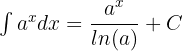
In the next section, you will find a list of integration rules that are quite helpful in finding the integrals of exponential functions:
Rules of Integration
Like differentiation, there are some rules which are used to solve the problems related to integration. These rules are explained below:
- Integration of a Constant
The integral of  is equal to ax + C.
- Integration Power Rule
 dx is equal to
- Integration Sum Rule
 is equal to
  a dx + b dx
- Integration Difference Rule
 is equal to a dx - b dx
- Multiplication by Constant
 is equal to
Now, we will see how to solve problems involving the integration of the exponential functions.
Worked Examples
Find 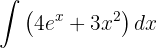
Apply the sum rule to split the integral into two separate terms:
 M1
M1
Use the constant multiple rule on the first term and the power rule on the second:
 A1
A1
The M1 is awarded for splitting into two integrals and applying the correct rule to at least one term. The A1 requires both terms correct and the constant of integration present.
Find 
The  is a constant and can be placed outside the integral sign using the constant multiple rule:
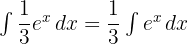 M1
M1
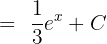 A1
A1
A common error here is to apply the power rule and write  — this is incorrect. The power rule applies to
  , not .
Find 
The exponent is a linear function of  , so apply the reverse chain rule. The derivative of the exponent
  with respect to is
  . Divide by this coefficient:
 M1 A1
M1 A1
Check: differentiate  using the chain rule:
 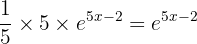 . ✓
. ✓
The M1 requires evidence of dividing by the coefficient of (i.e. the answer  without the
  scores M0). The A1 requires the correct coefficient and
  .
.
Find 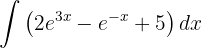
Split using the sum and difference rules and integrate each term separately. Each exponential term has a linear exponent, so the reverse chain rule applies to both:
 M1
M1
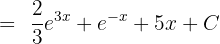 A1
A1
The sign of the  term causes the most errors. Dividing by
  flips the sign:
 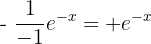 . The M1 is awarded for correct application of the reverse chain rule to at least two terms. The A1 requires all three terms correct with
  .
.
Find 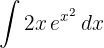
Identify the pattern: the integrand contains  multiplied by
  , where
  and
and  . Use substitution.
Let  . Then
  , so
, so  . M1
. M1
Substitute directly:
 M1
M1
 A1
A1
Substitute back:
 A1
A1
Two M marks here: the first for choosing a valid substitution and correctly computing  ; the second for completing the substitution so the integral is entirely in terms of
  . The two A marks reward the correct integrated form and the correct back-substitution respectively.
Find 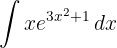
Let  . Then
  , so
, so  .
.
The integrand contains  , not
, not  . Rearrange:
 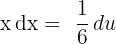 . M1
. M1
Substitute:
 M1
M1
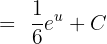 A1
A1
Substitute back:
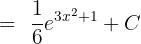 A1
A1
The key step earning the first M1 is correctly rewriting . A student who writes  and proceeds incorrectly would score M0 on both method marks.
Find 
Rewrite the integrand using index notation to clarify the structure:
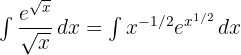
Let  . Then
 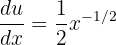 , so
, so 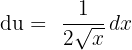 , which gives
  . M1
. M1
Substitute:
 M1
M1
 A1
A1
Substitute back:
 A1
A1
The rewrite step (index notation) is not required for marks but strongly recommended — it makes the structure of the substitution visible and avoids sign errors. The first M1 rewards the correct derivative  and the rearrangement to express
  in terms of .
Find 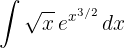
Rewrite  . The exponent is
  and its derivative is
  — a constant multiple of the factor already present in the integrand. This signals that substitution will work cleanly.
Let  . Then
 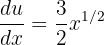 , so
, so 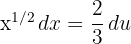 . M1
. M1
Substitute:
 M1 A1
M1 A1
Substitute back:
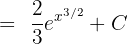 A1
A1
Find 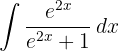
Notice that the numerator  is (up to a constant factor) the derivative of the denominator
  . This signals the standard pattern
 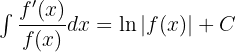 .
.
Let  . Then
  , so
, so 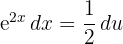 . M1
. M1
Substitute:
 M1
M1
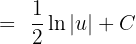 A1
A1
Substitute back. Since  for all , the modulus signs can be dropped:
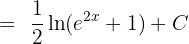 A1
A1
This question tests whether students can recognise the  pattern. Students who attempt to apply the exponential formula directly (treating this as an integral of ) score M0. The note that
  so the modulus is not needed is good practice and demonstrates AO2 understanding; it is unlikely to be mark-bearing but may appear in extended mark schemes.
Find 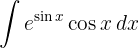
The integrand has the form 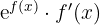 where
where 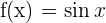 and
and  . Substitution applies directly.
Let  . Then
  , so
, so  . M1
. M1
Substitute:
 M1
M1
A1
Substitute back:
 A1
A1
This is a classic exam question that tests pattern recognition across two topics (exponentials and trigonometry). Once you identify  and , the substitution is straightforward. Students who attempt integration by parts here will generally make no progress and score M0.
Find 
Rewrite  using the identity
  :
:
 B1
B1
Now integrate using the reverse chain rule. The exponent is  , which is linear in with coefficient
  :
:
 M1 A1
M1 A1
Rewrite back in terms of :
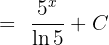 A1
A1
The B1 rewards writing — this is a standalone mark for the key algebraic step. Alternative method: recall 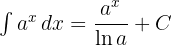 directly (M1 A1) and write the answer (A1). Both approaches earn full marks; the derivation method is safer under exam conditions since it doesn't require memorising the final formula.
Find 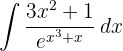
Rewrite the integrand by moving the exponential from the denominator to the numerator using negative indices:
 M1
M1
Now identify the pattern: the exponent is  and its derivative is
  . The factor
  is already present in the integrand.
Let  . Then
 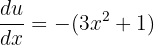 , so
, so  . M1
. M1
Substitute:
 A1
A1
Substitute back:
 A1
A1
The rewrite step (moving to a negative exponent) is the key insight and earns the first M1. Students who attempt this without first rewriting the fraction will struggle to identify a useful substitution. Either form of the final answer is acceptable:  or
or 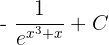 .
.
Common Exam Mistakes
Forgetting to divide by the coefficient of x. The most frequent error at AS. Writing  instead of
  . Always check by differentiating your answer — if it doesn't give back the integrand, you've missed the division.
Applying the reverse chain rule to non-linear exponents. The shortcut  is only valid when is a constant. For
  , for example, this formula does not apply — you need the integrand to contain a factor of for substitution to work neatly.
Losing the constant of integration. An indefinite integral without will lose the final accuracy mark (A1) on every question. This applies even when all other working is correct.
Forgetting to substitute back. In substitution questions, leaving the answer in terms of rather than will lose the final A1. Always substitute back.
Sign errors with negative coefficients. When  is negative — for example
  — students frequently write
  with the wrong sign. Again, differentiating your answer to check takes under ten seconds.
Integration of Exponents: Exam Tips
Always check by differentiating. For any exponential integral, differentiating your answer takes less than 15 seconds and will confirm whether you have the correct coefficient. This habit eliminates the most common error type in this topic.
Spotting the right technique without being told. A-Level exams rarely say "use substitution". Train yourself to ask: Is the exponent linear? (Use reverse chain rule.) Does the integrand contain multiplied by ? (Use substitution.) Is the base not  ? (Rewrite using .)
Show the substitution explicitly. Even if you can see the answer by inspection, writing "Let  " and showing
  ensures you earn the method marks. A bare answer with no working earns only the final A1 and risks losing all three preceding marks.
Definite integrals with substitution. If this type of question appears as a definite integral, either change the limits to -values and avoid substituting back, or keep the limits as -values, complete the indefinite integral in , and then evaluate. Both are valid; changing limits is slightly faster and avoids the risk of forgetting to substitute back.
Calculator use. At A-Level, integration questions appear on both the non-calculator paper (Paper 1) and the calculator papers (Papers 2–3 for AQA/Edexcel). For Paper 1, exact answers such as  or
or  must be left in that form — do not convert to a decimal.
Summarise with AI:
Did you like this article? Rate it!


 Loading...