In A-Level Mathematics, one of the primary geometric applications of definite integration is calculating the precise area enclosed by functions on a coordinate grid. While basic shapes like rectangles and triangles can be evaluated using standard geometric formulas, curves require calculus to account for their continuously changing gradients.
To solve these problems under exam conditions, you must master two core scenarios:
- Area between a single curve and the x-axis.
- Area enclosed between two intersecting functions.


Core Principles & The "Negative Area" Trap
Area Under a Curve vs. Net Integration
The definite integral:
measures the accumulation of the product of the vertical height,y, and an infinitesimally small horizontal width,dx.
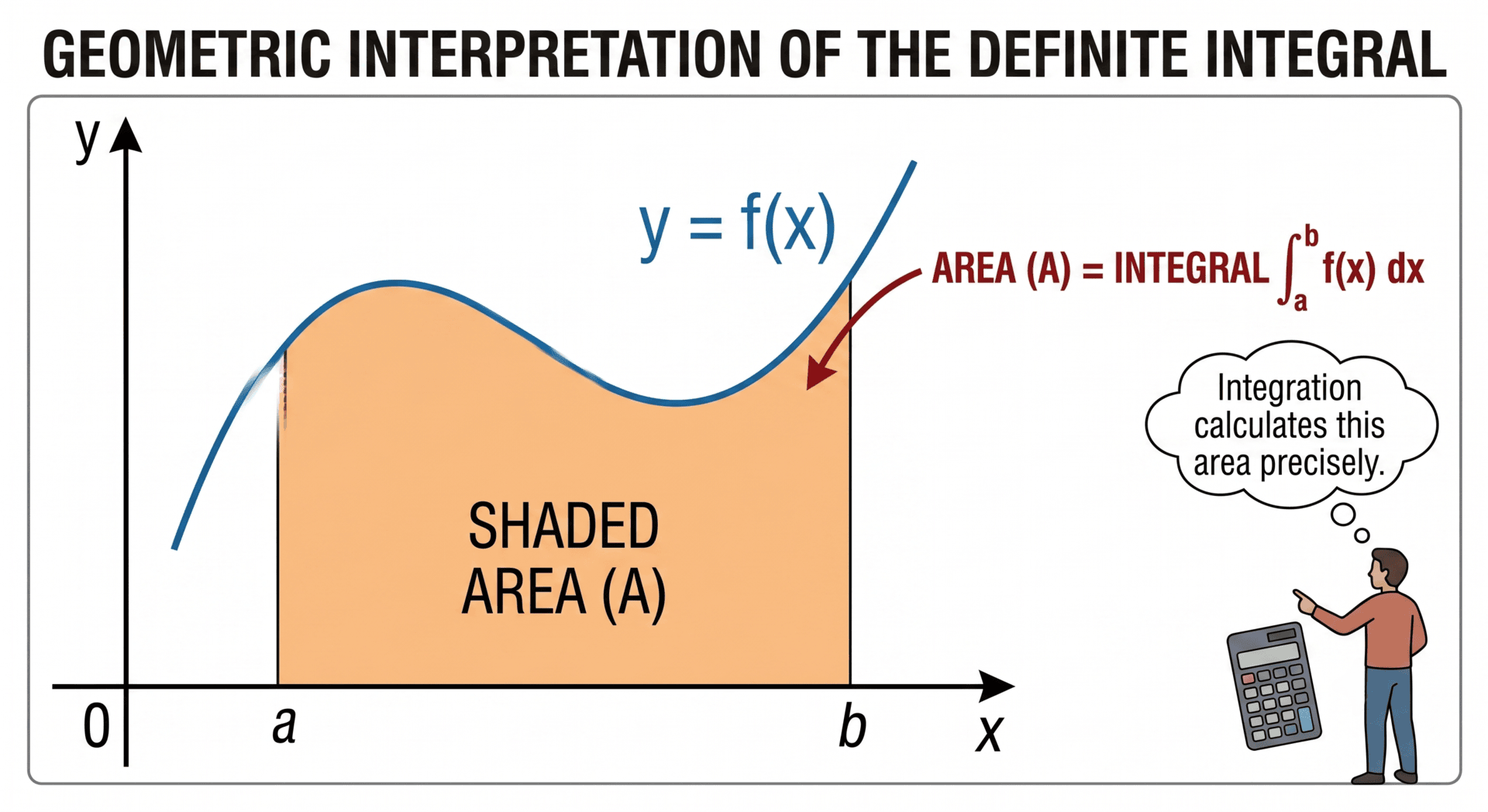
- Above the x-axis: The output
yvalues are positive, yielding a positive integral value. - Below the x-axis: The output
yvalues are negative, yielding a negative integral value.
Exam Warning: If a curve crosses the x-axis between your integration limits, the positive area above the axis and the negative area below the axis will algebraically cancel each other out, resulting in an incorrect net total.
How to Handle Sign Issues
To find the true physical (geometric) area of a curve that crosses the x-axis:
- Find all roots within the interval by setting
f(x) = 0. - Split the integral into separate tracking sections for each distinct region.
- Take the absolute value (ignore the negative sign) of any region situated below the x-axis, then add the components together.
Area Between Two Functions
To find the area bounded between two intersecting curves, y = f(x) and y = g(x), you do not need to worry about the position of the x-axis. Instead, you focus on which function sits vertically above the other across the interval.
The general formula is defined as:
The Visual-First Strategy
Before writing out your integral, always visualise or sketch the positions of the functions:
- Find the boundaries: Set
f(x) = g(x)and solve forxto determine the limits of integration,aandb. - Identify upper vs. lower: Over the interval
[a, b], determine which curve forms the upper ceiling and which forms the lower floor. If you cannot sketch it, substitute a test value betweenaandbinto both functions; the one yielding the higheryvalue is your upper function.
Problem Set 1: Area Between a Curve and the x-axis
Question 1
Calculate the area of the region completely bounded by the curve:
and the x-axis.
Visual-First Analysis
The function is a positive parabola. Setting
yields factorised roots of
meaning the curve intersects the x-axis at x = 1 and x = 6. Between these two roots, the vertex of the parabola drops entirely below the x-axis. Therefore, our definite integral will return a negative value, and we must take its absolute magnitude.
Solution
Set up the definite integral using the roots as boundaries:
Integrate the polynomial expression term-by-term:
Substitute the upper limit x = 6:
Substitute the lower limit x = 1:
Subtract the lower limit evaluation from the upper limit evaluation:
Take the absolute value to state the physical geometric area:
Question 2
Find the area of the plane region enclosed by the logarithmic curve:
the x-axis, and the vertical line .
Visual-First Analysis
The natural log curve crosses the x-axis where , which occurs at x = 1. From x = 1 to x = e, the curve climbs smoothly above the x-axis. Our limits of integration are therefore a = 1 and b = e.
Solution
Set up the definite integral:
Integrating requires the integration by parts technique (where and ), which gives the standard antiderivative:
Substitute the upper boundary limit x = e:
Substitute the lower boundary limit x = 1:
Subtract the components:
Question 3
Calculate the geometric area enclosed by the cubic curve and the x-axis across the complete interval [-1, 1].
Visual-First Analysis
Factorising the cubic expression gives:
The roots are located at x = -1, x = 0, and x = 1
- From x = -1 to x = 0, the curve loops above the x-axis.
- From x = 0 to x = 1, the curve loops below the x-axis.
Because of the perfect odd-function symmetry of this cubic model, integrating from [-1, 1] in a single run would return a net value of exactly 0. We must integrate the two balancing loops independently.
Solution
Set up the split integrals:
Find the common general antiderivative:
Evaluate Region 1, [-1, 0]:
Evaluate Region 2, [0, 1]:
Sum the two independent spatial fields together:
Problem Set 2: Area Enclosed Between Two Functions
Question 4
Calculate the area of the region completely enclosed by the parabola and the linear equation .
Visual-First Analysis
The function is an inverted parabola pointing downwards, while is a linear line passing through the origin with a positive gradient. The inverted parabola forms the upper ceiling of the enclosed space, and the line forms the lower floor.
Solution
Find the intersection boundary points by equating the functions:
The limits of integration are x = 0 and x = 3.
Set up the area integral using:
Perform the integration:
Substitute the upper boundary limit x = 3:
Substitute the lower boundary limit x = 0:
Subtract the lower limit evaluation:
Question 5
Find the exact area enclosed between the two overlapping parabolas given by:
Visual-First Analysis
is a standard right-side-up parabola centered at the origin. is an inverted parabola peaking in the first quadrant. The inverted parabola sits above the standard parabola inside the intersection zone.
Solution
Determine the boundary limits by equating both expressions:
The limits of integration are x = 0 and x = 2.
Subtract the lower function from the upper function:
Integrate the resulting expression:
Substitute the upper limit x = 2:
Substitute the lower limit x = 0, gives 0
State the final enclosed area value:
Exam-Style Practice
Find the area bounded by the linear equation:

the x-axis, and the vertical lines x = 2 and x = 8.
The function is a straight line sloping downward. Between x = 2 and x = 8, the line stays entirely above the x-axis (at x=8, y=2). This represents a simple proper definite integral.
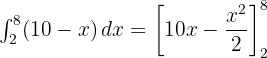
Substitute upper limit x = 8:

Substitute lower limit x = 2:
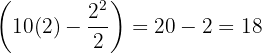
Subtract the values:

Calculate the total geometric area bounded between the curve:

and the curve:

from the vertical boundary line x = 0 to their first positive intersection point.
First, find the upper boundary limit by calculating the first positive intersection point where sin(x) = \cos(x). Dividing by cosine gives tan(x) = 1, which resolves to:
 .
.
Between

and
the cosine curve starts at 1 and drops, while the sine curve starts at 0 and climbs. Therefore, cosine is the upper function.

Substitute upper limit :

Substitute lower limit x = 0:

Subtract the values to find the exact area:

Derive the area formula for a circle of radius r by integrating the curve:

across the first quadrant and multiplying by four. Use the substitution:
 .
.
The area in the first quadrant spans from the origin x = 0 to the outer radius edge x = r. We integrate this quadrant and multiply the result by 4 due to circle symmetry.

Apply the trigonometric substitution:
meaning

Convert the limits of integration from x to t:
When

When

Substitute these terms into the integral:

Factor out  inside the radical and use the identity:
 :
:

Use the double-angle identity:
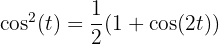
to make integration possible:

Evaluate the expression at the limits:



Summarise with AI:
Did you like this article? Rate it!


 Loading...