In A-Level Mathematics, integration serves two vital roles: conceptually, it is the exact operational inverse of differentiation (reverse differentiation), and geometrically, it represents the calculation of the precise area bounded under a curve.
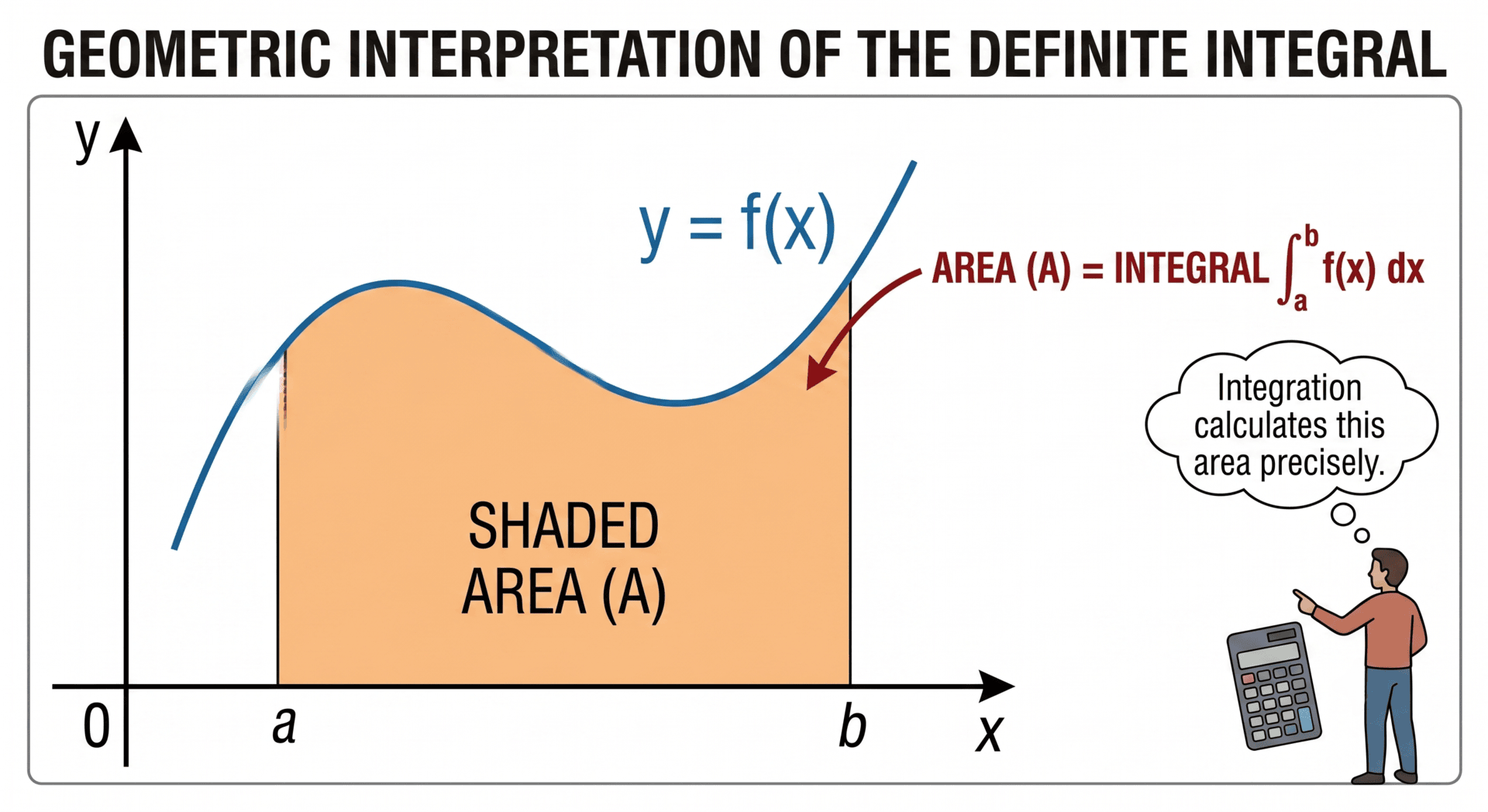
When we differentiate a function, we break it down to find its instantaneous rate of change (the gradient). When we integrate, we reverse this process, accumulating infinite, infinitesimally thin vertical strips across a coordinate plane to compute total area or recover the original algebraic model. This core document transitions from fundamental definitions to master-level integration problems and calculus techniques.


Method Overview & Key Strategies
To approach any integration question systematically, you must first classify the type of expression you are handling. Use the following operational roadmap:
1. Direct Integration (The Power Rule)
If an integrand can be written entirely as separate polynomial terms, expand the expression and apply the power rule term by term:
2. Integration by Substitution (u-Substitution)
The general formula for integration by substitution (often called u-substitution) is modelled as the reverse of the chain rule. It is written as:
Component Breakdown
To transition a complex integral from the x-domain into a simpler u-domain, the formula relies on three main parts:
- The Substitution: You choose an inner function to replace with a single variable, u = g(x).
- The Derivative: You differentiate u with respect to x to find how the differentials scale together:
The Simplified Integral: The original, messy product collapses cleanly into:
which can typically be solved using standard integration lookup rules.
3. Integration by Parts
When the integrand consists of two completely different families of functions multiplied together (e.g., an algebraic power multiplied by a trigonometric or exponential function), apply the parts formula:
Worked Example
Problem: Evaluate the following definite integral to find the precise area bounded by the curve between x = 0 and x = 2:
Step-by-step Solution:
1. Identify the Method: The power of the exponential is  , and its derivative is
  , which matches the external linear x term outside. This makes it an ideal candidate for u-substitution.
2. Define  and Differentiate: Let
3. Change the Integration Limits: When working with a definite integral during substitution, convert the boundary limits from x values into corresponding u values to avoid back-substitution later.
- Lower limit: When x = 0:
- Upper limit: When x = 2:
4. Substitute into the Integral:
The x variables cancel out perfectly, allowing you to pull the constants outside the operator:
5. Integrate and Evaluate:
Since  , the final exact structural answer is:
Practice Questions and Solutions
Find the general indefinite integral of the polynomial function:

Apply the standard power rule to each algebraic term independently by raising the power by one and dividing by that new value:
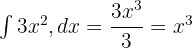
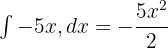
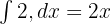
Combine the integrated terms and add the constant of integration:
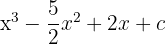
Determine the indefinite integral of the combined exponential and trigonometric expression:

Integrate each term using the standard exponential and trigonometric lookup laws, dividing by the inner linear coefficients:


Combine the final components together:
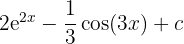
Evaluate the precise numerical value of the definite area defined by:

First, determine the general algebraic integral inside square brackets:

Substitute the upper boundary limit ( ):
):

Substitute the lower boundary limit ( ):
):

Subtract the lower result from the upper result:

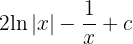
Find the antiderivative for the reciprocal function:
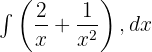
Rewrite the fraction expressions using standard index notation to make power rule integration straightforward:

The integral of  is a special case that yields a natural log. For the second term, apply the standard power rule:

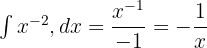
Combine the resolved terms:
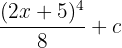
Use the reverse chain rule to determine the general solution for the linear composite expression:

For linear composite functions of the form  , integrate the outer bracket as a single unit and divide by the coefficient of the internal variable a:

Simplify the denominator:
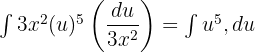
Apply u-substitution to solve the following indefinite integral:

Set equal to the inside expression of the parenthetical block:

Substitute these parameters back into the original structural equation:
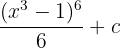
Integrate directly with respect to :

Re-substitute the original expression for to state the final answer:
Use the method of integration by parts to find the general solution for:

Apply the LATE priority framework to assign the variable parts:
Let:
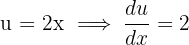
Let:

Substitute these terms directly into the integration by parts formula:


Since the integral of sin(x) is -\cos(x), the double negative resolves to positive:

Calculate the exact numerical value of the following definite exponential integral:
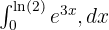
Integrate the exponential term to establish the foundational expression:
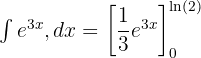
Substitute the upper limit:

Substitute the lower limit:

Subtract the values to find the final definite value:

Simplify the algebraic fraction first, then evaluate the indefinite integral:
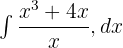
Before attempting to integrate, divide each term in the numerator by the common denominator factor x:

Now, integrate the simplified expression directly using the standard power rule:

Use a core trigonometric identity to transform and evaluate the expression below:
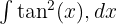
The term  cannot be integrated directly from basic lookups. Use the trigonometric identity
  to rearrange the expression:

Substitute this identity back into the integral operator:

Since the standard derivative of  is
is  , reversing it yields:

Summarise with AI:
Did you like this article? Rate it!


 Loading...