At the start of your calculus journey, integration seems straightforward: you simply reverse the power rule of differentiation term by term. However, as you progress to A-Level Mathematics, integrands become more complex. You will routinely encounter products, fractions, and composite functions that cannot be integrated directly.
The true challenge of an exam is not just executing the calculus itself, but diagnosing which technique to apply to a given problem. This guide provides a strategic decision-making framework to help you navigate advanced integration techniques and includes an exam-style integration techniques worksheet to test your skills.


The A-Level Integration Decision Framework
When you see an integral in an exam, do not guess the method. Run it through this structural checklist from top to bottom:
| Integrand Feature | Best Technique | Mathematical Indicator |
|---|---|---|
| Fraction where the numerator is a scalar multiple of the denominator's derivative | Integration by Recognition | 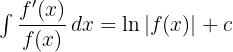 |
| A composite function multiplied by a scalar multiple of its internal derivative | Reverse Chain Rule / Recognition |  |
| A product of two distinct, unrelated function families (e.g. Algebraic * Exponential) | Integration by Parts |  |
| A complex composite function where a linear term is trapped inside a root or power | Integration by Substitution | Set  equal to the trapped 'inside' function equal to the trapped 'inside' function |
| An algebraic fraction with a denominator that factorizes into linear brackets | Partial Fractions first | 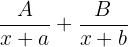 |
| Even powers of sine or cosine | Trigonometric Identities | Use double-angle identities to eliminate the squared terms |
Core Techniques and Worked Examples
1. Integration by Recognition (Reverse Chain Rule)
Recognition is the fastest integration technique. It is used when an expression is a configuration of an outer function containing an inner function, multiplied by the inner function's derivative.
The Logarithmic Standard Form
A crucial recognition form to memorise is:
Worked Example
Find:
Solution:
- Calculate the derivative of the denominator:
- Notice that the numerator is exactly twice the derivative of the denominator:
- Factor out the constant to expose the standard form:
Integrate directly by recognition:
2. Integration by Substitution (u-Substitution)
Substitution acts as a powerful alternative when recognition is difficult to spot or when a linear function is trapped inside a power or radical bracket, blocking algebraic expansion.
Worked Example
Find:
Solution:
Expanding the brackets using the binomial theorem is tedious. Instead, substitute the trapped inner linear expression.
- Define u:
- Differentiate and find dx:
- Rearrange for the remaining x:
- Substitute everything back into the integral:
- Pull out constants and simplify the algebra:
- Integrate using the standard power rule:
- Substitute the original x-expression back in:
3. Integration by Parts
Use Integration by Parts when the integrand is a product of two independent, distinct function families.
To choose which function becomes u, use the LATE priority system: Logarithmic, Algebraic, Trigonometric, Exponential.
Worked Example
Find:
Solution:
- This is a product of an algebraic function (
 ) and an exponential function (
 ). Following the LATE rule, Algebraic comes before Exponential, so we set
  .
. - Differentiate and integrate dv/dx:
- Apply the Integration by Parts formula:
- Simplify and complete the final remaining integral:
Practice Questions and Solutions
Evaluate the following indefinite integral:

The expression outside the bracket ( ) is a scalar multiple of the derivative of the inside function (
 ). This can be solved quickly by Recognition (or alternatively by setting
  ).
).
Adjust the constants outside the operator to set up the clean reverse chain rule form:
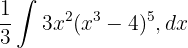
Increase the outer power by one and divide by that value:

Find the general solution for the trigonometric fractional product:

This is a product of an algebraic term ( ) and a trigonometric term (
 ). This requires Integration by Parts.
Following the LATE rule, prioritize the algebraic term for :
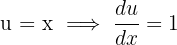

Apply the standard components to the formula:

Recall that the standard lookup integral for  is
is  :
:

Determine the general antiderivative for the following rational algebraic expression:
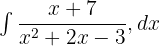
The numerator is not the derivative of the denominator, and it is a rational algebraic fraction. Factorize the denominator to see if it can be broken down using Partial Fractions.

Set up the partial fraction identity:

Multiply through by the common denominator:

Set:

Set:

Rewrite the original integral as two separate components and integrate using the logarithmic standard form:

Find the exact area under the curve given by the following definite limits:
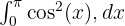
This is an even power of a single trigonometric function. It cannot be integrated directly. You must use a Trigonometric Identity first to remove the squared power.
Recall the cosine double-angle identity:

Substitute this linear conversion into the definite boundaries:

Substitute the upper boundary limit ( ):
):

Substitute the lower boundary limit ( ):
):
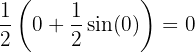
Subtract the limits to find the final exact value:

Evaluate the following integral using an appropriate substitution:
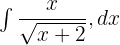
A linear function is trapped inside a square root in the denominator. This is a classic indicator for Integration by Substitution.
Let:

Rearrange the substitution to isolate the remaining variable:  . Substitute these terms into the original integral:

Apply the standard power rule to the independent indices:
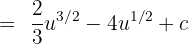
Substitute the original expression for back into the terms:

Summarise with AI:
Did you like this article? Rate it!


 Loading...