In A-Level Mathematics (across Edexcel, AQA, and OCR specifications), you will routinely encounter fractions containing algebraic expressions. When a function is written as the quotient of two polynomials, it is called a rational function:
Where P(x) and Q(x) are polynomial functions, and Q(x) ≠ 0.
Integrating these functions is a vital skill used to find areas under rational curves and solve real-world differential equations. The core challenge in an exam is identifying when and why to use a specific integration method. We choose our strategy by analysing the algebraic relationship between the numerator P(x) and the denominator Q(x).


The Strategic Classification Framework
Before performing any calculus, you must check the degree (the highest power of x) of both the numerator and the denominator to classify the fraction.
- Proper Rational Functions: The degree of the numerator is strictly less than the degree of the denominator. These can be integrated directly via logarithmic recognition or split using partial fractions.
- Improper Rational Functions: The degree of the numerator is greater than or equal to the degree of the denominator. You cannot integrate these directly or use partial fractions immediately; you must first simplify them using algebraic long division.
Step-by-Step Method Breakdowns
Method 1: Logarithmic Recognition
Always check for this form first. If the numerator is a direct scalar multiple of the derivative of the denominator, you can bypass complex algebra and integrate using the natural logarithm standard form:
Method 2: Partial Fractions Decomposition
If the rational function is proper but the numerator is not the derivative of the denominator, you must decompose the single complex fraction into a sum of simpler fractions. The setup depends on the factors of the denominator Q(x):
Case 1: Distinct Linear Factors
If the denominator factorises into unique linear brackets, split them with distinct constants:
Case 2: Repeated Linear Factors
If a linear bracket is squared or cubed, you must include a fraction for every progressive power of that factor:
Method 3: Improper Fractions (Algebraic Long Division)
When a fraction is improper, you must divide the numerator by the denominator. This transforms the expression into a standard polynomial plus a remaining proper rational fraction:
Once expressed in this form, the polynomial terms are integrated using the standard power rule, and the remaining proper fraction is solved using recognition or partial fractions.
Worked Example
Evaluate the following indefinite integral for the proper rational function:
Step 1: Check for recognition and classify
The denominator expands to:
which differentiates to 4x - 3. The numerator is 5x - 2, which is not a scalar multiple of 4x - 3. The fraction is proper (degree 1 over degree 2) with distinct linear factors. We must use Partial Fractions (Case 1).
Step 2: Set up the partial fractions identity
Step 3: Clear the denominators
Multiply every term by (x - 2)(2x + 1) to form the linear identity:
Step 4: Solve for constants A and B using substitution
- To eliminate B, substitute x = 2:
- To eliminate A, substitute x=-1/2:
Step 5: Reassemble and integrate
Substitute the values of A and B back into the integral:
Apply standard logarithmic integration rules (remembering to divide by the x-coefficient for the second term):
Practice Questions and Solutions
Find the general indefinite integral of the following rational function:
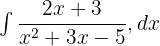
Differentiate the denominator:
 .
.
The numerator matches the derivative of the denominator exactly. Integrate directly using logarithmic recognition:

Evaluate the indefinite integral using logarithmic recognition:
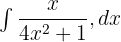
Differentiate the denominator:
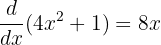
The numerator contains x, which is a scalar multiple of 8x.
Multiply the inside by 8 and factor out  to construct the clean standard form:

Decompose and evaluate the following integral using partial fractions:
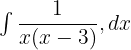
Proper fraction with distinct linear factors. Set up partial fractions:

Find Constants
Set:

Set:

Integration:

Using log laws, this can be simplified to:
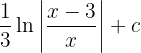
Find the general solution for the rational function with a repeated linear factor:
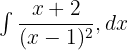
Proper fraction containing a repeated linear factor. Set up using the Case 2 framework:

Find Constants
Set:

Equate coefficients of :

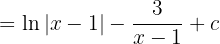
Integration: Rewrite the second term using indices to prepare for the power rule:

An improper rational function is given below. Use algebraic long division to convert the fraction, and evaluate its definite area between x = 2 and x = 4:
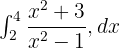
The degrees of the numerator and denominator are equal (both are 2), meaning this is an improper fraction. Run algebraic long division first.
Division Step:

Partial Fractions on Remainder: Factorize  :
:

Set:

Set:

Reassemble the Total Integral:

Evaluate Boundaries:
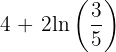
Upper limit (x = 4):
Lower limit (x = 2):
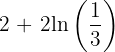
Subtract limits:

Summarise with AI:
Did you like this article? Rate it!


 Loading...