In calculus, differentiation allows us to calculate the instantaneous rate of change of a function, giving us its gradient profile. But what if we want to work backwards? What if we are given the gradient function and want to find the original algebraic expression, or calculate the geometric area locked beneath a curve?
To solve these problems, we use integration. Integration is the operational inverse of differentiation—often described as the mathematical process of "undoing" a derivative.
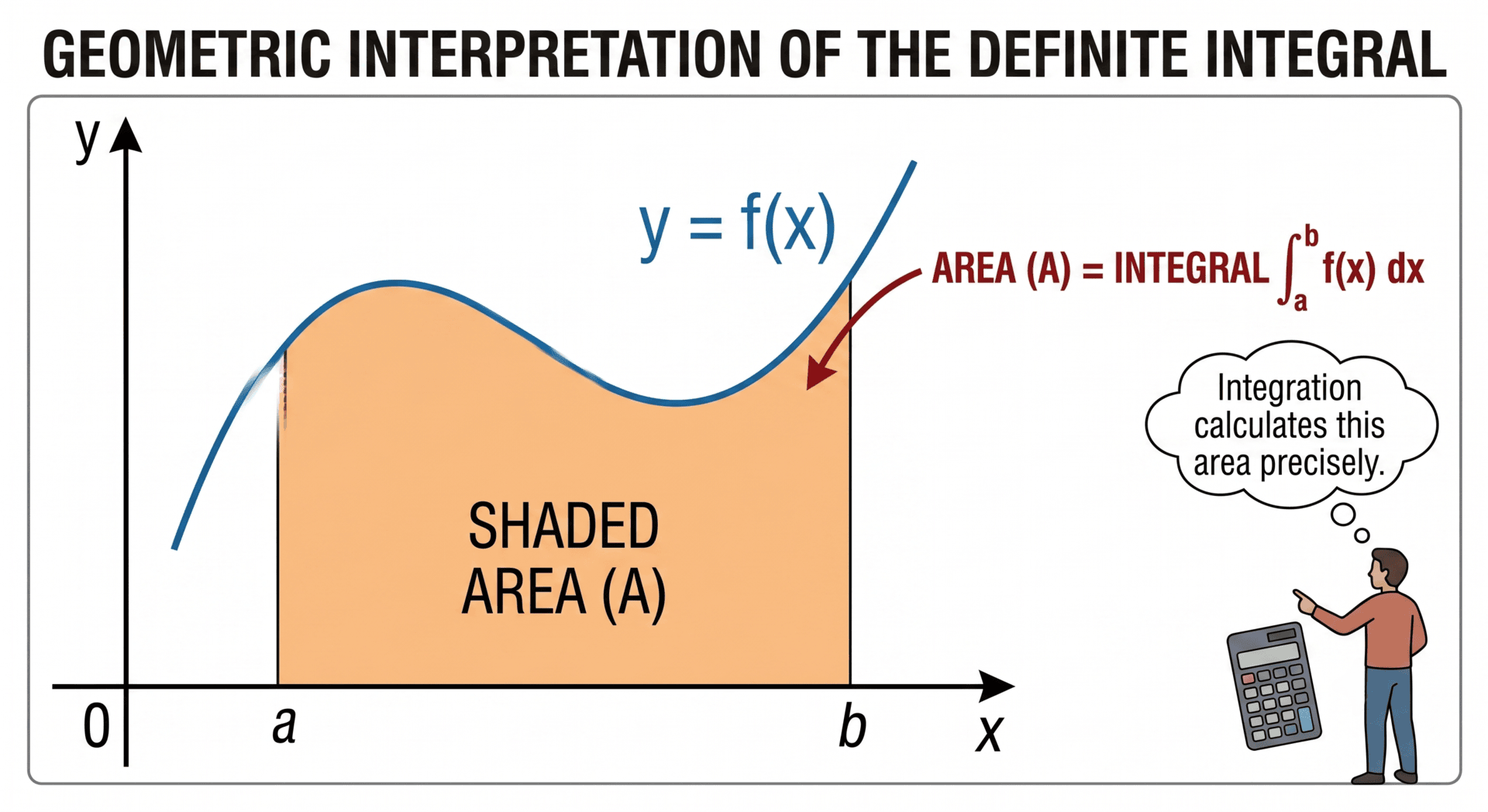


Core Principles of Integration
Integration is broadly divided into two structural categories:
- Definite Integration: Computes a specific numerical value representing physical properties like area, volumetric capacity, or displacement between two distinct boundaries.
- Indefinite Integration: Finds the general family of original algebraic functions from a given derivative. Because differentiating a constant term yields zero (), integrating a function leaves an unknown constant. We must always include a constant of integration, denoted as .
The Fundamental Theorem of Calculus formally bridges these two ideas, establishing that differentiation and integration are completely reciprocal operations.
The Power Rule Formula
Just as the power rule is the core mechanics for basic differentiation, the power rule for integration is the foundational tool used to integrate polynomial functions, root functions, and rational terms.
The standard algebraic template for indefinite power integration is:
The Critical Exception (n = -1)
Notice that the formula states a strict conditional constraint: . If you attempted to apply the power rule to (which is ), adding 1 to the power would yield , and dividing by the new power would force a division by zero (), which is mathematically undefined.
Exam Warning: The integral of is a unique logarithmic case: . Never attempt to apply the standard power rule to an index of .
Operational Rules: Linearity
When dealing with long polynomial expressions, you can break the calculation down using two essential properties of integration:
- The Constant Multiplier Rule: You can pull a constant coefficient outside the integration operation to simplify the calculus:
- The Sum/Difference Rule: You can split a multi-term polynomial expression and integrate each structural term independently:
Expanded Worked Examples
Example 1: Standard Polynomial Integration
Question: Calculate the indefinite integral:
Step-by-Step Solution:
Split the expression into individual terms:
Pull out the constant coefficients:
Apply the power rule to each independent component:
- For : Add to the power , divide by
- For : Add to the power , divide by
- For (constant ): Add to the power , divide by
Combine the terms and simplify:
Example 2: Fractional and Negative Indices
Question: Evaluate the following integral, expressing the final answer in clean radical/fractional notation:
Step-by-Step Solution:
Convert all expressions into index form:
Apply the power rule to the fractional power:
Add to the index:
Divide by the new index:
Apply the power rule to the negative power:
Add to the index:
Divide by the new index:
Assemble and rewrite back in standard algebraic format:
Exam-Style Practice Problems & Answers
Find the general indefinite integral expression for the function:

Step 1: Expand the brackets before attempting to integrate.

Step 2: Set up the integral operations:

Step 3: Apply the power rule to each component:

Final Answer:
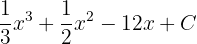
Evaluate the following integral involving fractional terms:
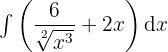
Step 1: Convert the radical fraction component into index form:
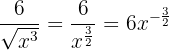
Step 2: Rewrite the full integral expression:
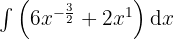
Step 3: Apply the power rule:
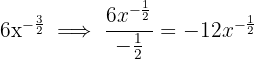
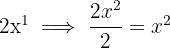
Final Answer:

Find the general solution for the expression:
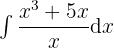
Step 1: Simplify the rational algebraic expression by dividing the single denominator term into the numerator:

Step 2: Set up and resolve the clean integral:

Summarise with AI:
Did you like this article? Rate it!


 Loading...