


Exercise 1
Study the following functions and determine if they are continuous. If not, state where the discontinuities exist and what type they are: 1
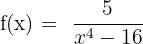
2

3
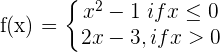
4
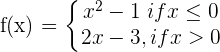
5 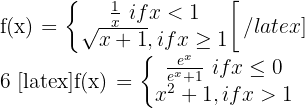
Exercise 2
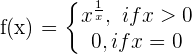
Determine if the following function is continuous at x = 0.
Exercise 3
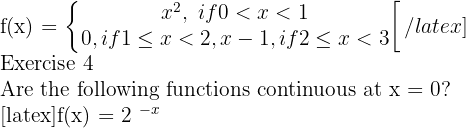
Determine if the following function is continuous on (0,3). If not, state where the discontinuities exist and what type they are:
Exercise 5
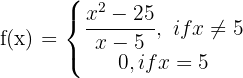
Given the function:
1 Prove that f(x) is not continuous at x = 5.
2Is there a continuous function which coincides with f(x) for all values with the exception x = 5? If so, determine the function.
Exercise 6
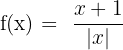
Determine if the following function is continuous. If not, state where the discontinuities exist or why the function is not continuous:
Exercise 7
Determine if the following function is continuous at x = 0.
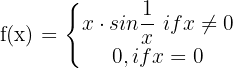
Exercise 8
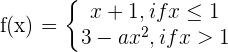
Determine the value of a to make the following function continuous.
Exercise 9
The function defined by:
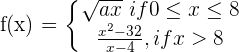
is continuous on [0, ∞).
Determine the value of a that would make this statement true.
Solution of exercise 1
Study the following functions and determine if they are continuous. If not, state where the discontinuities exist:
1
The function is continuous at all points of its domain.

D = R − {−2,2}
The function has two points of discontinuity at x = −2 and x = 2.
2
The function is continuous at R with the exception of the values that annul the denominator. If this is equal to zero and the equation is solved, the discontinuity points will be obtained.


x = −3; and by solving the quadratic equation: 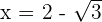 and
and  are also obtained
The function has three points of discontinuity at  , and .

 \lim _ {x \rightarrow 2^{-}} (x + 1) = 3
\lim _ {x \rightarrow 2^{+}} (2x - 1) = 3
The function is continuous.

\lim _ {x \rightarrow 0^{-}} (x^2 - 1) = -1
\lim _ {x \rightarrow 0^{+}} (2x - 3) = -3
The function has a jump discontinuity at x = 0 .
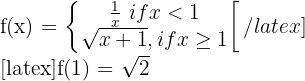
\lim_{x \rightarrow 1^{-}} (\frac{1}{x}) = 1
\lim_{x \rightarrow 1^{+}} \sqrt{x + 1} = \sqrt{2}
The function has a jump discontinuity at x = 1 .
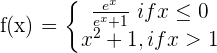

\lim_{x \rightarrow 0^{-}} (\frac {e^x}{e^x + 1}) = \frac{1}{2}
\lim_{x \rightarrow 0^{+}} x^2 + 1 = 1
The function has a jump discontinuity at x = 1/2 .
Solution of exercise 2
Determine if the following function is continuous at x = 0.

\lim_{x \rightarrow 0^{+}} x^ {\frac{1}{x}} = 0 ^ {\frac{1}{0^{+}}} = 0 ^{\infty} = 0
\lim_{x \rightarrow 0^{-}} x^ {\frac{1}{x}}
At x = 0, there is an essential discontinuity.
Solution of exercise 3
Determine if the following function is continuous on (0,3). If not, state where the discontinuities exist and what type they are:

\lim_{x \rightarrow 1^{-}} x^2 = 1
\lim_{x \rightarrow 1^{+}} 0 = 0
At x = 1, there is a jump discontinuity.

\lim_{x \rightarrow 2^{-}} 0 = 0
\lim_{x \rightarrow 2^{+}} x - 1 = 1
At x = 2, there is a jump discontinuity.
Solution of exercise 4
Are the following functions continuous at x = 0?
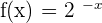
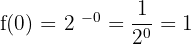
\lim_{x \rightarrow 0^{-}} 2^{-x} = 2 ^{0^{-}} = 2^0 = 1
\lim_{x \rightarrow 0^{+}} 2^{-x} = 2^{-0^{+}} = \frac{1}{2^0} = 1
The function is continuous at x = 0.
Solution of exercise 5
Given the function:
1 Prove that f(x) is not continuous at x = 5.

\lim_{x \rightarrow 5} \frac{x^2 - 25}{x - 5} = \frac{0}{0}
Solve the indeterminate form.
\lim_{x \rightarrow 5} \frac{(x + 5) (x - 5)}{x - 5} = \lim_{x \rightarrow 5} (x + 5) = 10
f (x) is not continuous at x = 5 because:
\lim_{x \rightarrow 5} f(x) \neq f(5)
2 Is there a continuous function which coincides with f(x) for all values with the exception x = 5? If so, determine the function.
If \lim_{x \rightarrow 5} f(x) = f(5) = 10 the function would be continuous, then the function is redefined:
Solution of exercise 6
Determine if the following function is continuous. If not, state where the discontinuities exist or why the function is not continuous:
The function f(x) is continuous for x ≠ 0. Therefore, study the continuity at x = 0.
\lim_{x \rightarrow 0 ^{-}} \frac{x + 1}{|x|} = \lim_{x \rightarrow 0^{-}} \frac{x + 1}{-x} = \lim_{x \rightarrow 0^{-}}(-1 - \frac{1}{x}) = -1 - \frac{1}{0^{-}} = \infty
\lim_{x \rightarrow 0 ^{+}} \frac{x + 1}{|x|} = \lim_{x \rightarrow 0^{+}} \frac{x + 1}{x} = \lim_{x \rightarrow 0^{+}}(-1 - \frac{1}{x}) = -1 - \frac{1}{0^{+}} = \infty
The function is not continuous at x = 0, because it is defined at that point.
Solution of exercise 7
Determine if the following function is continuous at x = 0:
The function  is bounded by
 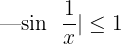 ,
,  , therefore takes place:
\lim_{x \rightarrow{0}} (x \cdot sin \dfrac{1}{x}) = 0 , since any number multiplied by zero gives zero.
As f(0) = 0.
The function is continuous.
Solution of exercise 8
Determine the value of a to make the following function continuous:

\lim_{x \rightarrow 1^{-}} (x + 1) = 2
\lim_{x \rightarrow 1^{+}} (3 - ax^2) = 3 - a


Solution of exercise 9
The function defined by:
is continuous on [0, ∞).
Determine the value of a that would make this statement true.
\lim_{x \rightarrow 8^{-}} \sqrt{ax} = \sqrt{8a}
\lim_{x \rightarrow 8^ {+}} \frac{x^2 - 32}{x - 4} = 8


Summarise with AI:
Did you like this article? Rate it!


 Loading...
what will be sign of -infinity is to power infinity plus or minus
The sign **cannot be determined**.
For a negative base:
* **Even exponent** → **positive**
* **Odd exponent** → **negative**
So as the exponent tends to infinity, the sign depends on whether the exponent is even or odd. Therefore, ((-\infty)^\infty) has **no definite sign**—it can be **positive or negative**.