In calculus, optimisation problems require us to find the absolute maximum or absolute minimum values of a system—whether we are maximising the profit of a business, optimising the structural efficiency of an engineering design, or finding peak acceleration in kinematics.
However, before executing a complex mathematical optimisation search, a fundamental question must be answered: Are we guaranteed that a maximum or minimum value actually exists? The extreme value theorem calculus framework provides this definitive logical guarantee. It is an existence theorem that establishes the precise geometric conditions under which a function must hit its absolute peak and absolute trough.


1. Core Theory and Definitions
The Extreme Value Theorem (EVT) states that if a real-valued function f(x) satisfies specific structural conditions, it is mathematically impossible for that function to avoid reaching an absolute maximum and an absolute minimum value.
The Theorem Statement
The Extreme Value Theorem: If a function f(x) is completely continuous on a closed interval [a, b], then f(x) must attain an absolute maximum value and an absolute minimum value at least once within that interval.
Breakdown of the Two Mandatory Conditions
For the theorem to apply, the function and its tracking boundaries must simultaneously satisfy two strict criteria:
- Continuity: The function must be continuous on the interval. Geometrically, this means the graph has no structural breaks, jumps, point holes, or vertical asymptotes within the boundaries. You can sketch the entire curve without lifting your pen from the paper.
- A Closed Interval: The domain being examined must contain its boundary endpoints. This is denoted using square brackets [a, b] or written as a compound inequality a ≤ x ≤ b. An open interval like (a, b) or a < x < b immediately invalidates the theorem's guarantee.
Absolute vs. Local Extrema
It is vital to distinguish between overall absolute boundaries and localised turning points for your exam:
- Absolute Maximum: The absolute highest coordinate output across the entire specified interval. Mathematically, f(c) ≥ f(x) for all x in [a, b].
- Absolute Minimum: The absolute lowest coordinate output across the entire specified interval. Mathematically, f(c) ≤ f(x) for all x in [a, b].
- Local (Relative) Extrema: Peaks and valleys that are only the highest or lowest points relative to their immediate neighbouring coordinates (such as standard stationary turning points where f'(x) = 0).
Intuition: Why the Conditions Matter
To understand the power of the Extreme Value Theorem, it is helpful to look at how the theorem fails if either of its two core pillars is removed.
Failure Mode 1: An Open Interval
Consider the simple linear function (x) = x on the open interval (0, 1).
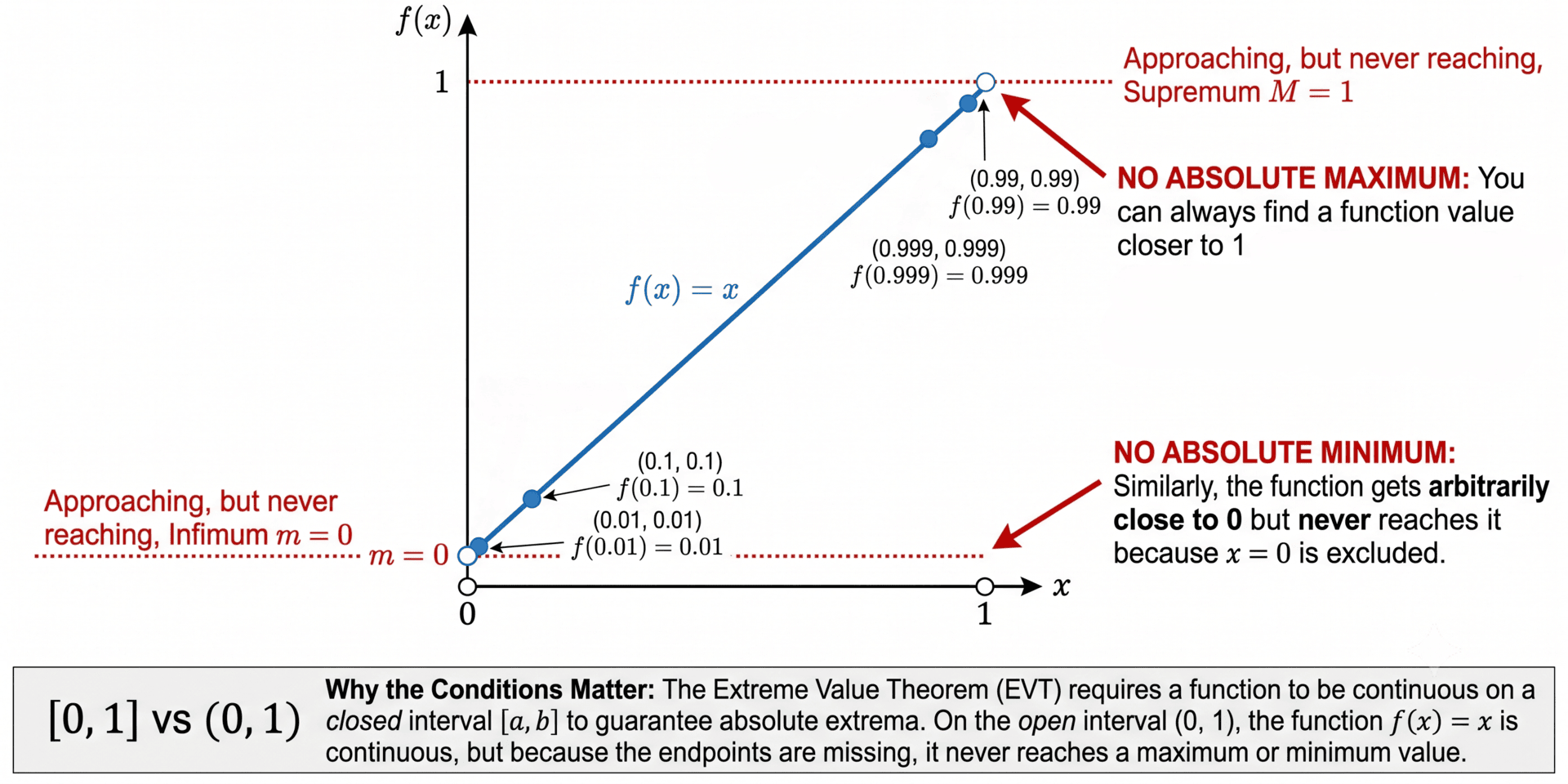
The function is continuous, but because the boundaries x = 0 and x = 1 are excluded, the function never reaches a definitive maximum or minimum. If you claim the maximum value is 0.99, a closer value exists at 0.999, then 0.9999, and so on, approaching 1 infinitely without ever arriving. Because the boundary endpoint is missing, an absolute maximum does not exist.
Failure Mode 2: A Non-Continuous Function
Consider a function bounded on a closed interval [1, 5] that tracks perfectly upward but contains a single step-discontinuity (a hole) at its highest point.
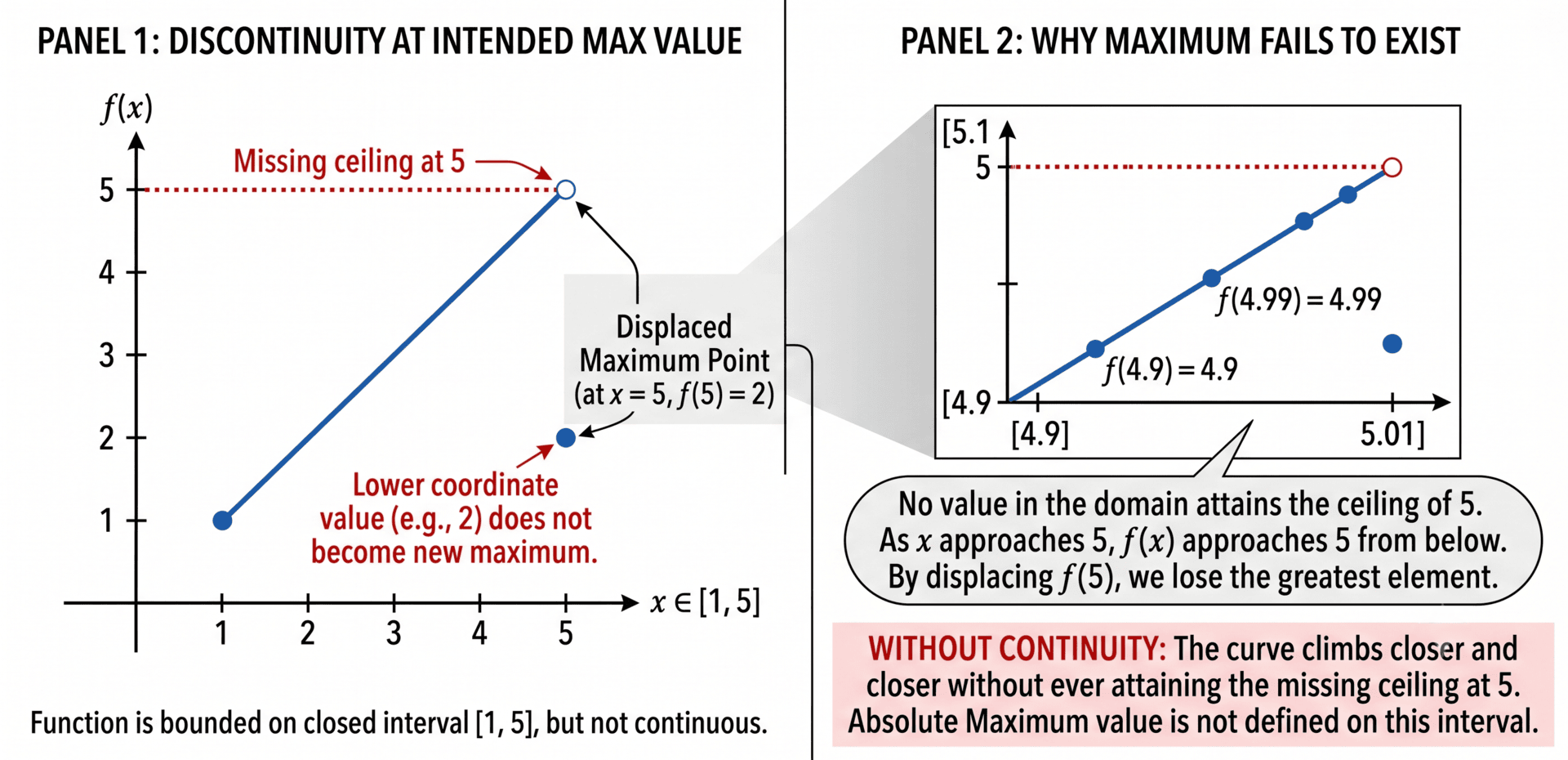
If the point where the maximum value should exist is completely removed or displaced to a lower coordinate value, the curve climbs closer and closer to that missing ceiling without ever attaining it. Without continuity, the structural guarantee of an absolute maximum collapses.
How to Find Absolute Extrema (The Candidates Test)
The Extreme Value Theorem tells us that extrema exist, but it does not tell us where they are located. To locate them on a closed interval, we use a systematic methodology known as the Candidates Test.
An absolute maximum or minimum can only occur at two structural locations on a continuous, closed curve:
- At an internal critical point within the interval (where f'(x) = 0 or f'(x) is undefined).
- At the outer boundary endpoints of the interval (x = a or x = b).
| Step | Operational Task | Mathematical Execution |
|---|---|---|
| 1 | Differentiate | Find the first derivative expression f'(x) |
| 2 | Locate Critical Points | Set f'(x) = 0 and solve for x. Filter out any roots outside [a,b] |
| 3 | Evaluate Critical Points | Substitute the valid internal x-roots back into the original function f(x) |
| 4 | Evaluate Endpoints | Calculate the boundary values f(a) and f(b) |
| 5 | Compare Coordinates | The highest output is the absolute maximum; the lowest is the absolute minimum |
Worked Example
Problem: Find the absolute maximum and absolute minimum values of the polynomial function given below on the closed interval [-2, 4]:
Step-by-step Solution:
Step 1: Find the first derivative - Apply the power rule to differentiate the function:
Step 2: Find the internal critical points - Set the derivative equal to zero to identify stationary values:
Factor out the common multiplier to simplify the quadratic equation:
This provides two critical values: x = 2 and x = -1. Check both against our interval [-2, 4]. Since both coordinates sit inside the closed boundaries, both are kept as viable candidates.
Step 3: Evaluate the original function at the critical points - Substitute x = -1 into f(x):
Substitute x = 2 into f(x):
Step 4: Evaluate the original function at the boundary endpoints. Substitute the lower bound x = -2:
Substitute the upper bound x = 4:
Step 5: Compare the candidate outputs. Compile and audit all calculated outputs:
- f(-1) = 12
- f(2) = -15
- f(-2) = 1
- f(4) = 37
The absolute maximum value is 37 (occurring at the endpoint x = 4).
The absolute minimum value is -15 (occurring at the internal stationary point x = 2).
Practice Questions & Solutions
State the two mathematical conditions that a function and its domain must satisfy to guarantee the existence of absolute extrema via the Extreme Value Theorem.
The function must be completely continuous across the entire chosen interval, and the interval itself must be strictly closed (containing its boundary endpoints).
Find the absolute maximum and absolute minimum values of the quadratic function:

on the closed interval [0, 5].
Differentiate the function to locate the internal stationary points:

Set the derivative equal to zero to find the critical value:

Evaluate the function at the critical point  :
:

Evaluate the function at the two boundary endpoints
 and
and  :
:


Compare all calculated outputs: -1, 3, and 8.
The absolute maximum value is 8, and the absolute minimum value is -1.
Explain why the Extreme Value Theorem does not guarantee the existence of absolute extrema for the reciprocal function:

on the closed interval [-1, 1].
The reciprocal function has a vertical asymptote at the coordinate position x = 0, where the function is completely undefined. Because x = 0 lies directly within the interval [-1, 1], the function is not continuous on this closed interval. Since it violates the continuity condition, the theorem's guarantees do not apply.
Determine the absolute extrema of the function:

evaluated over the closed interval [-1, 2].
Find the derivative of the polynomial expression:

Factorize the expression and set it equal to zero to find the critical values:

Evaluate the original function at both internal critical candidates:


Evaluate the original function at both boundary limits:


Comparing all values (0, -1, 7, 16) shows that the absolute maximum value is 16 (at x = 2) and the absolute minimum value is -1 (at x = 1).
Find the absolute maximum and absolute minimum coordinates for the trigonometric function:

restricted to the closed interval  .
.
Compute the first derivative of the composite trigonometric terms:

Set the expression equal to zero to discover the internal critical position:

Within the boundaries , this identity resolves to the exact critical angle:

Evaluate the function at this internal stationary point:

Evaluate the function at both boundary limits:

Compare the final values: 
The absolute maximum value is  , and the absolute minimum value is -1.
Summarise with AI:
Did you like this article? Rate it!


 Loading...
what will be sign of -infinity is to power infinity plus or minus
The sign **cannot be determined**.
For a negative base:
* **Even exponent** → **positive**
* **Odd exponent** → **negative**
So as the exponent tends to infinity, the sign depends on whether the exponent is even or odd. Therefore, ((-\infty)^\infty) has **no definite sign**—it can be **positive or negative**.