Whether you are sketching curves, evaluating derivatives, or determining area under a graph, continuity is one of the foundational building blocks of mathematical analysis.
Intuitively, a function is continuous if you can draw its graph on paper without lifting your pencil—meaning there are no gaps, holes, or sudden vertical jumps. However, in A-Level Maths and introductory university calculus, intuition must be backed up by a precise, formal definition using limits.


What is a Continuous Function?
An informal way to visualise a continuous function is a smooth, uninterrupted curve over its entire domain. If a graph breaks, leaps across a vertical gap, or shoots off to infinity, the function is discontinuous at that specific point.
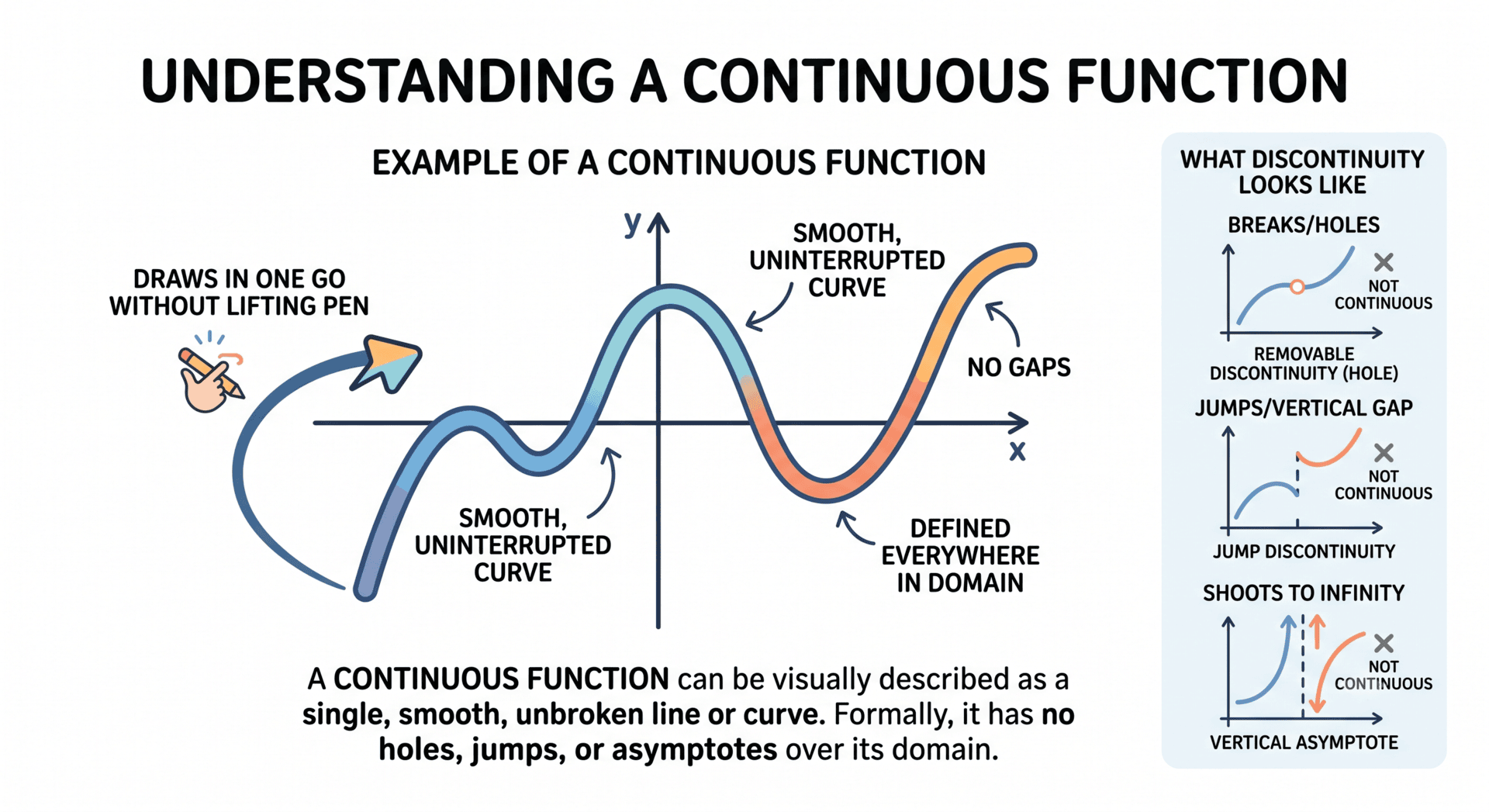
The Formal 3-Step Test for Continuity at a Point
To prove mathematically that a function is continuous at a specific point , it must satisfy all three of the following conditions:
ie. is f(c) a solid point on the graph?
ie. does the left-hand limit = right-hand limit?
ie. does the limit equal the exact value?
If any single condition fails, the function f(x) is discontinuous at x = c.
Algebra and Properties of Continuous Functions
If two functions and are both continuous at , then the following algebraic combinations are also continuous at :
Sum and Difference:
Constant Multiple: for any real constant
Product:
Quotient:, provided
Composite Function:, provided is continuous at and is continuous at
Standard Functions Continuous on Their Domains
The following basic family of functions are continuous at every point in their respective domains:
Polynomial functions (e.g., ) — continuous for all .
Rational functions (e.g., ) — continuous at all points where .
Exponential functions (e.g., ) — continuous for all .
Logarithmic functions (e.g., ) — continuous for all .
Trigonometric functions ( and on ; wherever ).
Types of Discontinuity
When a function fails the 3-step continuity test at , the failure generally falls into one of three distinct categories:
1. Removable Discontinuity (Point Discontinuity)
A removable discontinuity occurs when the limit exists, but either is undefined or Graphically, this appears as a single "hole" in the curve:
2. Jump Discontinuity
A jump discontinuity occurs when the left-hand limit and right-hand limit both exist as finite numbers, but they are not equal. Graphically, the curve "jumps" vertically from one line level to another.
3. Infinite Discontinuity (Essential Discontinuity)
An infinite discontinuity occurs when one or both of the one-sided limits approach . Graphically, this represents a vertical asymptote at .
Continuity in Piecewise Functions
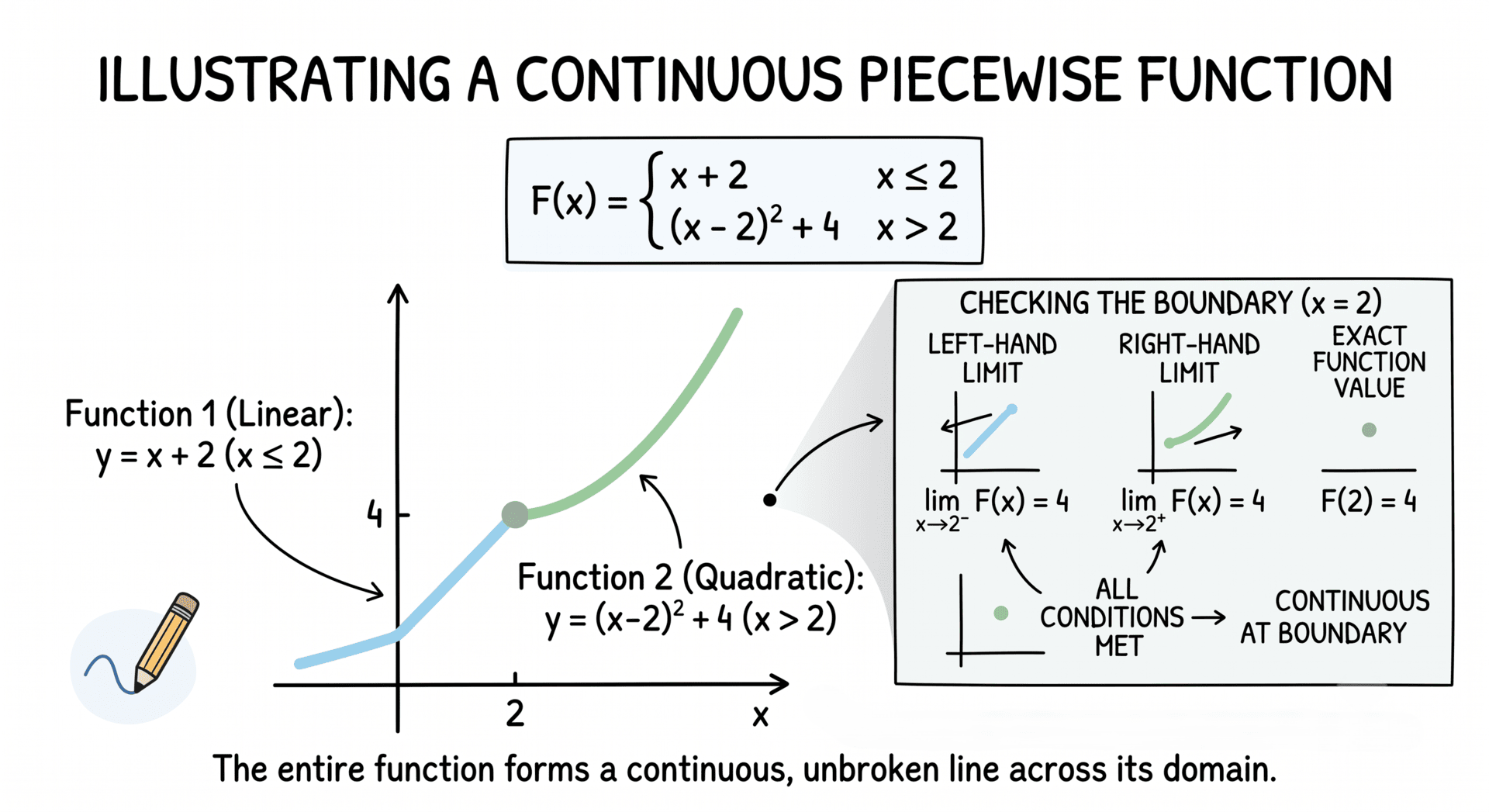
A piecewise function is defined by different sub-functions across different intervals of its domain. A piecewise function is continuous overall if:
- Each constituent sub-function is continuous on its open interval.
- The left-hand limit, right-hand limit, and exact function value match at every boundary transition point.
Are Radical Functions Continuous?
Radical functions of the form:
are continuous at every point across their entire domain. For odd root indices (such as the cube root ), the domain spans all real numbers (), making the function continuous everywhere on . For even root indices (such as the standard square root ), the function is defined and continuous on the interval , satisfying right-continuity at the boundary endpoint because:
In exam questions, note that values outside the domain (such as negative inputs for even roots) are points where the function is undefined, rather than points of discontinuity—a function is considered continuous if it is continuous at every point where it is defined.
Worked Examples & Solutions
Example 1: Testing Continuity at a Point
Question: Test whether the function is continuous at . If discontinuous, identify the type of discontinuity.
Step-by-Step Solution:
Check Condition 1 ( exists):
Because is undefined, fails Condition 1 and is discontinuous at .
Check Condition 2 ( exists):
Factorise the numerator for :
The limit exists and equals .
Classification:
Because exists but is undefined, has a removable discontinuity at .
Example 2: Finding a Constant for Piecewise Continuity
Question: Find the value of the constant that makes the piecewise function continuous for all real numbers:
Step-by-Step Solution:
Identify the boundary point: The transition occurs at . Both sub-functions ( and ) are polynomials and thus continuous on their own intervals.
Calculate the left-hand limit and function value at :
Calculate the right-hand limit at :
Equate limits for continuity:
Example 3: Trigonometric Piecewise Continuity
Question: Find the value of such that the function is continuous at :
Step-by-Step Solution:
Evaluate the limit as :
Using the standard limit identity :
Set :
Summarise with AI:
Did you like this article? Rate it!


 Loading...
what will be sign of -infinity is to power infinity plus or minus
The sign **cannot be determined**.
For a negative base:
* **Even exponent** → **positive**
* **Odd exponent** → **negative**
So as the exponent tends to infinity, the sign depends on whether the exponent is even or odd. Therefore, ((-\infty)^\infty) has **no definite sign**—it can be **positive or negative**.