Whether you are studying floor tilings, structural trusses, or geometric proofs, polygons are the fundamental two-dimensional building blocks of geometry. The word "polygon" originates from the Greek words poly (meaning "many") and gonia (meaning "angle").
While basic polygons like equilateral triangles and squares are familiar, higher-tier calculus and geometry problems require a deeper understanding of a polygon's internal anatomy—including its apothems, diagonals, heights, medians, and area mechanics.
In this guide, we will break down the rules of polygons, examine their key geometric components, provide essential formulas, and work through step-by-step practice problems.


What Defines a Polygon?
A polygon is a flat, two-dimensional (2D) closed plane figure bounded by straight line segments. To qualify as a polygon, a shape must satisfy three strict criteria:
- Straight Line Segments: Every side (edge) must be a straight line segment. Curved lines or arcs are not permitted (which is why circles and ellipses are not polygons).
- Fully Closed Loop: The sides must connect end-to-end to completely enclose a region of space, leaving no open gaps.
- Minimum of Three Sides: A polygon must have at least 3 sides ().
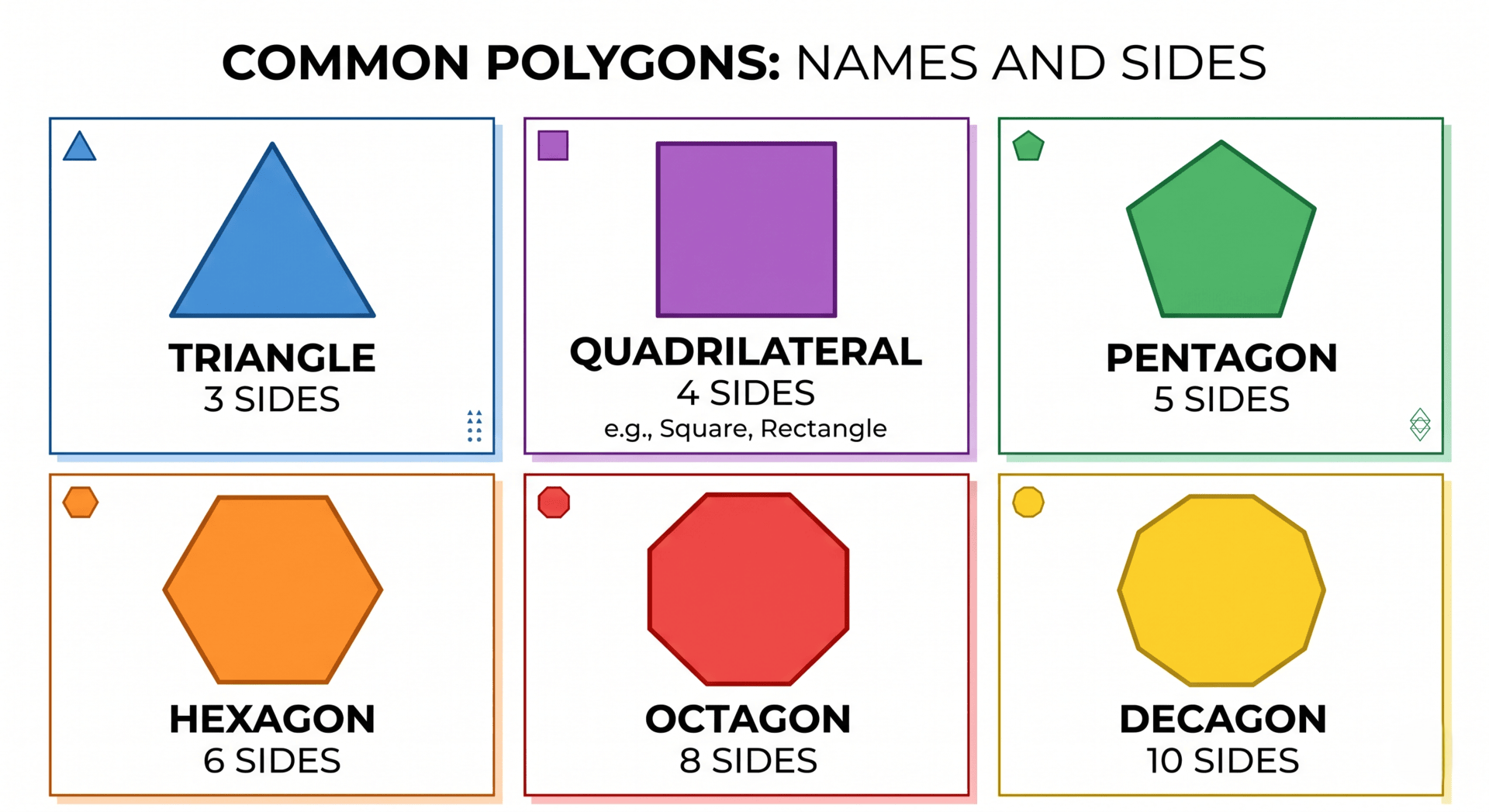
Classification Rules for Polygons
Polygons are classified into distinct categories based on their internal angles and side lengths:
Convex vs. Concave Polygons
- Convex Polygon: Every interior angle is strictly less than . If you draw a line segment between any two internal points, the line stays entirely inside the shape. All diagonals lie inside the polygon.
- Concave Polygon: At least one interior angle is a reflex angle (greater than ). The shape appears to "cave in" on at least one side, causing at least one diagonal to pass outside the boundary of the figure.
Regular vs. Irregular Polygons
- Equilateral Polygon: A polygon where all sides are equal in length.
- Equiangular Polygon: A polygon where all interior angles are equal in size.
- Regular Polygon: A polygon that is both equilateral and equiangular (e.g., a square or an equilateral triangle).
- Irregular Polygon: A polygon with sides of differing lengths, angles of differing sizes, or both.
Core Structural Anatomy of a Polygon
To solve advanced coordinate and geometric problems, you must understand the key line segments and geometric features within a polygon.
Vertex: Point where two sides meet.
Diagonal: Line connecting two non-adjacent vertices.
Apothem: Perpendicular distance from center to side midpoint.
Height: Perpendicular distance from base to highest apex.
Median: Line from a vertex to the midpoint of the opposite side.
Number of Sides and Vertices (n)
A polygon with n sides always has n vertices (corners) and n interior angles. As the number of sides n approaches infinity, the perimeter and area of a regular polygon approach that of a circle—though a polygon always retains discrete edges.
Diagonals
A diagonal is a straight line segment drawn between any two non-adjacent vertices.
To calculate the total number of diagonals (D) in an n-sided polygon:
- From any single vertex, you can draw diagonals to (n - 3) other vertices (you cannot draw a diagonal to the vertex itself or its two immediate neighbors).
- Multiplying by n vertices gives n(n - 3), but since every diagonal connects two vertices, this counts each line twice.
Height (Altitude)
The height (or altitude) of a polygon is the perpendicular distance measured from a chosen base side to the furthest opposite vertex (or line containing that vertex).
- In symmetric polygons with an even number of sides (like a regular hexagon or square), the height is the perpendicular distance between two opposite parallel sides.
- In regular polygons with an odd number of sides (like a pentagon), the height is measured from a base side directly to the opposite vertex.
Apothem (a)
The apothem is a line segment drawn from the geometric center of a regular polygon perpendicular to the midpoint of any of its sides.
The apothem is crucial for calculating the area of regular n-gons. For a regular polygon with side length s and n sides, the apothem is given by:
Medians
A median is a line segment drawn from a vertex to the midpoint of the opposite side. In triangles, the three medians intersect at a single balance point called the centroid.
Worked Examples
Example 1: Calculating Diagonals
Question: Calculate the total number of diagonals in a regular decagon (10-sided polygon).
Step-by-Step Solution:
Identify the number of sides: n = 10
Apply the diagonal formula:
Substitute n = 10:
Example 2: Area Using Perimeter and Apothem
Question: A regular hexagon has a side length of and an apothem of (approximately ). Calculate the exact area of the hexagon.
Step-by-Step Solution:
Calculate the perimeter (P): A hexagon has n = 6 sides
Identify the apothem (a):
Apply the regular polygon area formula:
Practice Questions & Answers
Calculate the total number of diagonals in a 12-sided polygon (a dodecagon).
Identify n: n = 12
Apply formula:

A regular pentagon has a perimeter of 40cm and an apothem of 5.5cm. Calculate the area of the pentagon.
Identify given values: P = 40cm, a = 5.5cm
Apply area formula:

Find the number of sides of a convex polygon if the total number of diagonals is 54.
Set up diagonal formula equal to 54:

Factorise quadratic:

Select positive solution: n = 12. The polygon has 12 sides.
Summarise with AI:
Did you like this article? Rate it!


 Loading...
Nice emma really precise information.. I appreciate u
Hey Raptor! Thanks very much for the positive feedback, very much appreciated!
explains everything for a child or a confused student in their ap maths class who is lost in the more detailed mathematics
Draw all types of polygon and its area and perimeter class 7th NCERT course
I’m just curious if the area between the polygon and the circumscribed circle has a name.
https://www.superprof.co.uk/resources/academic/maths/geometry/plane/orthocenter-centroid-circumcenter-and-incenter-of-a-triangle.html
Draw all types of polygon and its area and perimeter