


Introduction
The Pythagorean Theorem is a fundamental cornerstone of geometry and a vital skill for GCSE Maths. Named after the ancient Greek mathematician Pythagoras, it describes the unique relationship between the three sides of a right-angled triangle.
Whether you are calculating the distance between two points on a map, determining the height of a ladder against a wall, or solving complex architectural problems involving circles and squares, this theorem provides the essential mathematical framework for finding missing lengths.
Theory: The Right-Angled Triangle Relationship
The Pythagorean Theorem states that in any right-angled triangle, the area of the square whose side is the hypotenuse is equal to the sum of the areas of the squares whose sides are the two legs.
Defining the Components
- Hypotenuse: The longest side of a right-angled triangle, always located directly opposite the 90-degree angle. We usually label this side c.
- Legs: The two shorter sides that meet to form the right angle. We label these a and b.
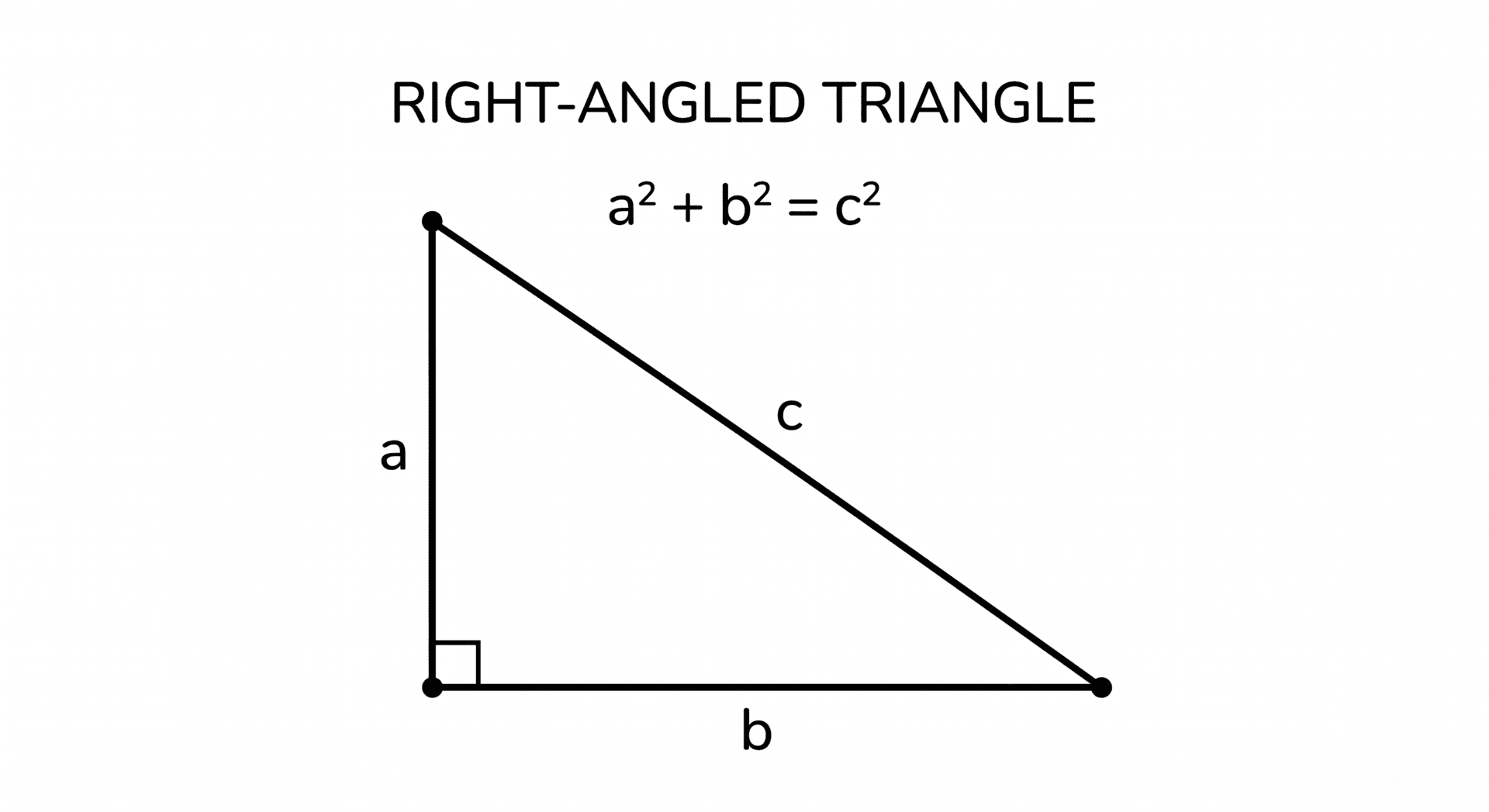
The Formula
The relationship is expressed mathematically as:
Step-by-Step Reasoning
To solve any problem using this theorem, follow this logical progression:
- Identify the right angle: Locate the 90° square symbol.
- Identify the hypotenuse: The side opposite the right angle is always c.
- Choose the calculation path:
- To find the hypotenuse, square both known sides and add them together.
- To find a shorter side, square both known sides and subtract the smaller square from the larger one.
- Square root the result: The theorem gives you the side length squared, so you must find the square root to get the final distance.
Common Pythagorean Triples
These are sets of three integers that perfectly satisfy the theorem:
| Side a | Side b | Hypotenuse c |
|---|---|---|
| 3 | 4 | 5 |
| 5 | 12 | 13 |
| 8 | 15 | 17 |
| 7 | 24 | 25 |
| 9 | 40 | 41 |
Worked Example
Question: A right-angled triangle has two shorter sides measuring 6 cm and 8 cm. Calculate the length of the hypotenuse.
Step 1: Identify sides a and b:
Step 2: Apply the formula:
Step 3: Square root to find c:
Practice Questions and Solutions
A right-angled triangle has legs of 9 cm and 12 cm. Calculate the length of the hypotenuse.
First, square the two legs:

Add the squares together:
Find the square root:

Final length:

Find the missing side length a of a right-angled triangle if the hypotenuse is 13 cm and side b is 5 cm.
Square the known side and the hypotenuse:


Subtract the square of the leg from the square of the hypotenuse:

Find the square root:

Final length:

A rectangle has a width of 8 cm and a length of 15 cm. Calculate the length of the diagonal.
The diagonal forms a right-angled triangle where the width and length are legs:


Add the squares:

Find the square root:

Final length:

Find the height of an isosceles triangle with two equal sides of 10 cm and a base of 12 cm.
The height bisects the base into two 6 cm lengths, creating a right-angled triangle:


Subtract the squares to find the height:

Find the square root:

Final height:

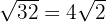
Calculate the diagonal of a square with a side length of 7 cm. Leave your answer in surd form.
Both legs are 7 cm:


Find the square root:

Simplify the surd:

Both legs are 7 cm:
Find the square root:
Simplify the surd:
Let the side be s. In a square, the diagonal creates a triangle where:


Divide by 2:

Find the square root:
Final length:

The area of a square is 2,304 cm². Calculate the diagonal length of this square.
First, find the side length:
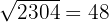
Use Pythagoras with both sides as 48:


Find the square root:

Final length:

A square is inscribed in a circle with a 4 m radius. Find the side length of the square.
The diameter of the circle is the diagonal of the square:

Using the diagonal relationship:


Final side length:
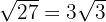
An equilateral triangle has a side of 6 cm. Find its vertical height.
The height forms a right triangle with a hypotenuse of 6 cm and a base of 3 cm:

Subtract to find the height:

Find the square root:
Final height:

A regular hexagon has a perimeter equal to a square with an area of 2,304 cm². Find the length of each hexagon side.
First, find the square's side:
Find the perimeter of the square:

Find the hexagon side length (6 sides):

Final length:

Summarise with AI:
Did you like this article? Rate it!

 Loading...
Please draw diagram for explanation
Thanks for your feedback! We’ll take your suggestion into account and look at how we can make the explanations clearer with diagrams. 😊
Nice emma really precise information.. I appreciate u
Hey Raptor! Thanks very much for the positive feedback, very much appreciated!
explains everything for a child or a confused student in their ap maths class who is lost in the more detailed mathematics
Draw all types of polygon and its area and perimeter class 7th NCERT course
I’m just curious if the area between the polygon and the circumscribed circle has a name.
https://www.superprof.co.uk/resources/academic/maths/geometry/plane/orthocenter-centroid-circumcenter-and-incenter-of-a-triangle.html
Draw all types of polygon and its area and perimeter