Triangles are the fundamental building blocks of geometry. From the rigid structures of bridges to the complex calculations in navigation and surveying, understanding how to calculate missing lengths and angles is essential.
In GCSE Maths, you will progress from basic properties to advanced trigonometry. This guide covers everything you need to know about right-angled and non-right-angled triangles, including the Sine Rule, Cosine Rule, and trigonometric area formulas.


Theory: Right-Angled Triangles
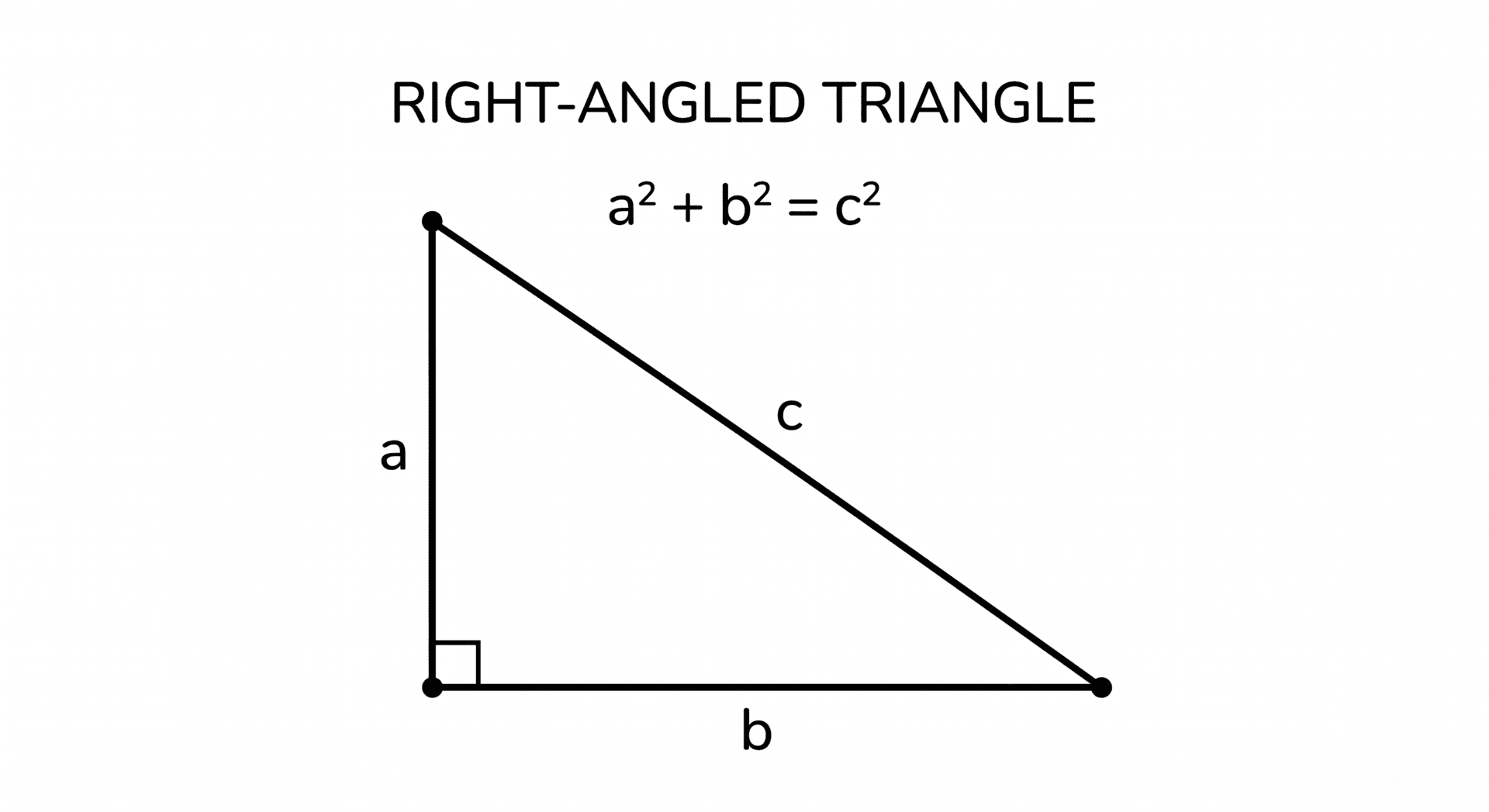
Right-angled triangles contain one angle of 90 degrees. There are two primary tools used for these triangles: Pythagoras' Theorem and SOH CAH TOA.
Pythagoras' Theorem
Used to find a missing side length when the other two sides are known:
Where c is the hypotenuse (the longest side opposite the right angle).
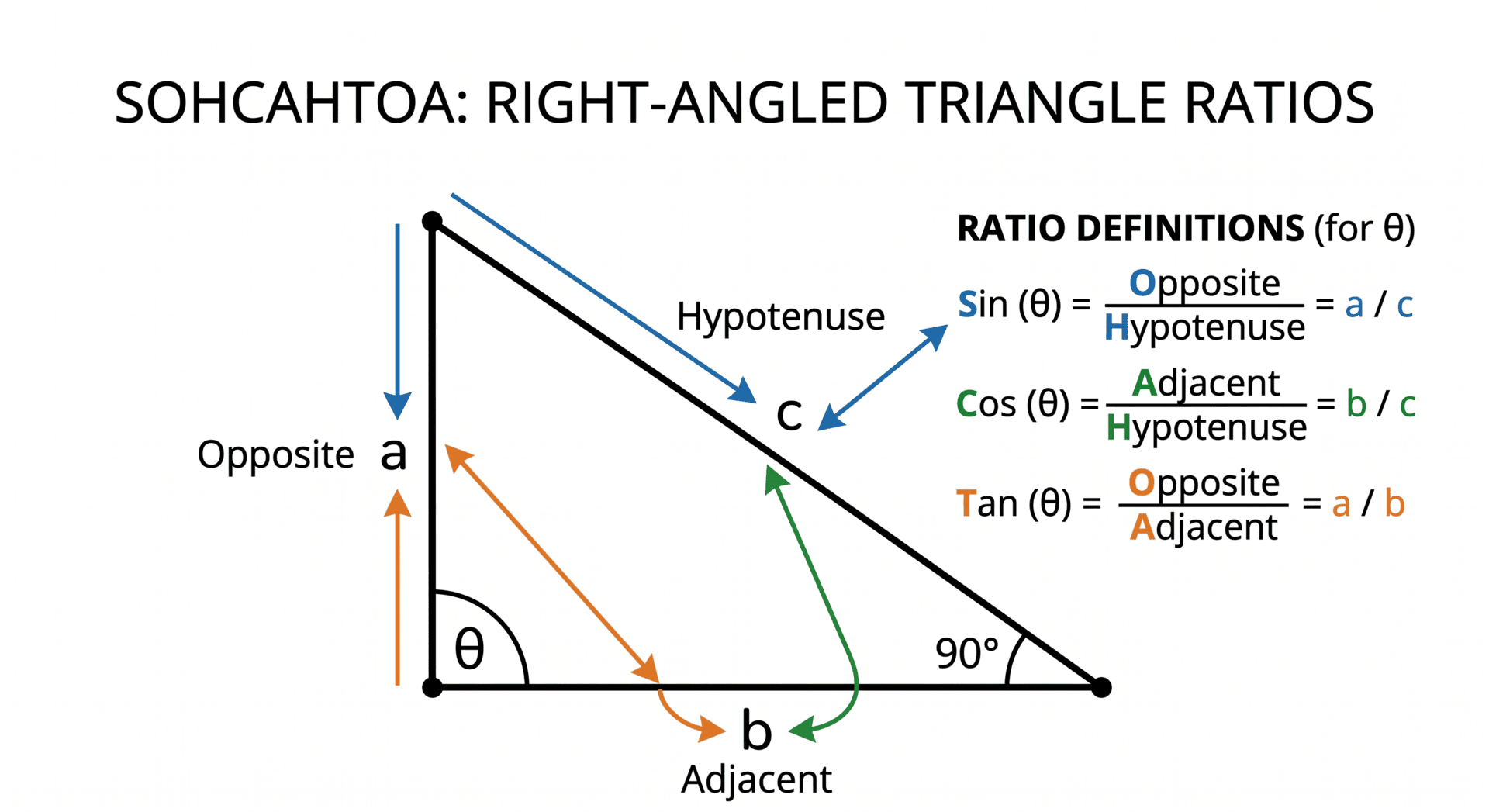
Trigonometry (SOH CAH TOA)
Used to find a missing side or angle using the relationship between sides and angles.
Theory: Area of a Triangle
Depending on the information provided, there are two ways to calculate the area of a triangle.
1. Basic Formula
Used when the base and vertical height are known:
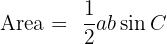
2. Trigonometric Formula
Used for any triangle when you know two sides and the included angle (the angle between them):
Theory: Sine and Cosine Rules
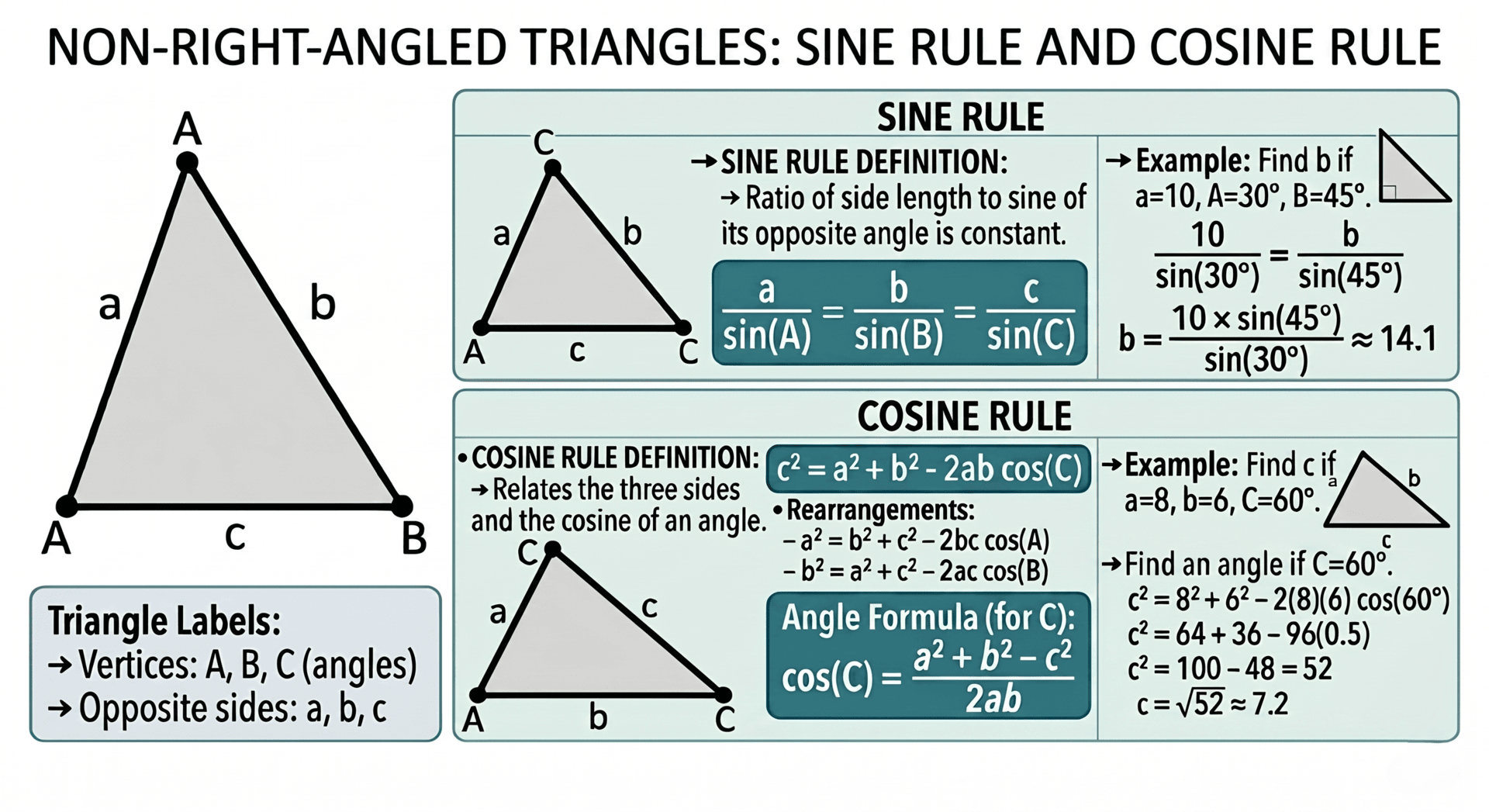
For non-right-angled triangles, we label the vertices with capital letters (A, B, C) and the opposite sides with lowercase letters (a, b, c).
The Sine Rule
Use this when you have "matching pairs" (an angle and its opposite side):
The Cosine Rule
Use this for more complex setups.
- To find a side:
- To find an angle:
When to Use Each Formula
| Scenario | Known Information | Rule to Use |
|---|---|---|
| Right-angled triangle | Two sides known | Pythagoras |
| Right-angled triangle | One side and one angle known | SOH CAH TOA |
| Any triangle | Two sides and included angle | Area = 1/2 ab sin C |
| Any triangle | A matching side/angle pair | Sine Rule |
| Any triangle | Three sides known (SSS) | Cosine Rule (Angle) |
| Any triangle | Two sides and included angle (SAS) | Cosine Rule (Side) |
Worked Examples
Example 1: Pythagoras' Theorem
Question: A right-angled triangle has sides of 5 cm and 12 cm. Find the hypotenuse. Solution:
- Identify sides: a = 5, b = 12.
- Apply formula:
Example 2: The Sine Rule
Question: In triangle ABC, angle A = 40, angle B = 60, and side a = 10 cm. Find side b.
Apply Sine Rule:
Rearrange:
Practice Questions and Solutions
Find the length of the hypotenuse in a right-angled triangle with shorter sides of 3 cm and 4 cm.
Identify the sides:

Apply Pythagoras:




Calculate the area of a triangle where side a = 8 cm, side b = 10 cm, and the included angle C = 30 degrees.
Use the trigonometric area formula:
Substitute the values:

Since sin(30) is 0.5:


In triangle ABC, a = 7 cm, b = 10 cm, and angle C = 60 degrees. Find the length of side c using the Cosine Rule.
Apply the Cosine Rule for a side:

Substitute the values:





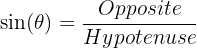
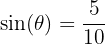
Use SOH CAH TOA to find the angle theta in a right-angled triangle where the Opposite side is 5 cm and the Hypotenuse is 10 cm.
Identify the correct ratio (Sine):
Substitute the values:
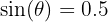
Find the inverse sine:


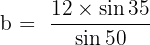
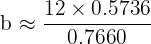
In triangle ABC, side a = 12 cm, angle A = 50 degrees, and angle B = 35 degrees. Find side b using the Sine Rule.
Apply the Sine Rule:
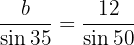
Rearrange to solve for b:
Calculate the value:

Summarise with AI:
Did you like this article? Rate it!


 Loading...
Nice emma really precise information.. I appreciate u
Hey Raptor! Thanks very much for the positive feedback, very much appreciated!
explains everything for a child or a confused student in their ap maths class who is lost in the more detailed mathematics
Draw all types of polygon and its area and perimeter class 7th NCERT course
I’m just curious if the area between the polygon and the circumscribed circle has a name.
https://www.superprof.co.uk/resources/academic/maths/geometry/plane/orthocenter-centroid-circumcenter-and-incenter-of-a-triangle.html
Draw all types of polygon and its area and perimeter