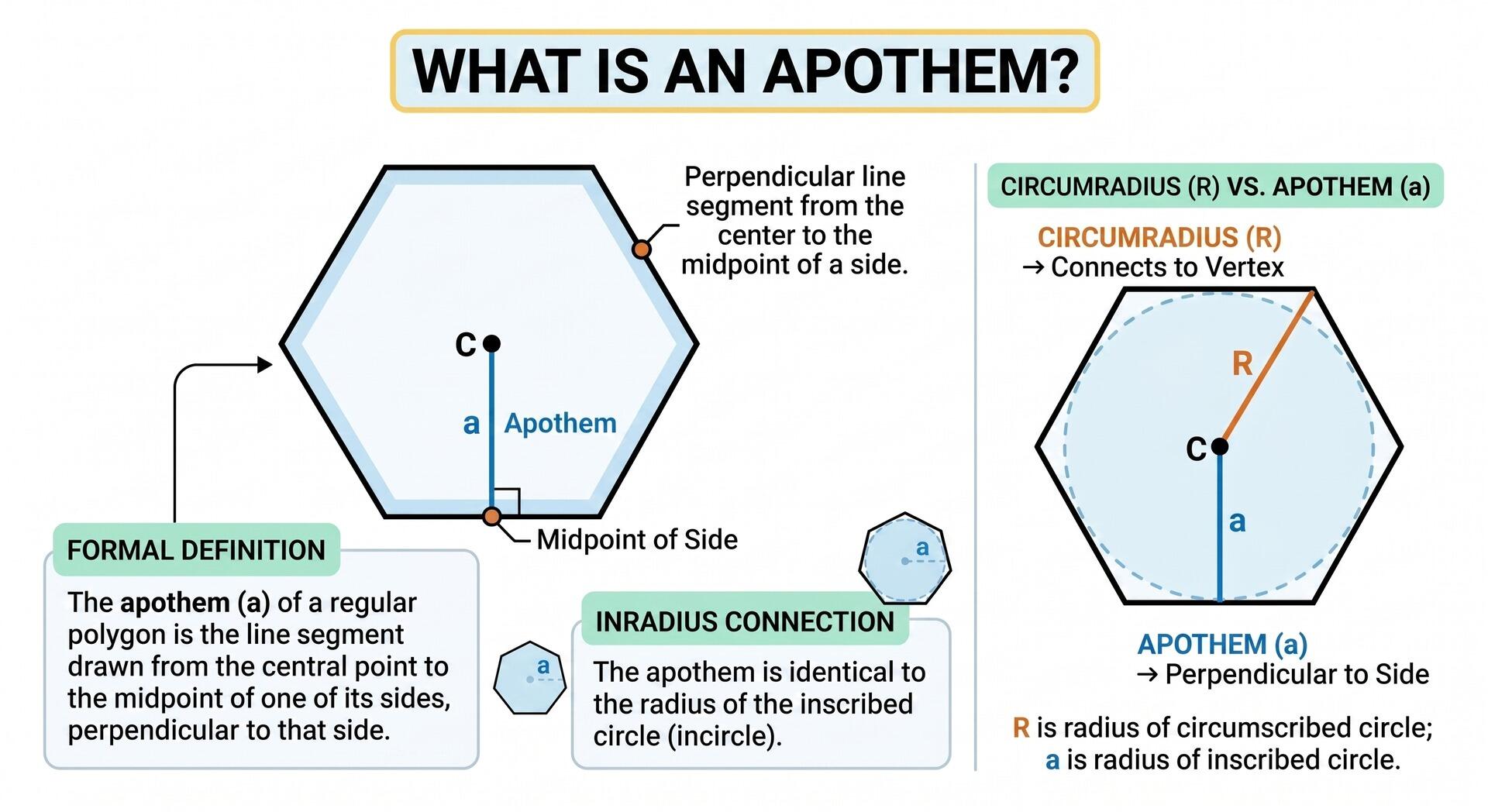
In geometry, a regular polygon is a two-dimensional closed shape with equal side lengths (equilateral) and equal interior angles (equiangular). Every regular polygon has a distinct geometric centre. The straight-line perpendicular distance from this central point to the midpoint of any outer side is known as the apothem.
Understanding the apothem is a key topic across GCSE and A-Level Mathematics (Edexcel, AQA, OCR). The apothem serves as the height of the internal triangles that construct the polygon, providing the simplest method to calculate the area of complex polygons such as pentagons, hexagons, and octagons.


What is an Apothem?
Formal Definition:
The apothem (a) of a regular polygon is the line segment drawn from the central point of the polygon perpendicular to the midpoint of one of its sides.
Inradius Connection: The apothem is identical to the radius of the inscribed circle (incircle) that sits perfectly inside the polygon, tangent to all its sides.
Circumradius (R) vs. Apothem (a): The circumradius connects the centre to a vertex, while the apothem connects the centre perpendicularly to the midpoint of a side.
Deriving the Apothem Formula for Any n-Sided Polygon
Any regular n-sided polygon with side length s can be partitioned into n identical isosceles triangles radiating from the centre. Bisecting one isosceles triangle forms a right-angled reference triangle with:
- Hypotenuse: Circumradius (R)
- Adjacent side: Apothem (a)
- Opposite side: Half-side length
- Half-central angle:
A. Formula Using Side Length (s)
Using the tangent trigonometric ratio:
Rearranging for the apothem a:
B. Formula Using Circumradius (R)
Using the cosine trigonometric ratio:
C. Formula Using Pythagoras' Theorem
When both the circumradius Rand side length s are known:
Calculating the Area of a Regular Polygon Using the Apothem
Because a regular polygon consists of n congruent triangles, each with base s and height a:
Since the perimeter is :
Universal Area Formula for Regular Polygons:
Apothems of Common Regular Polygons
- Square (n = 4):The centre splits the square evenly. The apothem is exactly half the side length:
- Regular Hexagon (n = 6):A regular hexagon splits into 6 equilateral triangles. Therefore, the circumradius equals the side length (R = s).
- Equilateral Triangle (n = 3):
- Regular Pentagon (n = 5):
Exam Focus & Common Pitfalls
Examiner Tip #1: Hexagon Side Length Equals Circumradius
In exam questions on regular hexagons, remember that each interior central triangle is equilateral. This means the side length always equals the circumradius (s = R).
Examiner Tip #2: Check Calculator Angle Mode
When calculating trigonometric values such as , ensure your calculator is set to Degrees (DEG) mode. If working with radians, use in Radians (RAD) mode.
Common Pitfall: Confusing the Apothem with the Radius
- Apothem (a): Distance to the midpoint of a side (always forms a angle with the side).
- Radius (R): Distance to a corner / vertex.The apothem is always strictly shorter than the circumradius (a < R).
Practice Questions & Solutions
Calculate the apothem and area of a square with a side length of 14cm.
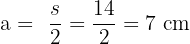
Step 1: Calculate the apothem.
Step 2: Calculate the perimeter.

Step 3: Calculate the area using the apothem formula.

A regular hexagon is inscribed in a circle of radius R = 10cm. Find its exact apothem and calculate its total area.
Step 1: Identify geometric relationships.
For a regular hexagon, side length s = R = 10cm.
Half-side length is:

Step 2: Calculate the apothem using Pythagoras' Theorem.

Step 3: Calculate the total area.


Find the apothem and area of a regular pentagon with side length s = 8cm, giving your answers to 2 decimal places.
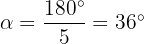
Step 1: Calculate the half-central angle.
Step 2: Apply the tangent formula for the apothem.

Step 3: Calculate the area.


A regular octagon has an apothem of a = 6cm. Determine its side length s and total area to 2 decimal places.
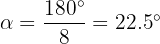
Step 1: Determine the half-central angle.
Step 2: Rearrange for side length s.


Step 3: Calculate perimeter and area.


An equilateral triangle has a side length of s = 12cm. Find its circumradius R and apothem a, and verify the ratio 
Step 1: Calculate the apothem a.

Step 2: Calculate the circumradius R.
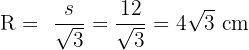
Step 3: Compare ratio.
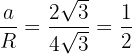
(In any equilateral triangle, the apothem is always exactly half the circumradius).
Summarise with AI:
Did you like this article? Rate it!


 Loading...
Nice emma really precise information.. I appreciate u
Hey Raptor! Thanks very much for the positive feedback, very much appreciated!
explains everything for a child or a confused student in their ap maths class who is lost in the more detailed mathematics
Draw all types of polygon and its area and perimeter class 7th NCERT course
I’m just curious if the area between the polygon and the circumscribed circle has a name.
https://www.superprof.co.uk/resources/academic/maths/geometry/plane/orthocenter-centroid-circumcenter-and-incenter-of-a-triangle.html
Draw all types of polygon and its area and perimeter