From the honeycomb of a beehive to the architecture of the Pentagon, polygons are the building blocks of our world. In geometry, a polygon is any two-dimensional shape formed by at least three straight line segments that close in a loop.
While a triangle or a square might feel simple, understanding the relationship between the sides of a polygon and its internal angles is a vital skill for GCSE maths. Whether you are calculating the strength of a bridge or the tiling of a floor, these formulas are your secret weapon.


Number of Sides and Naming Polygons
Polygons are classified primarily by the number of sides they possess. We generally distinguish between regular polygons (where all sides and angles are equal) and irregular polygons (where they are not).
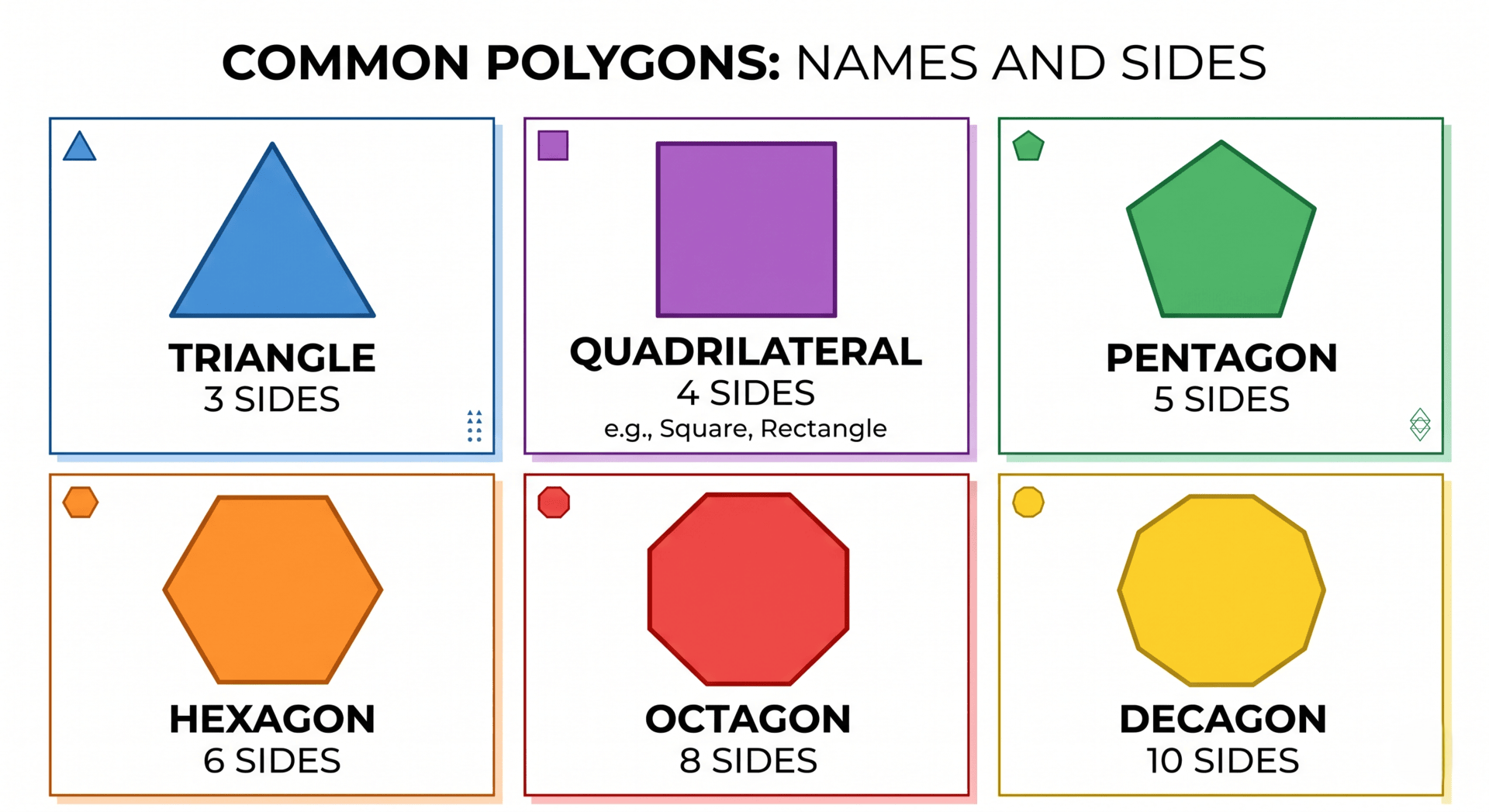
The naming convention usually involves a Greek prefix followed by "-gon." Here is a quick reference for the most common polygons you will encounter:
| Number of Sides | Name | Sum of Interior Angles | Interior Angle (Regular) |
|---|---|---|---|
| 3 | Triangle | 180 | 60 |
| 4 | Quadrilateral | 360 | 90 |
| 5 | Pentagon | 540 | 108 |
| 6 | Hexagon | 720 | 120 |
| 8 | Octagon | 1080 | 135 |
| 10 | Decagon | 1440 | 144 |
| 12 | Dodecagon | 1800 | 150 |
Interior Angle Formula Explained
Why does the sum of the angles in a triangle equal 180° and a quadrilateral equal 360°? The secret lies in triangulation. Any polygon with n sides can be split into n - 2 triangles by drawing lines from one vertex to all others.
Since every triangle contains 180°, we get the Sum of Interior Angles formula:
For a regular polygon, where every angle is the same, you can find the size of a single interior angle by dividing the sum by the number of sides:
Exterior Angles and Key Rules
An exterior angle is formed by extending one of the sides of the polygon outwards. There are two golden rules to remember for exterior angles:
- The Linear Pair Rule: At any vertex, the interior angle and the exterior angle must add up to 180° because they sit on a straight line. Interior + Exterior = 180°
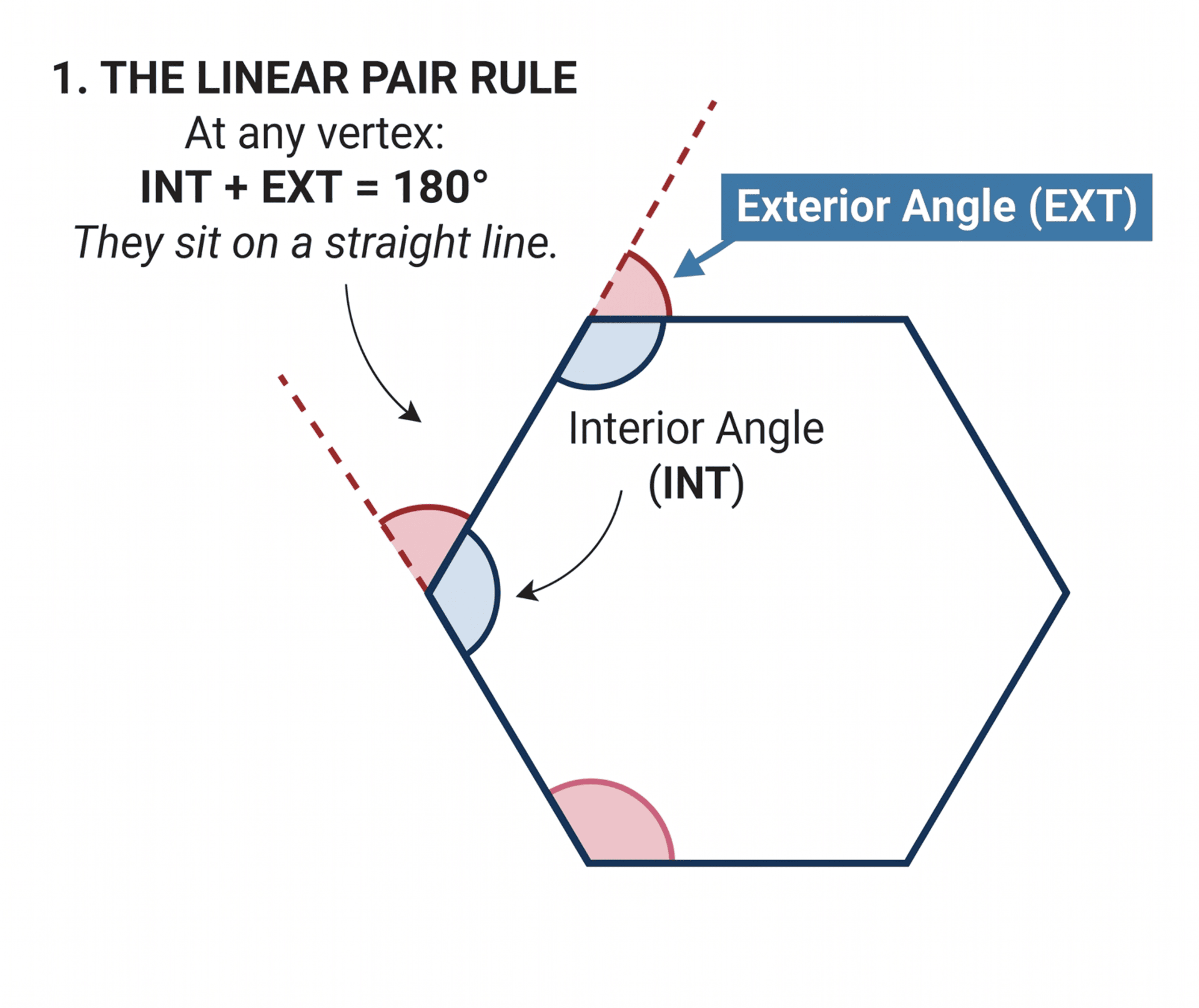
- The Full Circle Rule: For any convex polygon, no matter how many sides it has, the sum of all exterior angles is always 360°.
For a regular polygon, finding a single exterior angle is as simple as:
Finding the Number of Sides
Exam questions often flip the script: they give you an angle and ask you to find the number of sides of a polygon.
The easiest way to do this is to use the exterior angle. Even if the question gives you an interior angle, subtract it from 180° first to find the exterior angle. Then, use this rearrangement:
Polygon: A two-dimensional shape formed by at least three straight line segments that close in a loop
Regular Polygon: A polygon with sides that are all equal in length and interior angles that are all equal in size.
Interior Angle: An angle measured on the inside of a shape where two adjacent sides meet at a corner.
Exterior Angle: An angle measured on the outside of a shape between a side and the line extended from an adjacent side.
Worked Example
Problem: A regular polygon has an interior angle of 144°. Calculate how many sides the polygon has.
Step 1: Find the exterior angle. Since the interior and exterior angles sum to 180°:
The exterior angle is 36.
Step 2: Use the exterior angle sum formula. We know all exterior angles sum to 360°.
Result: The polygon is a decagon (10 sides).
Practice Questions and Solutions
Calculate the sum of the interior angles for a polygon with 15 sides.
Use the interior angle sum formula:

Substitute n = 15:



The sum of the interior angles is 2340 degrees.
A regular polygon has 8 sides (an octagon). Calculate the size of one of its interior angles.
First, find the sum of the interior angles:

Since it is a regular polygon, divide the sum by the number of sides:
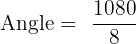

Each interior angle is 135 degrees.
The exterior angle of a regular polygon is 40°. How many sides does it have?
Use the formula for the number of sides based on the exterior angle:
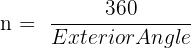


The polygon has 9 sides (a nonagon).
An interior angle of a regular polygon is 156°. Find the number of sides.
First, find the exterior angle:

Now, find the number of sides:


The polygon has 15 sides.
Three angles in a pentagon are 100°, 110°, and 120°. The remaining two angles are equal to each other. Calculate the size of one of the remaining angles.
First, find the total sum of interior angles for a pentagon (n = 5):

Subtract the known angles from the total:

Since the remaining two angles are equal, divide the remainder by 2:

Each of the remaining angles is 105 degrees.
A regular polygon has an exterior angle of 30° degrees. Identify the name of this polygon based on the number of sides.
To find the number of sides, use the exterior angle sum rule:
Substitute the given angle:


A polygon with 12 sides is called a dodecagon.
An irregular hexagon has five interior angles that each measure 130° degrees. Calculate the size of the sixth interior angle.
First, calculate the total sum of interior angles for a hexagon where n = 6:


Calculate the total of the five known angles:

Subtract this from the total sum to find the missing angle:

The sixth angle is 70 degrees.
For a regular polygon, the ratio of an interior angle to an exterior angle is 7 to 2. Determine the number of sides of the polygon.
We know that the interior and exterior angles sum to 180 degrees. Let the angles be 7k and 2k:



Find the size of the exterior angle:


Now, find the number of sides:
The polygon has 9 sides.
The interior angles of a quadrilateral are given as x, x + 20, 2x - 10, and x + 30. Find the value of x.
The sum of interior angles for any quadrilateral is 360 degrees. Set up the equation:

Combine the like terms:

Subtract 40 from both sides:

Divide by 5:


The value of x is 64.
A regular polygon has an interior angle sum of 3240 degrees. If each side of the polygon measures 8 cm, calculate the total perimeter of the shape.
First, find the number of sides (n) using the sum formula:

Divide by 180:
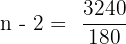


Now that we know the polygon has 20 sides, calculate the perimeter:


The perimeter of the polygon is 160 cm.
Summarise with AI:
Did you like this article? Rate it!


 Loading...
Nice emma really precise information.. I appreciate u
Hey Raptor! Thanks very much for the positive feedback, very much appreciated!
explains everything for a child or a confused student in their ap maths class who is lost in the more detailed mathematics
Draw all types of polygon and its area and perimeter class 7th NCERT course
I’m just curious if the area between the polygon and the circumscribed circle has a name.
https://www.superprof.co.uk/resources/academic/maths/geometry/plane/orthocenter-centroid-circumcenter-and-incenter-of-a-triangle.html
Draw all types of polygon and its area and perimeter