



What is Probability?
Probability measures how likely an event is to occur. It is expressed as a number between 0 and 1:
- A probability of 0 means the event is impossible.
- A probability of 1 means the event is certain.
- All other probabilities fall somewhere in between.
We write this as:

where  is an event and
  is the probability that event occurs.
The basic probability formula for equally likely outcomes is:

The set of all possible outcomes is called the sample space. For example, if you toss two coins simultaneously, the sample space is:

This is an example of simple probability — we are calculating the likelihood of a single event from a known set of outcomes.
Compound Probability
Compound probability deals with finding the probability that at least one of two (or more) events occurs. This uses the addition rule:

where:
- is the probability that event A occurs
 is the probability that event B occurs
 is the probability that both A and B occur simultaneously
We subtract to avoid counting outcomes that belong to both events twice.
Special case — mutually exclusive events: If A and B cannot happen at the same time (e.g. rolling a 3 and a 6 on a single die), then  , and the formula simplifies to:

Worked Examples
Example 1
In a class, there are 30 girls and 15 boys. Of the 30 girls, 20 like football and 10 like badminton. Of the 15 boys, 10 like football and 5 like badminton. A student is selected at random. Find the probability that the student is:
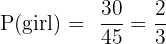
(a) a girl
(b) a boy who likes football
(c) a girl or a boy
Solution
Total number of students = 30 + 15 = 45.
(a) Number of girls = 30.
(b) Number of boys who like football = 10.

(c) Every student is either a girl or a boy, so this event is certain:

Example 2
John rolls a standard six-sided die. What is the probability of getting a 3 or a 6?
Solution
These two events are mutually exclusive — you cannot roll both a 3 and a 6 on a single die. So:

The individual probabilities are:

Applying the addition rule:


Example 3
Find the probability of selecting a red card or a 2 from a standard deck of 52 cards.
Solution
First, recall how a standard deck is structured: there are 4 suits (2 red and 2 black), each with 13 cards (Ace through 10, plus Jack, Queen, King).
Number of red cards = 
Number of cards showing a 2 = 4 (one per suit)
Number of cards that are both red and a 2 = 2 (the 2 of hearts and the 2 of diamonds)
The individual probabilities are:

Applying the addition rule:

Example 4
A pool contains 20 balls and 40 blocks. Of the 20 balls, 10 are red and 10 are blue. Of the 40 blocks, 15 are green, 10 are red, and 15 are blue. An item is picked at random. Find the probability that it is:
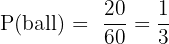
(a) a ball
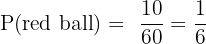
(b) a red ball
(c) a blue-coloured object
Solution
Total number of items = 20 + 40 = 60.
(a) Number of balls = 20.
(b) Number of red balls = 10.
(c) Blue objects include 10 blue balls and 15 blue blocks = 25 blue objects.

Example 5
Alice rolls a standard six-sided die. What is the probability that the number shown is a multiple of 2?
Solution
The multiples of 2 on a die are 2, 4, and 6 — that is, 3 favourable outcomes out of 6.

Example 6
A bag contains 5 red marbles, 3 blue marbles, and 2 green marbles. Two marbles are drawn at random without replacement. What is the probability that both marbles are red?
Solution
Total marbles = 5 + 3 + 2 = 10.
The probability of drawing a red marble first is:
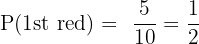
After removing one red marble, there are 4 red marbles left out of 9 total:

Using the multiplication rule for dependent events:

Example 7
A class has 12 boys and 18 girls. 5 boys and 8 girls wear glasses. A student is selected at random. What is the probability that the student is a boy or wears glasses?
Solution
Total students = 12 + 18 = 30.
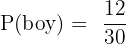


Applying the addition rule:

Example 8
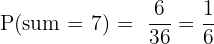
Two dice are rolled simultaneously. What is the probability that the sum of the numbers is 7?
Solution
When rolling two dice, the total number of outcomes is  .
.
The combinations that give a sum of 7 are: (1,6), (2,5), (3,4), (4,3), (5,2), (6,1) — that is, 6 favourable outcomes.
Example 9
A box contains 8 chocolates: 3 are milk chocolate, 3 are dark chocolate, and 2 are white chocolate. Emma picks two chocolates at random without replacement. What is the probability that she picks one milk and one dark chocolate (in any order)?
Solution
There are two possible orderings: milk first then dark, or dark first then milk.
Case 1 — milk then dark:

Case 2 — dark then milk:

Since these cases are mutually exclusive, we add them:

Example 10
In a school survey, 60% of students like maths, 45% like science, and 25% like both maths and science. A student is chosen at random. Find the probability that the student likes maths or science.
Solution
Let M be the event "likes maths" and S be the event "likes science".

Applying the addition rule:


The probability that a randomly chosen student likes maths or science is 0.80, or 80%.
Summarise with AI:
Did you like this article? Rate it!


 Loading...