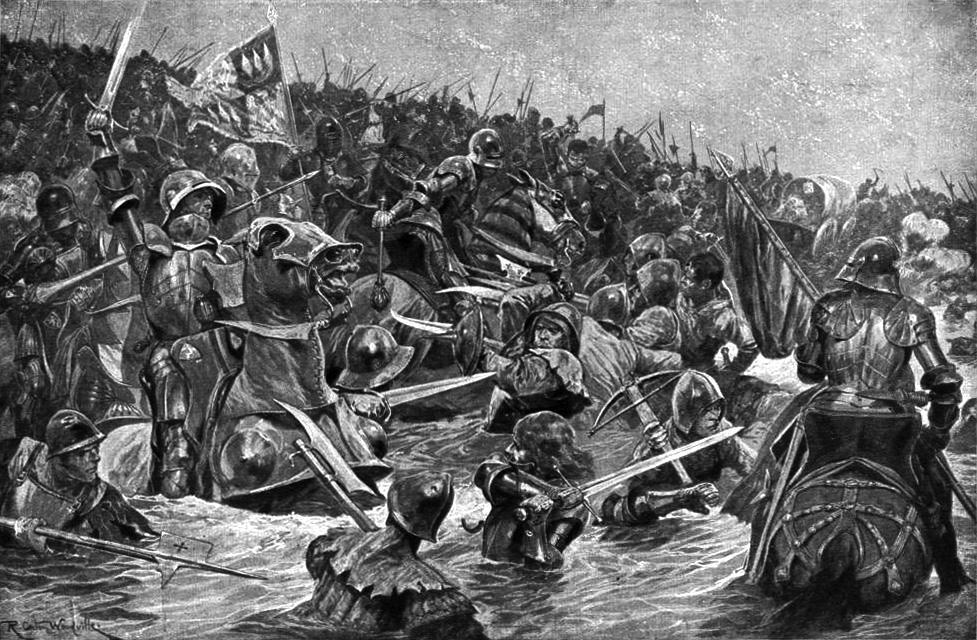
In the tumultuous era of 15th-century England, the War of the Barons, also known as the Wars of the Roses, unfolded as a dramatic saga of political intrigue, shifting loyalties, and bloody conflict.
In the years leading up to the Wars of the Roses, there had been a Lancastrian dynasty in England.
Between 1455 and 1459 we saw numerous rebellions. The Duke of York had gathered his forces in the North in 1455, and he met the king at St. Albans to try to make a deal. However, after unsuccessful negotiations, the Yorkist forces fought the king's, and a Yorkist victory ensued.
In 1459, Richard, Grand Duke of York, responded to the Queen’s preparations to plan an attack against him, and rebelled.
The renewal of war in 1459 marked a decisive turning point in the simmering tensions between the rival houses of York and Lancaster. Following a series of political manoeuvres and skirmishes, Richard, Duke of York, found himself forced into exile, fleeing the realm in the face of Lancastrian aggression.
Yorkists fled without fighting when faced with a royal force at Ludford Bridge, but the Lancastrians didn’t make the most of the opportunity they may have had.
As York sought refuge abroad, a new figure emerged on the English stage – Richard Neville, Earl of Warwick, better known as "the Kingmaker." Warwick's strategic brilliance and military prowess soon earned him a reputation as one of the most influential figures in the realm.





Capture of Henry VI
In July 1460, forces loyal to Richard, Duke of York, and his ally, the Kingmaker Richard Neville, Earl of Warwick, confronted the Lancastrian army led by Henry VI at the Battle of Northampton (so-called because the battle took place near the town of Northampton).
During the battle, many Lancastrian leaders, including the Duke of Buckingham, Lord Egremont, the Earl of Shrewsbury, and Viscount Beaumont were all killed in a crucial victory for the Yorkists.
Amid huge casualties, Henry VI was taken by the Yorkists. The capture of King Henry VI was a significant coup for the Yorkist cause, as it dealt a severe blow to the Lancastrian faction and bolstered the morale of the Yorkist forces. With Henry in their custody, the Yorkists sought to leverage their advantage to advance their claim to the throne and undermine the Lancastrian hold on power.
York Becomes Protector
After a spell in Ireland, the Duke of York returned to England and acted as King. He marched with a banner showing the coat of arms of England, which was a symbol of royal authority, and he had his sword carried upright in front of him as he entered London.
In October of 1460, a Parliament was called to meet and they repealed all the laws that were made in the previous year's Parliament in Coventry. On October 10th, York arrived in London and stayed in the royal palace. When he went to Parliament, he walked straight to the empty throne and put his hand on it, as if to claim it for himself.
Thomas Bourchier, the Archbishop of Canterbury asked if York wanted to see the king, but York replied proudly, saying that everyone should come to him instead of the other way around.
"I know of no person in this realm the which oweth not to wait on me, rather than I of him."
This didn't impress the Lords.
The next day, York formally claimed the crown as his right. But since not many of his peers supported him, his claim failed. After weeks of talks and debates in the House of Lords, they agreed to something called the Act of Accord. This recognised York and his children as the next kings after Henry.
However, in October 1460, Parliament gave York a lot of power to protect the country. They made him Lord Protector of England and gave him the money and land that belonged to the Prince of Wales, who was Henry's son.
With Henry basically a prisoner, York and Warwick were the ones effectively running the country and its government in this tumultuous time.
A Brief Lancastrian Revival
The Lancastrian revival gained momentum with a series of decisive battles that rocked the realm. The Battle of Wakefield in December 1460 proved to be a setback for the Yorkists, as Richard of York met his untimely demise on the battlefield.
The second Battle of St Albans further solidified the Lancastrian cause, paving the way for the restoration of Henry VI to the throne.
Yet, amidst the chaos and bloodshed, a new contender emerged – Edward, son of Richard of York, who proclaimed himself King Edward IV. Bolstered by the support of loyal followers and battle-hardened veterans, Edward rallied the Yorkist forces and prepared for a showdown that would determine the fate of the country and the kingship.
The Yorkist Position in 1461
On one hand, the Yorkists possessed formidable military commanders, such as Warwick 'the Kingmaker,' whose strategic genius and tactical acumen bolstered their chances of success. Additionally, the Yorkist faction enjoyed widespread support among the nobility, drawing upon powerful allies and influential backers to bolster their ranks.
However, the Yorkists also faced significant challenges and vulnerabilities. Internal divisions and rivalries threatened to undermine their power, as ambitious nobles vied for power and influence within the faction. The Lancastrian cause remained resilient, with loyalists rallying behind the banner of Henry VI and continuing to resist Yorkist advances.
The Battle of Towton
The battle of Towton brought the conflict to a head, and was brutal and protracted, lasting for hours and fought in harsh winter conditions. It is estimated that tens of thousands of soldiers were involved, making it one of the largest battles of the mediaeval period. The fighting was fierce, with both sides suffering heavy casualties as they clashed repeatedly on the snow-covered battlefield.
Ultimately, the Yorkist forces emerged victorious at Towton, securing a decisive triumph over the Lancastrians. Edward IV's army succeeded in breaking through the Lancastrian lines and routing their opponents, driving them from the field in disarray.
The defeat at Towton dealt a devastating blow to the Lancastrian cause, resulting in the collapse of their political and military influence. Many prominent Lancastrian supporters were killed or captured in the battle, weakening their ability to resist Yorkist rule. Edward IV was able to claim the throne as a result of this bloody and devastating battle.
Summarise with AI:
Did you like this article? Rate it!

 Loading...