In this article, we will discuss structure of fluid mosaic membrane, arrangement of various materials in cell surface membrane, and role of different components. So, let us get started.


Introduction
Membranes are important structures that are present in all cells. The cell surface membrane forms an enclosed region that segregates the internal cell environment from the external one. The intracellular membranes create partitions within the cell-like RER, mitochondria, and nucleus.
Membranes not only segregate various regions but also maneuver the exchange of materials across them. Besides this, they also play the role of interface for communication. Membranes are partially permeable, and substances can enter them through osmosis, diffusion, and active transport.
The structure of cell membranes in all organisms is the same. Different types of molecules such as phospholipids, cholesterol, and glycolipids are present in the cell membranes. The two types of proteins present in the cell membranes include glycoprotein that contains carbohydrates and other proteins which include transport proteins.
In the next section, we will discuss the structure of the fluid mosaic model membrane concerning hydrophobic and hydrophilic interactions.
Structure of Fluid Mosaic Membrane
Cell membranes are composed of a phospholipid bilayer that also has proteins. The proteins in the phospholipid bilayer can be either:
- Intrinsic (Integral): These proteins are embedded in the membrane. Hydrophobic and hydrophilic compartments determine their arrangement.
- Extrinsic (Peripheral): These proteins are present on the inner or outer surface of the membrane.
According to the fluid mosaic model, cell membranes are fluid because of the following reasons:
- The proteins and phospholipids can move around through diffusion.
- The movement of phospholipids is generally sideways within their layers.
- Several different types of proteins scatter throughout the bilayer and move about within it just like the icebergs in the sea. Some may have a fixed position.
According to the fluid mosaic model, cell membranes are mosaics because:
- Proteins create a scattered pattern within the phospholipid bilayer which somewhat seems like a mosaic when seen from above
- In the next section of the article, we will discuss components of cell surface membranes which include phospholipids, cholesterol, glycolipids, glycoproteins, and proteins.
Components of Cell Surface Membrane
Phospholipids
Phospholipids create a bilayer, i.e. two layers of phospholipid molecules. They have:
- Hydrophobic tails, i.e. fatty acid chains that point towards the interior of the membrane
- Hydrophilic heads, i.e. phosphate groups that point out towards the surface of the membrane
A single phospholipid molecule can move around within its monolayer through the process of diffusion.
Cholesterol
These molecules also contain hydrophilic heads and hydrophobic tails. They lie between phospholipid molecules and are aligned in the same way, i.e. head out and tail in. Membranes in prokaryotes do not contain these molecules.
Glycolipids
They refer to the lipids with attached chains of carbohydrates. These chains project out into any fluid that surrounds the cell as they are present on the outer phospholipid monolayer.
Glycoproteins
Glycoproteins refer to the proteins with an attached chain of carbohydrate. Like glycolipids, these chains also project out into any fluid that surrounds the cell. They are present on the outer phospholipid monolayer.
Proteins
Proteins can be intrinsic or extrinsic. Intrinsic proteins are embedded within the membrane and are also known as integral proteins. Proteins that are present on the inner or outer surface of the membrane are called extrinsic or peripheral proteins. Transmembrane proteins refer to the proteins that span the whole membrane. An example of transmembrane is transport proteins as they cross the entire membrane.
In the next section of the article, we will discuss the role of the above-discussed components in cell surface membranes.
Role of Various Components in Cell Surface Membranes
Phospholipids
Structurally phospholipids have two different compartments: a polar head and two non-polar tails. A phospholipid has a polar, i.e., hydrophobic phosphate head that is insoluble in water.
What is a phospholipid monolayer?
If spread in water, phospholipids create not only an individual layer with the hydrophilic phosphate heads in the water but also the hydrophobic fatty acid tails that stick up away from the water. This is referred to as a phospholipid monolayer.

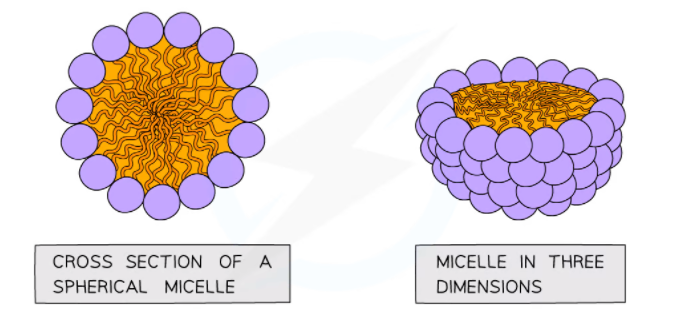
What is micelle?
When mixed with water, the phospholipids create spheres with the hydrophilic phosphate heads that face out towards the water and hydrophobic fatty acids tails that face in towards each other. This is known as a micelle.
What are phospholipid bilayers?
The two-layered structures may create in sheets which are referred to as phospholipid bilayers. This is the primary structure of the cell membrane. The phospholipid bilayers can create the regions.
Membrane-bound regions created from phospholipid bilayers give the primary structure of organelles, enabling the specialization of processes within the cell. Lysosome which is present in animal cells is an example of a membrane-bound organelle that has several hydrolytic enzymes that break down several different types of biomolecules. The enzymes should be kept compartmentalized to prevent the breakdown of the majority of the cellular components.
What Role do Phospholipids play in cell surface membranes?
They act as a barrier to the majority of the water-soluble substances such as the non-polar fatty acid tails that stop the polar ions or molecules to pass across the membrane. It prevents the leaking out of water-soluble molecules like amino acids, sugars, and proteins from the cell. It also ensures that the undesired water-soluble molecules cannot enter the cell.
They can be altered chemically to play the role of signaling molecules by:
- Moving inside the bilayer to activate other molecules such as enzymes
- Being hydrolyzed so that tiny water-soluble molecules can be released that can bind to certain receptors in the cytoplasm.
Cholesterol
It enhances the fluidity of the membrane and prevents it from becoming extremely rigid at low temperatures (enabling the cells to survive at lower temperatures)
This happens because cholesterol prevents the phospholipid tails from packing extremely close. Cell membranes also stabilize at higher temperatures when cholesterol and phospholipid tails interact with each other. It prevents the membrane from becoming extremely fluid.
When the molecules of cholesterol bind to the hydrophobic tails of phospholipids, they stabilize them and ensure that phospholipids pack more closely together. They also ensure that the membrane is impermeable to ions. In addition to this, they enhance the stability and mechanical strength of the membranes.
Glycolipids & Glycoproteins
Glycolipids and glycoproteins have chains of carbohydrates that are present on the surface. These chains enable glycolipids and glycoproteins to act as receptor molecules. This enables the glycoproteins and glycolipids to bind with specific substances at the surface of the cell. The receptors are of three types:
Signaling receptors for neurotransmitters and hormones
- Receptors that are involved in endocytosis
- Receptors are involved in stabilization and cell adhesion
Few glycolipids and glycoproteins play the role of cell markers or antigens for cell-to-cell recognition. For instance, ABO blood group antigens are glycoproteins and glycolipids that are minute differences in their carbohydrate chains.
Proteins
Transport proteins form hydrophilic channels to enable polar molecules and ions to move through the membrane. There are two kinds of transport proteins:
- Channel (pore) proteins
- Carrier proteins
Each transport protein is meant for a specific molecule or ion. These proteins enable the cell to control which substances should enter or leave.
Summarise with AI:
Did you like this article? Rate it!


 Loading...