In this article, we will discuss the sucrose loading mechanism and phloem mass flow. We will especially discuss how companion cells move assimilates to phloem sieve tubes, with reference to proton pumps and cotransporter proteins. Moreover, we will also explain mass flow in phloem sieve tubes down a hydrostatic pressure gradient from source to sink. So, let us start with our first topic “the sucrose loading mechanism”.


The Sucrose Loading Mechanism
Phloem sieve tubes move assimilates like sucrose from source to sink.
Plants move carbohydrates in the form of sucrose because of the following reasons:
- Transporting carbohydrates in the form of sucrose allows for efficient energy transfer and enhanced energy storage. This is because the sucrose is a disaccharide and hence it has more energy
- The second reason is the less reactive nature of sucrose as compared to glucose. Sucrose is a non-reducing sugar so when it is being moved, there are no intermediate reactions.
Now, let us discuss the loading of assimilates like sucrose.
Loading of Assimilates
Scientists have not yet comprehended the pathway used by the sucrose molecules to travel to the sieve tubes. The transportation of molecules may occur through the:
- Simplistic pathway (via the cytoplasm and the plasmodesmata). It is a passive process because the movement of sucrose molecules occurs through diffusion.
- Apoplastic pathway (via the cell walls). It is an active process.
If the sucrose molecules take the apoplastic pathway, then the modified companion cells also referred to as transfer cells, pump hydrogen ions out of the cytoplasm through the proton pump and into their cell walls. Unlike the first process discussed above, i.e. the simplistic pathway, the apoplastic pathway is an active process and hence it required ATP as a source of energy.
There is a huge concentration of hydrogen ions in the cell wall of the companion cells. Due to this, the hydrogen ions move down the concentration gradient back to the cytoplasm of the companion cell.
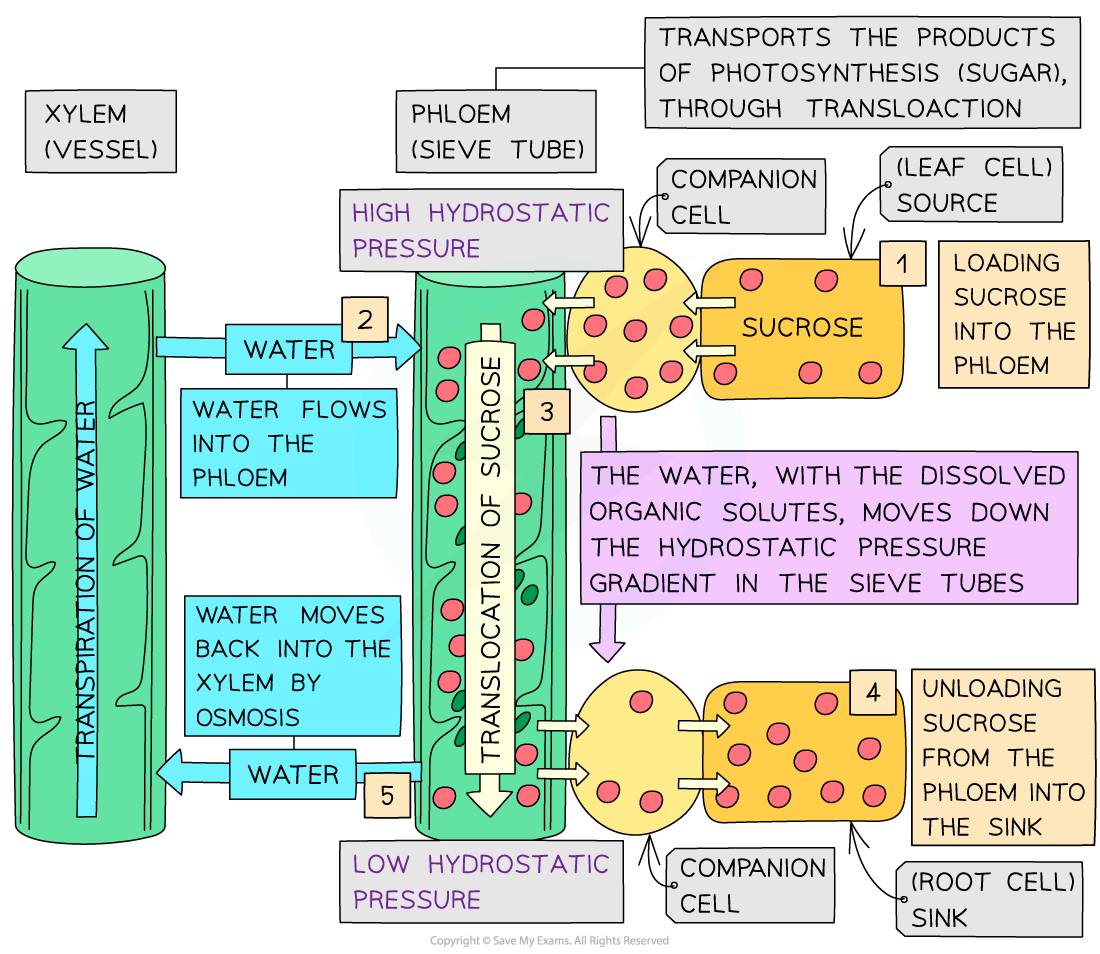
The movement of hydrogen ions occurs through a cotransporter protein. When hydrogen ions are transported, this protein also takes sucrose molecules into the companion cell against the concentration gradient for sucrose. After that, the sucrose molecules are moved into the sieve tubes through the plasmodesmata from the companion cells.
Companion cells increase their available surface area through the infoldings in their cell surface membrane for the active transport of several mitochondria and solutes to provide energy for the proton pump. This mechanism allows a few plants to build up sucrose in the phloem to almost three times the concentration of that in the mesophyll.
Now, we will discuss the unloading of assimilates.
Unloading of Assimilates
The unloading of assimilates takes place at the sinks. According to the scientists, the unloading of sucrose resembles the loading of sucrose as the sucrose is actively transported out of the companion cells and then moved out of the phloem tissue through apoplastic and symplastic pathways.
Sucrose is converted into other molecules so that a concentration gradient in the sink tissue is maintained. Since this is a metabolic reaction, hence it needs enzymes, for instance, invertase which hydrolyses sucrose into glucose and fructose.
In the next section of the article, we will discuss phloem mass flow in detail.
Phloem Mass Flow
The Mass Flow Hypothesis was the initial model that was employed to explain how assimilates move in the phloem tissue. Ernst Munch 1930 modelled the mass flow hypothesis. His simple mass flow hypothesis model had:
- Two partially permeable membranes have solutions with varying concentrations of ions (one concentrated and the other diluted).
- He placed the two membranes in the two chambers that contained water. He then connected the membranes through a passageway.
- The two membranes were connected through a tube
- Because the water surrounded the membranes, hence it moved through osmosis across the membrane that had a more concentrated solution. It forced the concentrated solution towards the membrane that contained the more dilute solution (It was where the water was being forced out of because of the hydrostatic pressure)
Now, there is another hypothesis “the pressure-flow gradient” which is the modified version of the “mass flow hypothesis”. Scientists support the modified version of this hypothesis which is explained below in detail.
Pressure Flow Gradient
Phloem sap that contains sucrose and other organic solutes is moved through mass flow up and down the plant
We have already discussed that the carbohydrates are usually moved in the plants in the form of sucrose because of the following two reasons:
- It enables efficient transfer of energy and enhanced energy storage. This is because the sucrose is a disaccharide molecule and hence it has more energy
- Sucrose is less reactive as compared to glucose because it is a non-reducing sugar and hence no intermediate reactions take place while it is being moved
The advantage of mass flow is that it transports the organic molecules quicker than diffusion. In xylem tissue, the pressure difference that causes the mass flow takes place due to the water potential gradient between the soil and the leaf (this needs no energy input by the plant).
However, energy is needed in the phloem tissue to create the pressure differences for the mass flow of organic solutes. The active loading of sucrose into the sieve elements at the source generates this pressure difference. The source is generally a storage organ or a photosynthesizing leaf that lowers the water potential in the sap. It results in the movement of water into the sieve elements as it moves down the water potential gradient through osmosis. The water presence within the sieve elements enhances the hydrostatic or turgor pressure at the source. As the solutes like sucrose are unloaded to removed from the sieve elements, the water follows by osmosis at the sink to create a low hydrostatic pressure. As a result, the hydrostatic pressure gradient occurs.
The mass flow of water (containing the dissolved organic solutes) from the high hydrostatic pressure area to the low hydrostatic pressure area occurs due to the pressure difference between the source and the sink. The mass flow of organic solutes within the phloem tissue takes place above and below the sources (which usually are the photosynthesizing leaves). Hence, the sap flows upwards and downwards within a plant.
Summarise with AI:
Did you like this article? Rate it!


 Loading...