In this article, we will discuss the differences between structural genes and regulatory genes as well as the differences between repressible enzymes and inducible enzymes. Moreover, we will also elucidate the concept of genetic control of protein production in a prokaryote using the lac operon.
The process of protein synthesis is not going over all the time in the cell. Instead, it takes place at intervals, and after that cells experience periods of what we call genetic silence. Hence, the gene expression process is controlled and regulated by the cell.
The control of gene expression may take place at many levels in the cell. For instance, genes usually do not work during mitosis, especially when the DNA fibres are shortening and thickening to form chromatin. The inactive, compact and tightly coiled chromatin controls access to genes. Scientists have researched the concept of gene control in bacteria in detail. In microorganisms such as bacteria, the genes are classified as structural genes, regulator genes, and control genes. The control genes are also referred to as control regions. These three units create a functional unit known as an operon.


Gene Control
In each cell of the human body, the nucleus carries the same genes. However, one should remember that every gene is not expressed in every cell of the human body. There are many existing mechanisms inside the cells that ensure that the right genes are expressed in the right cell at the right time. They include regulatory genes.
In the next section of the article, we will discuss the differences between structural and regulatory genes.
Structural Vs Regulatory Genes
What is a structural gene?
A structural gene refers to a gene that codes for a protein that performs a function inside a cell. For instance, the F8 gene codes for protein Factor VIII which plays a crucial role in blood clotting.
What is a regulatory gene?
A regulatory gene refers to a gene that codes for a protein that assists in controlling the expression of another gene. Both structural and regulatory genes work in harmony and are usually present close to each other.
In the next section of the article, we will discuss the differences between inducible and repressible enzymes.
Inducible and Repressible Enzymes
There are some genes that code for proteins that result in the formation of enzymes. Some enzymes are needed all the time, whereas others are needed only at specific times.
The expression of genes that produce enzymes can be regulated.
- Inducible enzymes: These enzymes are only synthesized in the presence of their substrate. When the substrate is present, it induces the synthesis of the enzyme by starting the transcription of the gene for the enzyme.
- Repressible enzymes: The synthesis of these enzymes occurs normally until a repressor protein binds to an operator. When the receptor protein is present, it represses the synthesis of an enzyme by stopping the transcription of the gene for the enzyme.
Regulation during the synthesis of enzymes is helpful for cells because it prevents the materials and energy from being wasted. For instance, Using energy and materials for the synthesis of an enzyme in the absence of substrate and it cannot perform its function is extremely wasteful.
In the next section of the article, we will discuss the concept of genetic control of protein production in a prokaryote using the lac operon.
Gene Control: Lac Operon
As the name implies, the regulatory genes regulate (control) the structural genes and their level of protein production. Sometimes, regulatory genes can control many structural genes at a time.
In prokaryotes, structural genes can create an operon. An operon refers to a group or a cluster of genes that are controlled or regulated by the same promoter. One of the most popular examples of these is lac operon which is present in some bacteria. The lac operon regulates the production of enzyme lactase along with the two other structural proteins.
The enzyme lactase is also referred to as β-galactosidase. Lactase helps to break down the substrate lactose so that it can be employed as a source of energy in a bacterial cell. Lactase is an inducible enzyme which means that it is only synthesized in the presence of lactose. It helps stop the bacteria from wasting materials and energy.
Structure of the Lac Operon
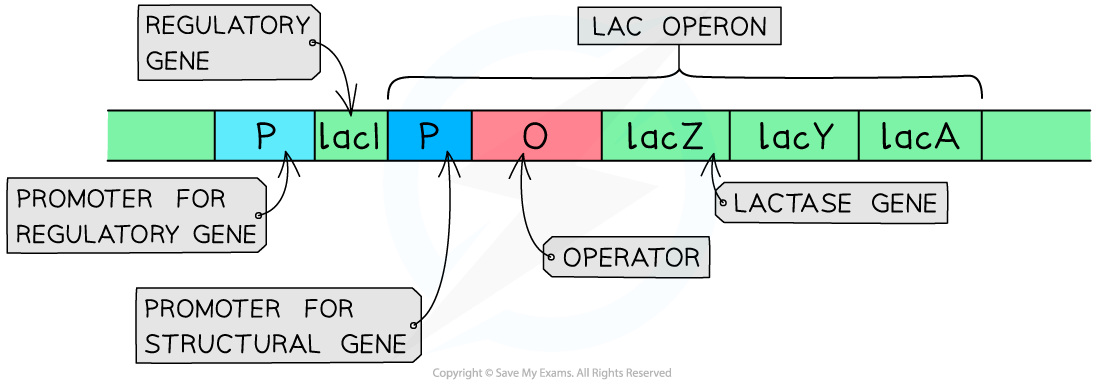
Different components of lac operon are present in the following order:
- Promotor: For structural genes
- Operator
- A structural gene lacZ that codes for lactase
- A structural gene lacY that codes for permease (enables lactose into the cell)
- A structural gene lacA that codes for transacetylase
The following components are also present to the left (upstream) of the lac operon on the bacterium's DNA
- Promoter for regulatory gene
- Regulatory gene lacI that codes for the protein called lac repressor
There are two binding sites of the lac repressor protein that enable it to bind to the operator in the lac operon and also to lactose (the effector molecule). When it binds to the operator, it stops the transcription of the structural genes because RNA polymerase is unable to attach itself to the promoter.
On the other hand, its binding to lactose results in distortion of the shape of the receptor protein. Consequently, it cannot bind to the operator any longer.
In the Absence of Lactose
Due to the absence of lactose in the medium in which the bacterium is growing, the following processes occur:
- Transcription and translation of regulatory gene take place to produce lac repressor protein
- The binding of the lac repressor protein to the operator region upstream of lacZ takes place
- Because of the presence of repressor protein, RNA polymerase cannot bind to the promoter region
- Transcription of the structural genes cannot occur
- Lactase enzyme is not synthesized
In the Presence of Lactose
The processes explained below occur when lactose is present in a medium that the bacterium is growing in:
- Bacterium uptakes lactose
- The binding of lactose to the second binding site on the repressor protein takes place, which distorts its shape so that it is unable to bind to the operator site
- RNA polymerase then binds to the promoter region and transcription occurs
- The translation of mRNA from all the three structural genes occurs
- The production of enzyme lactase takes place and lactose can be broken down and employed for energy by the bacterium
Summarise with AI:
Did you like this article? Rate it!

 Loading...