In this article, we will discuss that genes that are to be transferred into an organism may be extracted from the DNA of a donor organism, synthesized from the mRNA of a donor organism, and synthesized chemically from nucleotides. Moreover, we will also explain the roles of restriction endonucleases, DNA ligase, plasmids, DNA polymerase, and reverse transcriptase in the transfer of a gene into an organism. First, let us see what genes and their functions are.


What are Genes?
Genes refer to the functional units of heredity as they are composed of DNA
The chromosome is composed of DNA that contains several genes. Every gene is made up of a specific set of instructions for a specific function or protein coding. Generally speaking, genes are responsible for heredity and there are almost 30,000 genes in each cell of the human body. DNA in a gene is made up of 2 percent of the genome only.
Now, let us see what the different functions of genes are.
Functions of Genes
The functions of DNA and RNA are controlled by the genes. Proteins are a vital element of the human body that not only play their role in building blocks for muscles, and connecting tissue and skin, but also participate in enzyme production. These enzymes play a critical role in conducting different chemical processes and reactions inside the human body. Hence, all the activities that take place inside our bodies are attributed to protein synthesis and are primarily controlled by genes. Genes have a specific set of instructions or perform particular functions. For instance, the globin gene contains instructions to produce hemoglobin which is a protein that assists in carrying oxygen in the blood.
In the next section of the article, we will discuss that genes that are to be transferred into an organism may be extracted from the DNA of a donor organism, synthesized from the mRNA of a donor organism, and synthesized chemically from nucleotides.
Isolating the Desired Gene
We can obtain the genes with particular attributes in the following ways:
- Extraction of the gene from the DNA of the donor organism by employing enzymes, for instance, restriction endonucleases
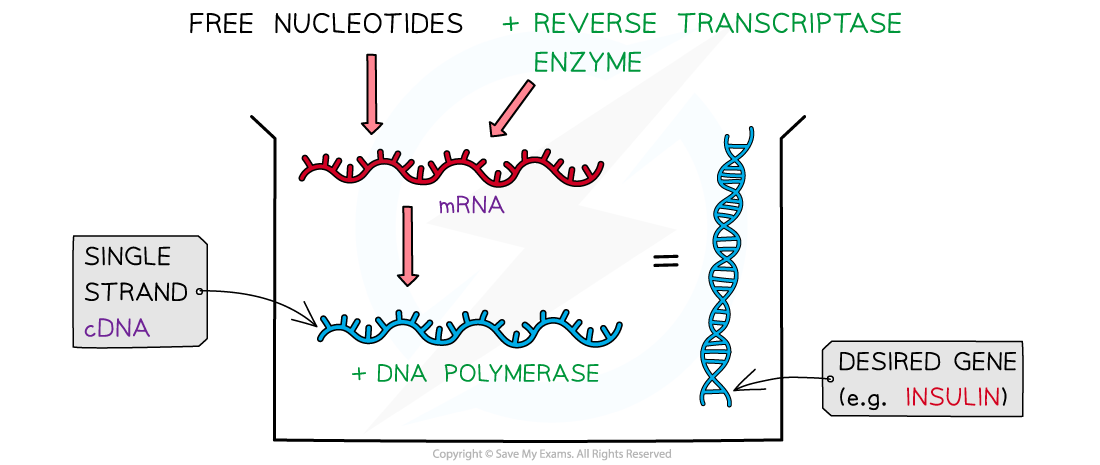
- Employing reverse transcriptase for the synthesis of a single strand of complementary DNA (cDNA) from mRNA of a donor organism
- Artificial synthesis of the gene using nucleotides
In the next sections of the article, we will discuss all the three ways one by one.
Extracting the Genes from the DNA of Donor Organism
What are restriction endonucleases?
Extracting the gene that contains the desired nucleotide sequence from the donor organism requires restriction endonucleases. Restriction endonucleases refer to a class of enzymes present in bacteria. These enzymes are employed by the bacteria as a defense mechanism against bacteriophages. Bacteriophages refer to viruses that infect bacteria, also called phages.
How are these enzymes used?
These enzymes cut the viral genetic material into tiny bits at specific nucleotide sequences inside the molecule. In this way, they restrict a viral infection. They got the name restriction endonuclease due to this specific reason. They are also known as restriction enzymes. These enzymes are employed in recombinant DNA technology and play a vital role in determining the point at which the required gene is inserted into the vector genome.
Different restriction endonucleases
Several different restriction endonucleases are present as they bind to a particular restriction site, i.e. the particular sequence of bases, on DNA. Take an example of HindIII which will always bind to the base sequence AAGCTT.
Name of the restriction endonucleases
The source of the bacteria and which numbered enzyme it is from that source determine the name of the restriction endonucleases. For instance, HindIII coming from the Haemophilus influenzae is the third enzyme from that bacteria.
How do restriction endonucleases split two different strands of DNA?
Restriction endonucleases will split two distinct strands of DNA at a particular base sequence by cutting the sugar-phosphate backbone in an unruly manner to yield sticky edges or straight across to give blunt ends. Consequently, one strand of the DNA fragment is longer as compared to the other strand because of the sticky end.
How do sticky ends help in inserting the desired gene into the DNA of another organism?
Because of the sticky ends, it becomes easier to insert the desired gene into the DNA of another organism as they can create hydrogen bonds easily with the complementary base sequences on other fragments of DNA that were cut with a similar restriction enzyme. Nucleotides can be added to form sticky ends while employing genes isolated by restriction endonucleases that give blunt ends.
mRNA and Reverse Transcriptase
Another method of isolating the required gene is to employ the mRNA that was transcribed for that gene. After isolation, the mRNA then combines with a reverse transcriptase enzyme and nucleotides to form a single strand of complementary DNA (cDNA). Retroviruses are the source of reverse transcriptase enzymes and they speed up the reaction that reverses transcription. The mRNA is employed as a template to create the cDNA.
After that, DNA polymerase is employed to transform a single strand of cDNA into a double-stranded DNA molecule which entails the required code for the gene. This technique to isolate the required gene is considered beneficial because it is easier for scientists to find the gene as specialized cells create highly specific mRNA types. For instance, β-cells of the pancreas produce several insulin mRNAs. mRNA does not have introns.
Artificial Synthesis
Artificial synthesis of the gene is very much possible because scientists are becoming way more familiar with the base sequences for our proteins (proteome). The genetic code knowledge, scientists can employ computers to generate the nucleotide sequence instead of the mRNA template to produce the gene.
First, tiny bits of DNA are produced which are combined to create longer nucleotide sequences, and then they are inserted into vectors, for instance, plasmids. This method is employed for the creation of novel genes. These genes are employed to create vaccines and for the synthesis of new bacteria genomes.
Summarise with AI:
Did you like this article? Rate it!

 Loading...