In this article, we will discuss the relationship between genes, proteins, and phenotype concerning the TYR gene, tyrosinase and albinism, HBB gene, haemoglobin and sickle cell anaemia, F8 gene, factor VIII and haemophilia, HTT gene, huntingtin, and Huntington’s disease. Moreover, we will also discuss what role gibberellin plays in stem elongation including the role of the dominant allele, Le, which codes for a functional enzyme in the gibberellin synthesis pathway, and the recessive allele, le, that codes for a non-functional enzyme. So, let’s get started


Genes, Proteins and Phenotypes
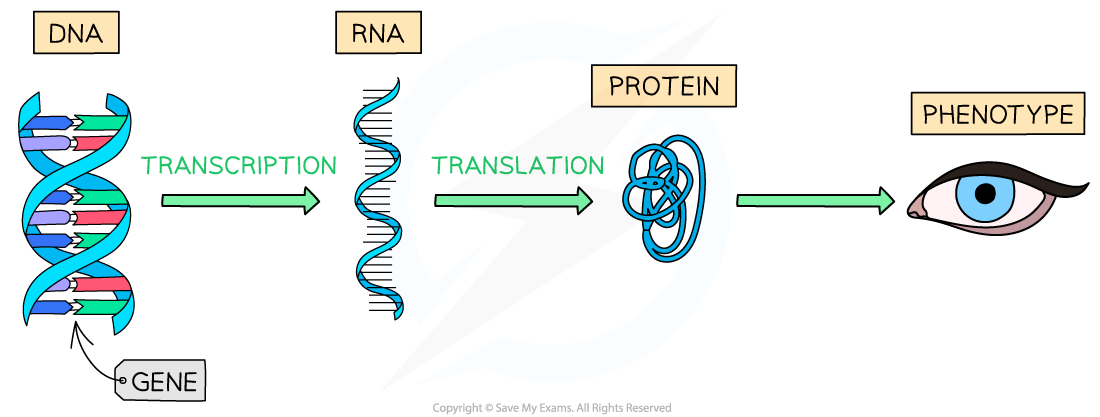
An organism’s phenotype is affected by the gene of the person. A gene codes for a single protein that influences the phenotype of the person through a specific mechanism. Environmental factors also play a role in determining the phenotype of a person. It means that the phenotype of an organism is not only affected by its gene, but also by its environment.
TYR Gene & Albinism
When humans do not have a pigment known as melanin in their hair, skin, and eyes, then they have albinism. Due to this, these people have extremely pale skin, pale hair, and pale blue or pink irises in their eyes. A metabolic pathway is present to produce melanin which is explained below:
- The enzyme tyrosinase converts the amino acid tyrosine to DOPA
- The same enzyme tyrosinase converts DOPA to dopaquinone
- Dopaquinone is finally converted to melanin
Tyrosine (Enzyme) → DOPA → Dopaquinone → Melanin
A gene referred to as TYR present on chromosome 11 codes for the enzyme tyrosinase. The absence of enzyme tyrosinase or the presence of inactive tyrosinase is attributed to a recessive allele for the gene TYR. In the absence of the enzyme tyrosinase, tyrosine cannot be converted into melanin.
HBB Gene & Sickle Cell Anaemia
Sickle cell anaemia is a disease in which individuals get infected frequently and go through recurrent phases of pain and anaemia. Humans who have this disease have abnormal haemoglobin in their red blood cells. A polypeptide known as β-globin present in haemoglobin is coded for by the gene HBB which is present on chromosome 11. An abnormal allele for the gene HBB produces a sequence of amino acids which is slightly different than the normal allele.
The change of one base in the DNA of the abnormal allele leads to an amino acid substitution (CAC replaces the base sequence CTC). The change in amino acid sequence (Val replaces the amino acid Glu) leads to an abnormal β-globin peptide. The structure and shape of the red blood cells get affected by the abnormal β-globin in the haemoglobin in the following ways:
- The red blood cells are pulled to a half-moon shape
- They cannot carry oxygen around the body
- The red blood cells stick to each other and clump together which results in the blockage of capillaries
A homozygous individual that contains two abnormal alleles for the HBB gene produces sickle cell haemoglobin only. Hence, such individuals have sickle cell anaemia and they carry the related symptoms.
The heterozygous individuals that contain one normal allele and one abnormal allele for the HBB gene produce some sickle cell haemoglobin and some normal haemoglobin. These individuals are a carrier of the allele and may show no symptoms of the disease.
F8 Gene & Haemophilia
Factor VIII protein coded by the gene F8 is a coagulating agent that plays a crucial role in blood clotting. There are abnormal alleles of the F8 gene that can result in the following:
- Produce abnormal forms of factor VIII
- Produce less normal factor VIII
- Do not produce factor VIII
The absence of normal factor VIII stops the normal clotting of the blood and results in a condition known as haemophilia.
The F8 gene is present on the X chromosome which implies that:
- F8 is a sex-linked gene
- Haemophilia is a sex-related disease
- If males contain an abnormal allele, then they will have this disease because they have a single copy of gene only
- Females can be heterozygous for the F8 gene and can be the carrier, however, it is unlikely that they suffer from this disease
HTT Gene & Huntington's Disease
Huntington’s disorder refers to a progressive brain disorder that develops because of a defective gene. This genetic disease develops as an individual age and usually, the person does not exhibit any symptoms until he/she is more than 30 years old.
A person having this condition suffers from neurological degeneration which means that they cannot walk, talk and think. Eventually, this disease proves fatal for a person.
It has been discovered that the persons suffering from this disease contain abnormal alleles of the HTT gene which codes for the protein huntingtin which plays its role in neuronal development. People containing a huge number, i.e., more than 40 repeated CAG triplets in the nucleotide sequence of their HTT gene have this disease. In these people, the abnormal allele is dominant over the normal allele. A person having a single abnormal allele will suffer from this disease.
In the next section of the article, we will discuss what role Gibberellin plays in stem elongation.
What Role does Gibberellin Plays in Stem Elongation?
Genes influence the height of some species of the plant. The height in some plants is influenced by the Le gene which has two alleles: Le and le:
- When the dominant allele Le is present the plants are tall
- When the recessive allele le is present, the plants are shorter in length (it is the case of a homozygous individual)
The gene controls the production of an enzyme that plays its role in a pathway that forms active gibberellin GA. Active gibberellin GA refers to a hormone that assists plants in their growth by stimulating cell division and elongation in the stem.
The recessive allele le leads to a non-functional enzyme. It has the following attributes:
- It has a single nucleotide different from the dominant allele
- It results in a single amino acid substitution in the primary structure of the enzyme
- This change in primary structure that takes place at the active site of the enzyme makes it non-functional
In the absence of this enzyme, no active gibberellin is formed and plants are not taller. Dwarves refer to plants that are homozygous for the recessive allele le. Some farmers employ active gibberellin in shorter plants to trigger growth.
Summarise with AI:
Did you like this article? Rate it!


 Loading...