In this article, we will discuss the theory of evolution as a process leading to the formation of new species from pre-existing species over time because of changes to gene pools from generation to generation. Moreover, we will also discuss how DNA sequence data can show evolutionary relationships between species.


Evolution Theory
We can define species as:
A group of organisms that can interbreed and produce fertile offspring is referred to as species.
In a real-world scenario, it becomes quite difficult to define species and determine whether two organisms belong to the same species. Remember that the individuals belonging to one species are reproductively isolated from the individuals belonging to another species. Members of the same species share the same behavioural, physiological, i.e., metabolic, and morphological, i.e. structural characteristics. One of the best examples that can be used to explain this concept is the mule. A mule is an infertile offspring that is produced as a result of a male donkey and female horse mating.
The Gene Pool
The phenotype of all organisms depends on their genotype and the effect of the environment on them. Individuals belonging to the same species have the same genes. However, for these genes, alleles may exist. We can define a gene pool as:
The collection of genes within an interbreeding population is referred to as a gene pool
We can think of a gene pool as a sum (collection) of all the alleles at all of the loci within the population genes of a single species or population.
Changes to the Gene Pool
The gene pool or the frequencies of the allele in a population of a species can undergo change over time because of the following processes:
- Natural selection
- Genetic drift
- The founder effect
With a sufficient change in the gene pool within a species population over time, there is also a change in the features of the species. This change can become significant enough to form a new species. This is known as evolution.
We can define evolution as:
The formation of new species from pre-existing species over time because of the changes to the gene pools over generations (generation to generation) is known as evolution
The population should be genetically and reproductively isolated from pre-existing species populations so that it can evolve into a distinct species. Mutations cause reproductive isolations that result in the incompatibility of gametes or differences in breeding behaviour.
The two populations are also considered genetically isolated from each other if they are reproductively isolated. It implies that they do not exchange genes with each other to produce offspring.
Isolated populations do not share the changes in the allele frequencies. Hence, they evolve independently of each other which can result in the formation of two groups that cannot interbreed successfully and are considered distinct species. The formation of species in this way is referred to as speciation.
It takes a long time and several generations for the new species to evolve. The organisms which have a short generation time, for example, bacteria, the evolution of new species can be seen very fast.
In the next section of the article, we will discuss how DNA sequence data can exhibit evolutionary relationships between species.
Evidence of Evolutionary Relationships in DNA
The evolutionary relationship between species can be observed by sequencing DNA present in the nucleus, mitochondria, and chloroplasts of the cells. The differences between the nucleotide sequences, i.e., the DNA of various species offer a lot of information:
- Species are more closely related to each other if the sequence is similar. The extent of the close relationship between the species depends on the extent of similarity in the sequence.
- We can say that the two groups of organisms with quite similar DNA may have evolved as distinct species more recently than the two groups which show less similarity in their DNA sequences
DNA sequences can be analyzed and compared to create family trees that exhibit the evolutionary relationship between species.
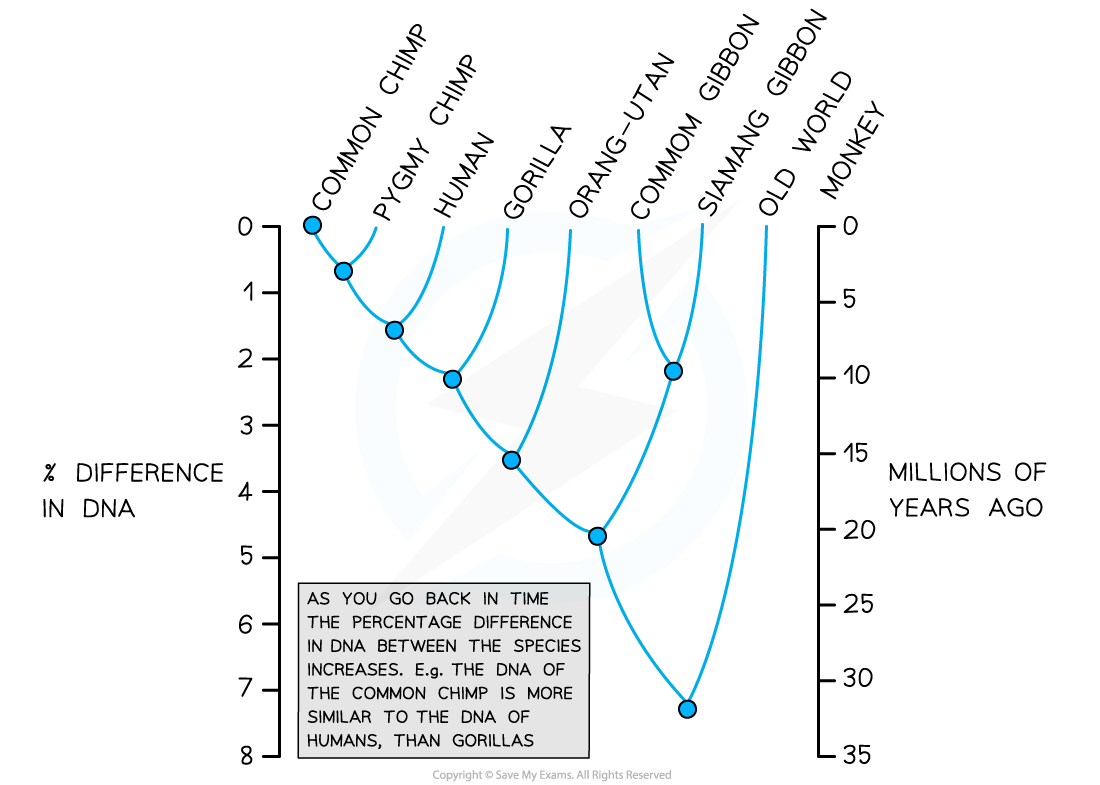
Analysis and Comparison of DNA
The extraction of DNA can be done from the nuclei of cells taken from an organism. Blood or skin samples from living organisms or fossils can be used to extract the DNA. After that, the processing and analysis of DNA are done to obtain the base sequence which is then compared to that of other organisms in order to determine the evolutionary relationships. The members of the distinct species are more closely related to each other if there are more similarities in the base sequence of DNA.
Do you know that chimpanzees are the closest living relatives of human beings? This fact was discovered in 2005 when the chimpanzee genome was sequenced and compared to humans. The results revealed that we share 99% of our DNA sequences with the chimpanzee.
Another sequencing attempt was made in 2012 which revealed that humans and bonobos share 98% of their genome.
Mitochondrial DNA
Remember the following points while analyzing DNA from mitochondria:
- Only maternal mitochondrial DNA is found in the zygote because it has all the mitochondria of the egg and none from the sperm. In other words, paternal mitochondrial DNA is absent in the zygote. (It was thought until recently, however, current research suggests that paternal DNA may also be found in zygotes)
- No “crossing over” takes place in mtDNA, hence the base sequence can only undergo change through mutation
No crossing over in mtDNA has enabled scientists to research the origins of species, genetic drift, and migration events. Scientists can even estimate how long ago the first human lived and where.
Approximately 200,000 years ago, the mitochondrial eve is thought to have lived in Africa. The molecular clock theory has been used to obtain this estimation which assumes that the rate of mutation is constant over time. The number of differences between the nucleotide sequence determines how long ago the common ancestor of both species lived. The greater the difference, the longer ago the common ancestor existed of both species. Fossils and carbon dating is employed to calibrate the molecular clock. A fossil of the known species is carbon-dated to determine how long ago an organism lived. This mtDNA of this species is then employed as a baseline for comparison with the mtDNA of other species.
Summarise with AI:
Did you like this article? Rate it!

 Loading...