In this article, we will discuss and explain the formation of urine in the nephron, limited to the formation of the glomerular filtrate by ultrafiltration in the Bowman’s capsule and selective reabsorption in the proximal convoluted tubule. Moreover, we will also relate the detailed structure of the Bowman’s capsule and proximal convoluted tubule to their functions in the formation of urine. So, let us get started with the formation of urine in the nephron.


Formation of Urine in the Nephron
The functional unit of the kidney is the nephron. A kidney is made up of millions of nephrons which play a central role in the formation of urine. Urine in the kidneys forms in the following two stages:
- Ultrafiltration: This process takes place in a cup-shaped Bowman’s capsule
- Selective reabsorption: This process occurs in proximal convoluted tubule
Now, let us discuss ultrafiltration in detail.
Ultrafiltration
Arterioles lead to each nephron after they branch off the renal artery. In the nephron, they create a knot of capillaries known as glomerulus which is inside the Bowman’s capsule. As the capillaries enter the glomerulus further, they get narrower. As a result, the pressure on the blood moving through them increases. Finally, due to this, the smaller molecules are carried in the blood so that they can be forced out of the capillaries into the cup-shaped Bowman’s capsule. Bowman’s capsule is the place where they create a filtrate.
The two layers of the cell with a basement membrane between them segregate the blood in the glomerular capillaries from the lumen of the Bowman’s capsule:
- The first layer of the cell is the endothelium of the capillary. Thousands of small membrane-lined circular holes perforate each capillary endothelial cell
- The next layer is known as the basement membrane which is composed of a network of collagen and glycoproteins
- The second layer is the Bowman’s capsule’s epithelium. Several small finger-like projections with gaps between them are present in these epithelial cells. These projections are known as podocytes.
When blood moves through the glomerular capillaries, the holes in the capillary endothelial cells and the gaps between the podocytes enable substances that are dissolved in the blood plasma to move into the Bowman’s capsule.
- The glomerular filtrate is the name given to the fluid that filters through the blood into the Bowman’s capsule.
- The primary substances that pass out of the capillaries and create the glomerular filtrate include water, amino acids, urea, glucose, and inorganic ions like Na+, K+, and Cl-.
Since platelets and red and white blood cells are quite large to pass through the holes in the capillary endothelial cells, hence they remain in the blood. The basement membrane plays the role of the filter as it prevents the large protein molecules from getting through.
How does ultrafiltration take place?
- Ultrafiltration takes place because of the differences in water potential between the plasma in the glomerular capillaries and filtrate in the Bowman’s capsule.
- Water always moves down the concentration gradient and certain factors such as high pressure and the presence of solutes increase this potential.
- However, the pressure gradient affects the water potential more than the concentration of solute.
- Due to this reason, the water potential in the blood plasma in the glomerulus is higher as compared to the water potential of the filtrate in the Bowman’s capsule.
- It implies that as the blood flows through the glomerulus, there is a net movement of water down the water potential gradient from the blood into the Bowman’s capsule.
Selective Reabsorption
Several substances that are present in the glomerular filtrate are actually required by the body. These substances get reabsorbed into the blood when the filtrate passes along the nephron. This process is referred to as selective reabsorption because only a few substances are reabsorbed.
The majority of the reabsorption takes place in the proximal convoluted tubule. The lining of the proximal convoluted tubule is made up of a single layer of epithelial cells. These epithelial cells are adapted for carrying out reabsorption in many ways:
- Microvilli
- A high number of mitochondria
- Co-transporter proteins
- Tightly packed cells
How do adaptations of proximal convoluted epithelial cells assist in reabsorption?
- Several microvilli are present on the luminal membrane which enhances the surface area for reabsorption.
- Several co-transporter proteins are found in the luminal membrane. Each type of co-transporter protein transports a certain type of solute, for instance, glucose or specific amino acid across the luminal membrane.
- Several mitochondria provide energy for sodium-potassium pump proteins in the basal membranes of the cells.
- Tightly packed cells ensure that no fluid can pass between the cells.
How does Selective Reabsorption Take Place?
- Blood capillaries are present near the outer surface of the proximal convoluted tubule. Because the blood in these capillaries enters straight from the glomerulus, hence it contains very little plasma. This blood loses much of its water, inorganic ions, and other small solutes.
- The basal membranes of the proximal convoluted tubule epithelial cells are the parts of the cell membranes that nearest to the blood capillaries.
- These basal membranes have sodium-potassium pumps which move sodium ions out of the epithelial cells and into the blood where they are transported away
- It results in a lower concentration of the sodium ions inside the epithelial cells which diffuse the sodium ions in the filtrate down their concentration gradient through the luminal membranes
- Through the luminal membranes, these sodium ions do not diffuse freely, rather they should move through the co-transporter proteins in the membrane.
- There are many types of these co-transporter proteins and each type moves a sodium ion and another solute from the filtrate, for instance, a specific amino acid or glucose.
- These solutes diffuse down their concentration gradient, once they are inside the epithelial cells. In this process, they pass through the transport proteins in the basal membranes of the epithelial cells into the blood.
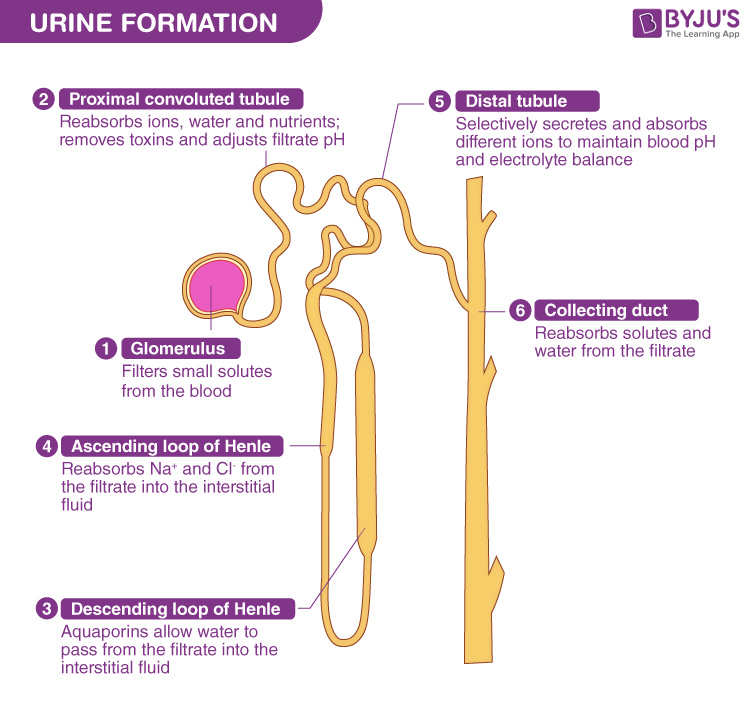
Which Molecules are Reabsorbed from the Proximal Convoluted Tubule During Selective Reabsorption?
- All of the glucose in the glomerular filtrate gets reabsorbed into the blood which implies that no glucose is found in the urine.
- Vitamins, amino acids, and inorganic ions get reabsorbed
- The water potential of the filtrate is enhanced and the water potential of the blood in the capillaries is decreased due to the movement of all of the above solutes from the proximal convoluted tubule into the capillaries
- It results in the formation of a steep water potential gradient and causes water to move into the blood through osmosis
- A huge amount of urea also gets reabsorbed
- The urea concentration in the filtrate is higher as compared to the concentration in capillaries which causes the urea to diffuse from the filtrate back into the blood
Reabsorption of Water and Salts
- The dripping of the filtrate through the Loop of Henle causes essential salts to get reabsorbed back into the blood through diffusion
- Water follows through the process of osmosis when salts are reabsorbed back into the blood
- Water also gets reabsorbed from the collecting duct in varying amounts based on how much water is required by the body at that time.
- After complete reabsorption of essential amino acids, water, glucose, and inorganic ions, the filtrate finally exits the nephron and is now known as urine
- The urine then flows out through the kidneys, along the ureters, and into the bladder where it is stored for some time

Summarise with AI:
Did you like this article? Rate it!

 Loading...