In this article, we will discuss the role of sensory receptor cells in identifying stimuli and stimulating the transmission of impulses in sensory neurons. Moreover, we will also describe the sequence of events that results in an action potential in a sensory neuron, by using a chemoreceptor cell in a human taste bud as an example. So, let us get started.


What is a Receptor Cell?
A receptor cell can be defined as:
The cell that responds to a stimulus is referred to as a receptor cell
Now, the question arises what is the stimulus in biology that prompts the receptor cell to respond to it. Well, in biology stimulus is anything that triggers any sort of reaction in an organism or in any part of it in some way or another. For instance, sunlight is a stimulus because it causes plants to move or grow towards it.
Now, that you know what receptor cells and stimulus are, we will further discuss the concept of receptor cells below.
- Receptor cells are transducers because they transform (convert) energy in one form, for instance, heat, light, or sound, into energy in an electrical impulse inside a sensory neuron
- Receptor cells are usually present in sense organs. For example, light receptor cells are present in the eye
- Few receptors like light receptors in the eye and chemoreceptors in the taste buds are examples of specialized cells that can identify a special kind of stimulus and affect the electrical activity of the sensory neuron
- Other receptors which include some types of touch receptors are merely the ends of the sensory neurons themselves
- Receptor cells are depolarized when they are stimulated (when they detect a stimulus)
- The cells are not depolarized enough and the sensory neuron does not get activated to send impulses if the stimulus is extremely weak
- The sensory neuron gets activated and transfers impulses to the central nervous system (CNS) if the stimulus is not sufficiently stronger
So, far we have discussed what are receptors and how they respond to the stimulus. In the next section, we will especially focus on the sensory receptors.
Sensory Receptors
- Sensory receptors refer to the specialized cells in the nervous system that are able to identify physical stimuli and transform (convert) them into electrical signals (the generator potential)
- These receptors can detect environmental changes and are usually present in the sensory organs like eyes and ears, however, they are also present in other organs like hands and feet
- Once the sensory receptors detect the stimulus, they convert it into a nerve impulse which is then transferred through the CNS to an effector. The effector then responds to that stimulus
- The sensory receptors are usually specific to a single kind of stimulus because of their specialized structures that are specific to only a single type of physical property
- For example, Pacinian corpuscles identify changes in pressure in the skin
From the above discussion, we can conclude that the two primary features of the sensory receptors are:
- They are specific to one type of stimulus
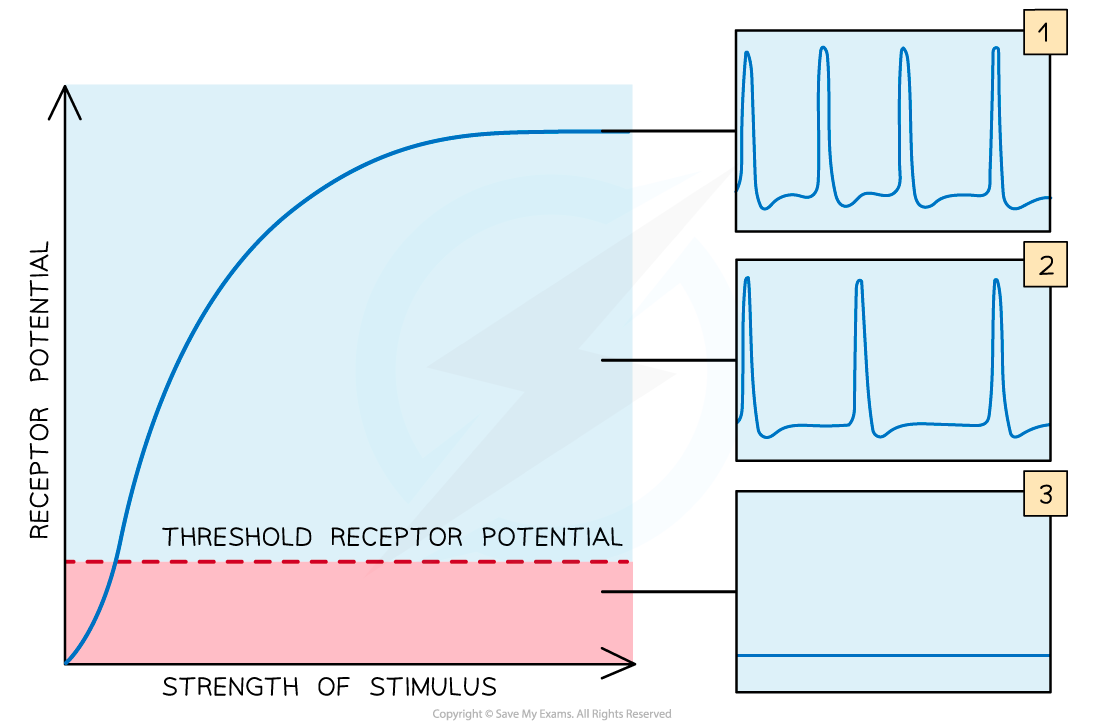
- They play a role of a transducer which means that they convert stimulus into an impulse. As transducers, the sensory receptors create a generator potential. The generator potential is also known as receptor potential and it refers to the depolarization of the receptor cell that takes place in response to a stimulus and is graded according to the intensity. It also leads to action potential when a sufficient threshold is reached.
Examples of Sensory Receptors
- Mechanoreceptor: The example includes the Pacinian corpuscle which responds to pressure and movement in the skin.
- Chemoreceptor: The example includes the olfactory receptor which responds to the stimulus chemicals in the nose
In the next section of the article, we will discuss the sequence of events that leads to an action potential in a sensory neuron, by using a chemoreceptor cell in a human taste bud as an example.
An Example of the Sequence of Events that Leads to an Action Potential in a Sensory Neuron
- Several tiny bumps called papillae cover the surface of a tongue
- Many taste buds cover the surface of each papilla
- Many receptor cells referred to as chemoreceptors are present in each taste bud
- These chemoreceptors have inherent sensitivity towards chemicals present in drinks and food
- The receptor proteins cover each chemoreceptor and various receptor proteins detect different chemicals
- For example, chemoreceptors present in the taste buds that detect salt (sodium chloride) respond to sodium ions directly
What happens if salt is found in food?
Now, we will discuss what will happen if salt is found in food, i.e. dissolved in saliva, being eaten, or present in a liquid that is being drunk.
- Through highly selective channel proteins, sodium ions will diffuse in the cell surface membranes of the microvilli of the chemoreceptor cells
- This will result in the depolarization of the chemoreceptor cell membrane
- There will be an increase in positive charge within a cell. This increase in positive charge is referred to as receptor potential or generator potential
- If stimulation by sodium ions is enough and there is sufficient depolarization of the membrane, then the receptor potential or generator potential becomes sufficiently larger to stimulate the opening of voltage-gated calcium ion channel proteins
- Consequently, calcium ions will enter the chemoreceptor cell’s cytoplasm and stimulate the exocytosis of vesicles that contain neurotransmitters from the basal membrane of the chemoreceptor
- The action potential in the sensory neuron is stimulated by the neurotransmitter
- The sensory neuron then transfers an impulse to the brain
- Receptors such as chemoreceptors are depolarized when they are stimulated
- In case of a weak stimulus that is below a specific threshold, the receptor cells will not be depolarized enough, and the sensory neuron will not get activated to send impulses
- In case of a sufficiently stronger stimulus, the receptor potential will increase above the threshold potential. This increase in receptor potential will stimulate the sensory neuron to send impulses
- It is a perfect example of the all-or-none law because an impulse is only transferred if the initial stimulus is enough to increase the membrane potential beyond a threshold potential
- Instead of staying consistent, the threshold levels in receptors usually increase with consistent stimulation. Hence, a greater stimulus is needed before sending the impulses along the sensory neurons.
The following things happen, in the case of strong, weak, and extremely weak stimuli:
- Strong stimulus: The receptor is given a strong stimulus which results in the generation of a high frequency of impulses in the sensory neuron
- Weak stimulus: The receptor is given a weak stimulus which results in the generation of a low frequency of impulses
- Very weak stimulus: n extremely weak stimulus is given to the receptor which leads to failure in the generation of any impulses in the sensory neuron
Summarise with AI:
Did you like this article? Rate it!

 Loading...