In this article, we will discuss the tissue fluid in detail. So, let us get started.


Capillaries and Tissue Fluid
Besides arteries and veins, capillaries are another type of blood vessel which are found in the circulatory system. Capillaries have leaky, thin walls that enable the substances to leave the blood so that they can reach the tissues of the body. The networks of capillaries are known as capillary beds which are the crucial exchange surfaces within the circulatory system.
Now, we will discuss the structure and function of capillaries.
Structure and Function of Capillaries
- Capillaries have an extremely small diameter, i.e. the lumen. This structure forces the blood to move slowly which provides more opportunity for diffusion to occur.
- Capillaries branch between the cells. This structure enables the substances to diffuse between the cells and blood rapidly because there is a shorter diffusion distance.
- The walls of the capillaries are solely composed of a single layer of endothelial cells. This layer also lines the lumen in veins and arteries. The wall of the capillaries is only one cell thick. This structure minimizes the distance for oxygen and carbon dioxide between the blood and body tissues. The cells of the wall contain gaps referred to as pores which enable blood plasma to leak out and create a tissue fluid.
So far, we have discussed the capillaries and their related structure and functions in detail. Now, in the next section of the article, we will discuss tissue fluid in detail.
Tissue Fluid
- 55% of our blood is made up of plasma.
- Plasma is a straw-colored liquid that is largely made up of water. The water constitutes approximately 95% of the plasma. Since water is a good solvent, hence it is able to dissolve many substances in it. Due to this nature of plasma, many substances are transported around the body.
- Some of the plasma leaks out through gaps in capillary walls to surround the cells of the body as the blood passes through capillaries. As a result, tissue fluid is formed.
- Plasma and tissue fluid share the same composition, although tissue fluid has very less proteins. This is because the proteins are extremely large to fit through gaps in the walls of the capillaries, so they remain in the blood.
- Outside the circulatory system, nearly all the cells of the body bath in the tissue fluid.
- The exchange of substances between the cells and blood takes place through tissue fluid. For instance, carbon dioxide generated as a result of aerobic respiration leaves the cell, dissolves into the tissue fluid that surrounds it, and then diffuses into the capillary.
Hence, we can say that the tissue fluid is a watery liquid that is distinct from the blood and surrounds the cells of the body. It transports oxygen and nutrients to the cells and eliminates waste products.
Tissue fluid performs the following two functions in the body:
- Tissue fluid bathes the tissues because it can seep into the small gaps between the cells, i.e., enter intercellular spaces where capillaries are unable to reach
- It helps in the exchange of materials such as glucose between the cells of the blood. The tissue fluid enables contact between the cells and the blood.
Differences Between Tissue Fluid and Blood
Although tissue fluid is created from the blood plasma, however, both the fluids differ in their composition.
The common elements found in blood plasma and tissue fluid are:
- Solutes such as amino acids, ions, and glucose
- Gases such as oxygen
- Metabolic wastes like water and carbon dioxide
Generally, tissue fluid does not contain large plasma proteins and red blood cells. Both these components are part of the blood plasma.
Now, we will explain how the tissue fluid is created.
Creation of the tissue fluid
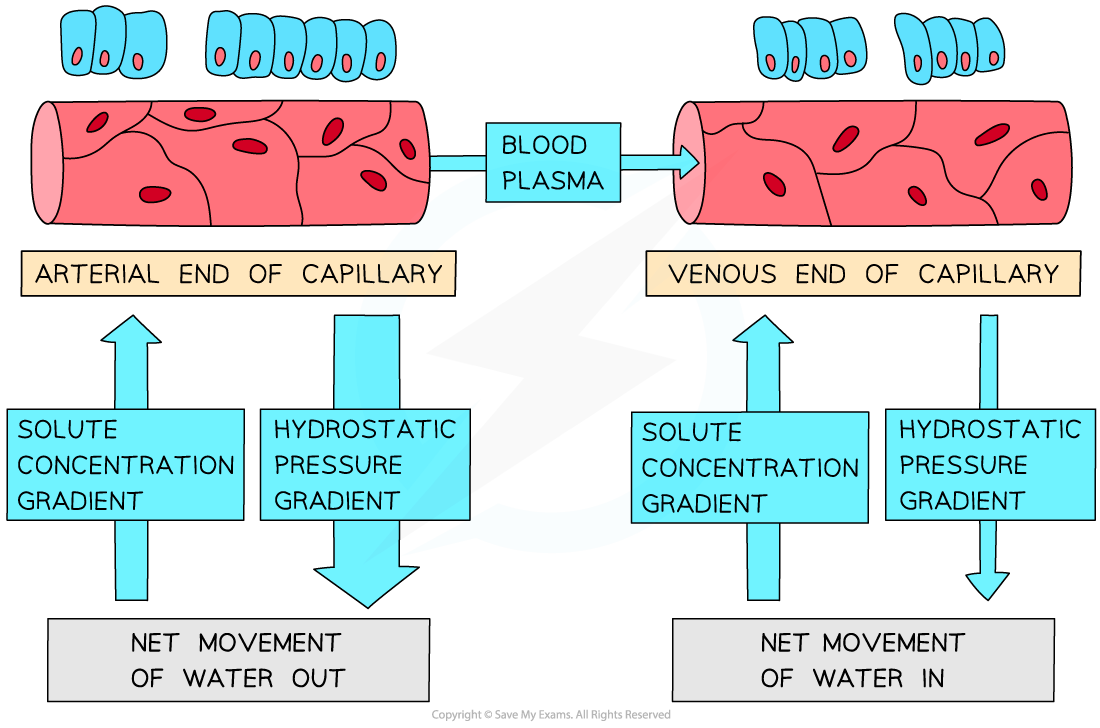
- The two opposing forces determine the amount of liquid that leaves the plasma to create the tissue fluid.
- When blood is at the arteriole end of the capillary, the hydrostatic pressure is sufficient to force molecules out of the capillary.
- Proteins are left behind in the blood. The greater protein content creates a water potential between the capillary and the tissue fluid.
- At the venule end of the capillary, less fluid is forced out of the capillary because the pressure within the capillary is decreased.
- The water potential gradient between the capillary and tissue fluid remains constant, like at the end of the arteriole. Hence water starts to flow back into the capillary to create the tissue fluid.
- Generally, more fluid leaves the capillary than it returns. It results in leaving behind the tissue fluid to bathe the cells.
- If there is hypertension, i.e. the blood pressure is high, then the pressure at the arteriole end is even more. This increased pressure forces more fluid out of the capillary and the fluid starts to gather around the tissue. This is referred to as oedema.
Now, we will discuss how lymph is formed.
Creation of Lymph
- Some tissue fluid enters the capillaries again, whereas some enter the lymph capillaries.
- The lymph capillaries are not connected with the circulatory system and contain closed ends and large pores to enable molecules to pass through.
- Larger molecules that are unable to pass through the capillary wall enter the lymphatic system as lymph.
- Tiny valves in the vessel walls are the entry points to the lymphatic system.
- The liquid travels along the larger vessels of this system through compression created by the movement of the body.
- The valves prevent any potential backflow. Due to this reason, the people who are inactive on planes experience swelling in the lower limbs.
- Finally, the limbs enter the bloodstream again via veins present close to the heart. Any plasma proteins that have escaped from the blood enter the blood again through lymph capillaries.
- Remember that if plasma proteins are not eliminated from the tissue fluid, they can result in lower water potential of the tissue fluid and stop the reabsorption of water into the blood in the capillaries.
- After digestion, the lipids are moved from the intestine to the bloodstream through the lymph system.
Summarise with AI:
Did you like this article? Rate it!


 Loading...