In this article, we will discuss the characteristics of the endocrine system regarding the hormones ADH, glucagon, and insulin. We will also compare the features of the nervous system and the endocrine system. In the end, we will explain the structure and function of a sensory neuron and a motor neuron and state that sensory neurons and motor neurons are connected by intermediate neurons. So, let us get started.


The Endocrine System
What are Hormones?
A hormone refers to a chemical substance that is produced by an endocrine gland and transported by the blood.
- Hormones are chemicals that transfer information from one part of our body to another and trigger a change.
- These chemical substances are responsible for changing the activity of one or more specific target organs.
- Hormones control the function in the body of organisms that do not require quick responses.
What makes up an endocrine system?
An endocrine system refers to a collection of endocrine glands that produce hormones in animals.
A gland refers to a group of cells that produces and releases one or more substances through a process which is referred to as secretion. Hormones like glucagon, insulin, ADH, and adrenaline are cell-signalling molecules. These molecules are released into the blood.
How do hormones reach the target organs?
There is a proper supply of blood in endocrine glands so that when they produce and release hormones, they can be carried immediately into the bloodstream, especially the blood plasma. This is done to ensure that they can be transmitted around the body and reach the target organs where they can trigger a response.
Which cells are affected by hormones?
Only cells with receptors are affected by the hormones because hormones bind to these receptors. They are either present on the cell surface membrane or within the cells. Receptors should be complementary to hormones to bring about an effect.
Insulin, Glucagon, and ADH
Hormones like insulin, glucagon, and ADH are tiny proteins or peptides which are water-soluble so that they cannot cross the phospholipid bilayer of cell surface membranes. On the cell surface membranes of their target cells, these hormones bind to the receptors which make second messengers active so that they can transmit signals throughout the cytoplasm.
Testosterone, Oestrogen and Progesterone
Steroid hormones include testosterone, oestrogen, and progesterone. These steroid hormones are lipid-soluble so that they can cross the phospholipid bilayer. All these three hormones bind to the receptors in the nucleus or cytoplasm of their target cells.
In the next section of the article, we will compare the features of the nervous system and the endocrine system.
Comparison of Nervous and Endocrine Systems
Elements of the system
Nervous System: In the nervous system, the parts are the spinal cord, brain, and neurons/nerves
Endocrine System: The elements of the system that constitute an endocrine system are glands.
Type of message
Nervous system: Electrical impulse
Endocrine system: Chemical hormone
Mode of transmission
Nervous system: Nervous system transfer information through nerves/neurons
Endocrine system: The endocrine system transmits chemical hormones through the bloodstream
Effectors
Nervous system: The effectors in the nervous system are muscles or glands
Endocrine system: In the endocrine system, the effectors are target cells in specific tissues
Transmission speed
Nervous system: The transmission speed of the nervous system is extremely fast
Endocrine system: The transmission speed of the endocrine system is slower
Length of effect
Nervous system: The length of effect in the nervous system is shorter and it lasts until electrical impulses stop
Endocrine system: The length of effect in the endocrine system is long and it lasts until the hormone is broken down.
In the next section of the article, we will explain the structure and function of a sensory neuron and a motor neuron and state that sensory neurons and motor neurons are connected by intermediate neurons.
Neurons
- Neurons contain a long fibre called an axon
- This long fibre is insulated by a fatty sheath with tiny uninsulated sections that are present along its length. These sections are known as nodes of Ranvier
- The fatty sheath is composed of myelin which is a substance that is made up of specialized cells called Schwann cells
- Myelin is created when Schwann cells wrap themselves around an axon along its length
- It implies that the electrical impulse does not move down the entire axon, but jumps from one node to the next
- It also implies that less time is wasted in transmitting the impulse from one cell to another
- Their cell bodies have several extensions known as dendrites which means that they are able to connect to several other neurons and receive impulses from them. Thus, in this way, they form a network for easier communication.
Types of Neurons
The three types of neurons are:
- Sensory neurons: They transfer impulses from receptors to the central nervous system (CNS)
- Motor neurons: Motor neurons transfer impulses from CNS to effectors which include muscles and glands
- Relay: Relay or intermediate neurons are present completely inside the CNS and they connect sensory and motor neurons
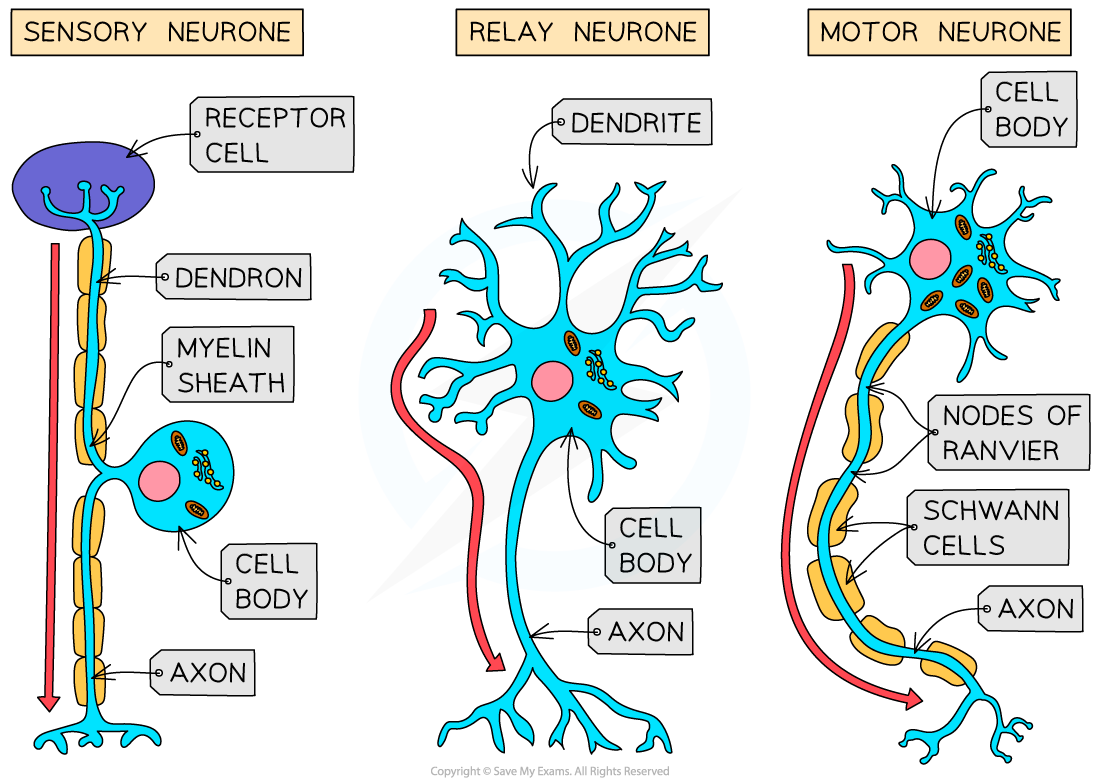
The structure of each of the above neurons is slightly different.
Motor Neurons
- Motor neurons contain a cell body at one end, that is found inside the brain or spinal cord.
- The cell body always contains a nucleus.
- These neurons also have several highly-branched dendrites that extend from the cell body.
- These dendrites offer a large surface area for the axon terminals of other neurons.
Sensory Neurons
- The basic structure of sensory neurons resembles that of the motor neurons, however, they contain a cell body that branches off in the middle of the cell.
- It may be present near the stimuli source or in the spinal nerve, swelling referred to as ganglion.
Reflex arc
- All the three neurons, i.e. sensory, relay, and motor work in hormones to bring about a response to a stimulus
- A reflex arc refers to a pathway along which impulses are transferred from a receptor to an effector. This pathway does not include conscious parts of the brain
- Because it does not involve the brain, hence the reflex response is faster as compared to any other type of nervous response
Examples of Reflex Actions
Examples of reflex actions include blinking, removing the hand quickly from a hot or sharp object, and controlling how much light can enter the eye.
In the above examples, a pin which is a stimulus is identified by a pain receptor present in the skin. The sensory neuron sends electrical impulses to the spinal cord which are then transferred to a relay neuron in the spinal cord. The relay or intermediate neuron connects to the motor neuron and transfers the impulses. The motor neuron transfers the impulses to the effector, i.e. muscle in the leg. The muscle contracts due to the impulses and the person pull the leg up and away from the sharp object as a response.
Summarise with AI:
Did you like this article? Rate it!

 Loading...