A gene refers to a component of DNA that encodes for the synthesis of a single protein.
The whole DNA is composed of thousands of genes that directly control all the functions of the cell through the synthesis of proteins. The sequence of amino acids in a polypeptide is determined by the sequence of nucleotides in a gene. Hence, the nucleotide should be conserved for the normal synthesis of the protein. Any variations in the sequence of nucleotides will result in the synthesis of abnormal proteins.


What is a Mutation?
A mutation refers to any change in the sequence of nucleotides.
The factors that result in mutations are referred to as mutagenic or carcinogenic agents. In the next section of the article, we will discuss gene mutations in detail.
Gene Mutations
A gene mutation refers to a change in the sequence of base pairs in a DNA molecule that may cause an altered polypeptide
Mutations can take place continuously and spontaneously. During DNA replication, errors in DNA can occur. Because the sequence of amino acids that create a protein is determined by the DNA base sequence, therefore gene mutations can sometimes cause an alteration in the polypeptide that the gene encodes for.
The majority of the mutations do not change the polypeptide or only change it slightly so that there is no change in its structure and function (because the genetic code is degenerate)
Mutations in the base sequence of DNA can only take place because of the insertion, deletion, or substitution of a nucleotide or due to the inversion, duplication, or translocation of a part of a gene.
In the next section of the article, we will discuss the insertion of nucleotides.
Insertion of nucleotides
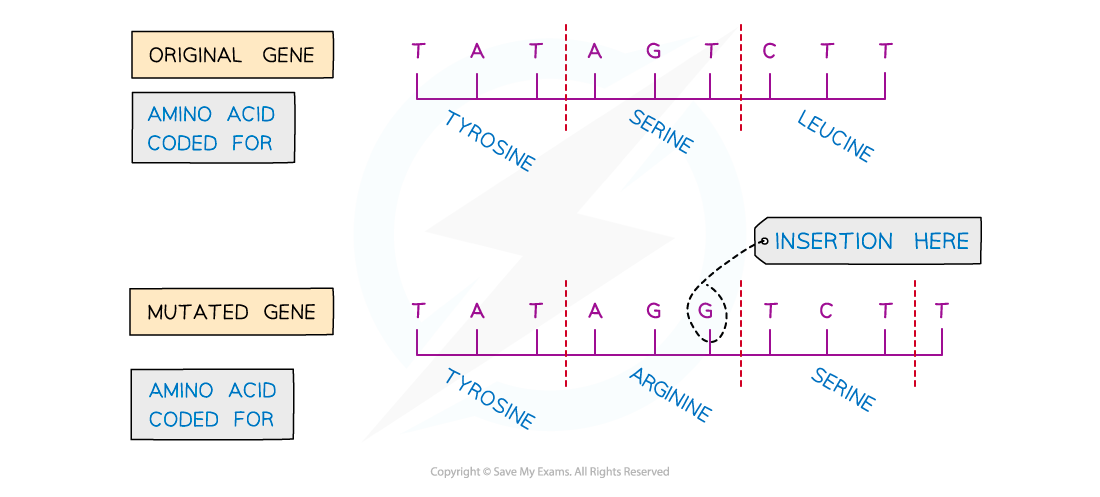
A mutation that takes place when a nucleotide is inserted randomly with a new base into a DNA sequence is referred to as an insertion mutation.
An insertion mutation causes a change in the amino acids that would have been encoded for by the original base triplet, as it forms a new, distinct triplet of bases. This is because every group of three bases in a DNA sequence encodes for an amino acid. An insertion mutation also has a knock-on effect by altering the triplets, i.e. a group of three bases further on in the DNA sequence. Sometimes, this is called a frameshift mutation. This may alter the amino acid sequence considerably produced from this gene. As a result, the ability of the polypeptide to function is also affected.
Deletion of Nucleotides
Deletion mutation is defined as:
A mutation that takes place when a nucleotide (and its base) is randomly deleted from the DNA sequence is referred to as a deletion mutation
Just like an insertion mutation, a deletion mutation also has a knock-on effect by altering the groups of three bases further on in the DNA sequence. Sometimes, this is referred to as a framework mutation. It can significantly alter the amino acid sequence produced from the gene and hence the ability of the polypeptide to function.
Substitution of Nucleotides
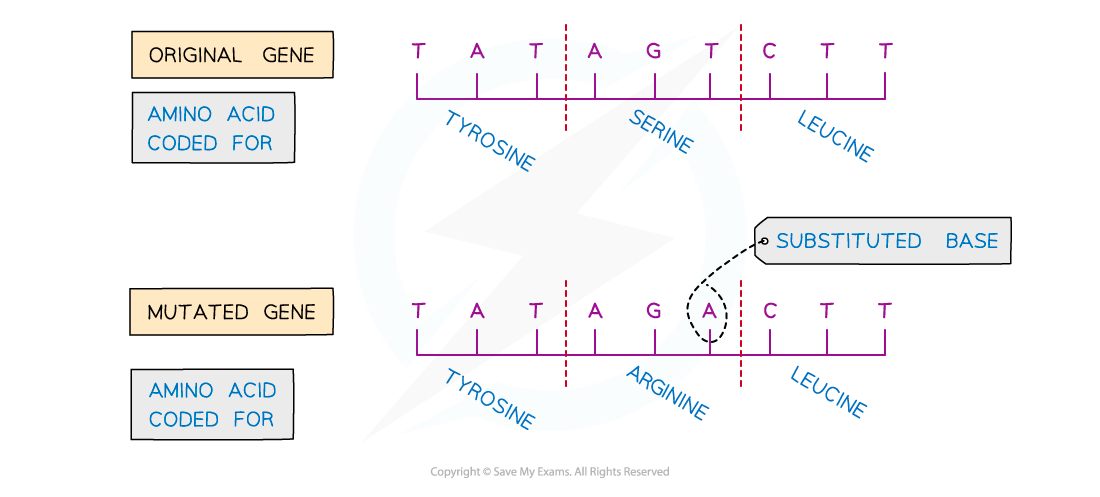
A substitution mutation refers to a kind of mutation that takes place when a base in the DNA sequence is randomly swapped for a different base.
As compared to an insertion or deletion mutation, a substitution mutation will only alter the amino acid for the triplet, i.e. a group of three bases, in which the mutation takes place. It will not have any knock-on effect.
There are three forms of a substitution mutation:
- Silent mutations: This mutation does not change the amino acid sequence of the polypeptide (this is due to the fact that the specific codons may code for the same amino acids when the genetic code is degenerate)
- Missense mutations: This type of mutation changes one amino acid in the polypeptide chain. For instance, a single substitution mutation that alters one amino acid in the sequence causes a disease known as sickle cell anaemia.
- Nonsense mutations: Due to this mutation, a premature stop codon is created. Premature stop codon refers to the signal for the cell to stop translation of the mRNA molecule into an amino acid sequence. This results in the incomplete production of the polypeptide chain and hence affects the final protein structure and function. For instance, the nonsense mutation causes a disease known as cystic fibrosis. However, it is not the only cause of this disease.
In the next section, we will discuss inversion within a gene section.
Inversion Within a Gene Section
It generally takes place while crossing over in meiosis. A single gene DNA is cut in two places. The portion that is cut is inverted  , then joined back to the same place within the gene. As a result, a large section of the gene is backward which in turn affects the multiple amino acids. Inversion mutations often cause a non-functional protein. In a few cases, a different protein is produced.
This type of mutation is usually dangerous because the original gene cannot be expressed from that chromosome. The harmful effect of the mutation can be minimized if the other chromosome in the pair carries a working gene.
Duplication of a Gene
An entire gene or a gene section is duplicated so that the two copies of the gene or section appear on the same chromosomes. This mutation is not dangerous because the original version of the gene remains in place. With time, the second copy can undergo mutations that allow it to develop new functions. Duplication mutations are a crucial source of evolutionary change. For instance, alpha, beta, and gamma haemoglobin genes have evolved because of the duplication mutations.
In the next section of the article, we will discuss the translocation of a gene section.
Translocation of a Gene Section
A gene is cut in two places just like inversion. The part of the gene that is cut off attaches to a separate gene. As a result, the cut gene becomes non-functional because of the missing section. Moreover, the gene that has gained the translocated section can also become non-functional. If the section of the proto-oncogene is translocated onto a gene that controls the cell division, then it could increase expression and cause tumours.
Similarly, if a section of a tumour suppressor gene is translocated which results in a faulty tumour suppressor gene, then cell continuing replication can occur when it has faulty DNA.
Summarise with AI:
Did you like this article? Rate it!


 Loading...