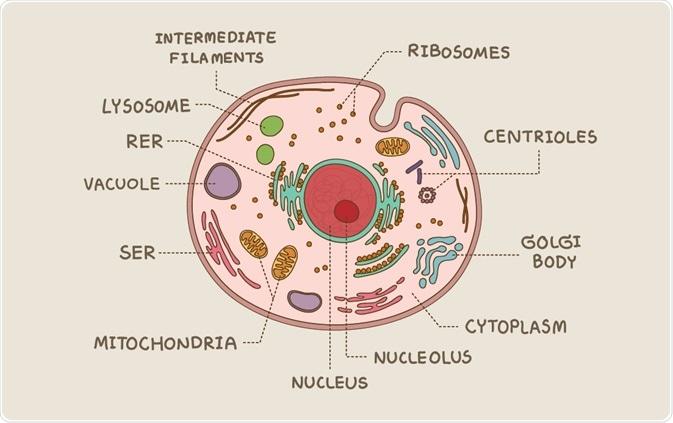
In this article, we will discuss the cell structures present in the eukaryotic cells. So, let us get started.

The best Science tutors available


Joe
£70
/h

1st lesson free!

Hiren
£85
/h
1st lesson free!

Harjinder
£25
/h
1st lesson free!

Petar
£45
/h
1st lesson free!

Imad
£95
/h
1st lesson free!

Andrew
£250
/h
1st lesson free!

Juneyt (ma, msc oxford)
£110
/h
1st lesson free!

Ritchard
£168
/h
1st lesson free!
Joe
£70
/h
1st lesson free!
Hiren
£85
/h
1st lesson free!
Harjinder
£25
/h
1st lesson free!
Petar
£45
/h
1st lesson free!
Imad
£95
/h
1st lesson free!
Andrew
£250
/h
1st lesson free!
Juneyt (ma, msc oxford)
£110
/h
1st lesson free!
Ritchard
£168
/h
1st lesson free!
Cell Surface Membrane
- A cell surface membrane surrounds every cell. The main objective of this membrane is to control the exchange of materials between the internal and external environment of the cell.
- This membrane is partially permeable which means that it allows some materials to pass through it, whereas it prevents other materials to enter the cell.
- The cell membrane is created from a phospholipid bilayer of phospholipids having a diameter of around 10 nm.
- The cell membrane is also referred to as a plasma membrane.
Cell Wall
- Unlike the cell membrane, which is a partially permeable membrane, the cell wall is a freely permeable membrane which means that it allows most substances to pass through it.
- The cell wall is present outside the cell membrane.
- The cell wall provides structural support to the plasma or cell membrane.
- In-plant cells, the cell wall provides structural support to the cell membrane through polysaccharide cellulose.
- In many bacterial cells, the cell wall provides structural support to the cell membrane through peptidoglycan.
- Plasmodesmata which are narrow threads of cytoplasm that connect the cytoplasm of neighbouring plant cells are surrounded by the cell membrane.
Nucleus
- The nucleus of the cell contains the genetic material of the cell known as chromatin.
- Chromatin refers to the complex of DNA and histone proteins.
- The nucleus is found in all eukaryotic cells.
- The nucleus in the eukaryotic cells is relatively large.
- A double membrane having several pores known as the nuclear envelope segregates the nucleus from the cytoplasm
- Nuclear pores in the nucleus of the eukaryotic cell are vital channels that allow mRNA and ribosomes to move out of the nucleus.
- Nuclear pores also enable enzymes like DNA polymerases and signalling molecules to move in.
- The nucleus has chromatin. Chromosomes are made up of chromatin.
- Generally, in eukaryotic cells, one can observe at least one or more darkly stained regions.
- These regions are individually referred to as nucleolus and are termed as sites of ribosomes production.
Mitochondria
- In eukaryotic cells, mitochondria (single: mitochondrion) are the site of aerobic respiration. Aerobic respiration is a type of respiration that requires oxygen.
- We can observe mitochondria using a light microscope
- Mitochondria are surrounded by the double membrane and the inner membrane of the mitochondria contains protein complexes that are critical for the later stages of aerobic respiration embedded within it.
- The inner membrane of the mitochondria is folded to form cristae
- The matrix created by the cristae has enzymes that are vital for aerobic respiration and the production of ATP
- Mitochondrial DNA which are the circular pieces of DNA and ribosomes are also present in the matrix.
- Mitochondrial DNA and ribosomes are required for replication.
Chloroplast
- Chloroplasts are present in the green parts of the plant. The green colour is due to the photosynthetic pigment known as chlorophyll
- Like mitochondria, a double membrane also surrounds the chlorophyll.
- Chloroplasts are larger than mitochondria.
- Structures known as grana are formed when membrane-bound compartments containing chlorophyll referred to as thylakoids are stacked
- Lamellae refer to the thin and flat thylakoid membranes that join the grana together
- Chloroplasts are the main site of photosynthesis which refers to the process by which plants make their food.
- The light-dependent stage of photosynthesis occurs in thylakoids
- The light-independent stage known as the Calvin cycle of photosynthesis occurs in the stroma.
- Chloroplasts also have circular pieces of DNA and ribosomes which play an important role in the synthesis of proteins.
- Protein synthesis is required in chloroplasts replication and photosynthesis.
Ribosome
- Ribosomes are created in the nucleolus and are made up of equal amounts of protein and RNA.
- These structures are present freely in the cytoplasm of all the cells or as a component of the rough endoplasmic reticulum in eukaryotic cells
- Each ribosome is a composite of ribosomal RNA (rRNA) and proteins
- In eukaryotic cells, 80S ribosomes made up of 60S and 40S subunits are present
- 70S ribosomes made up of 50S and 30S subunits are found in prokaryotes, chloroplasts, and mitochondria
- Ribosomes are the site of translation, i.e. protein synthesis.
Endoplasmic Reticulum
Rough Endoplasmic Reticulum (RER)
- It refers to a surface that is covered in ribosomes
- It is created from continuous folds of membrane continuous with the nuclear envelope
- RER processes proteins created by the ribosomes
Smooth Endoplasmic Reticulum
- It does not contain ribosomes on the surface
- Its main function is different from the RER (rough endoplasmic reticulum)
- It plays an important role in producing, processing, and storing carbohydrates, lipids, and steroids.
Golgi Apparatus (Golgi Complex)
- It refers to the flattened sacs of the membrane that resembles smooth endoplasmic reticulum
- It alters proteins and packages them into lysosomes or vesicles
Large Permanent Vacuole
- It refers to the sac in a plant cell that is surrounded by the tonoplast which is a selectively permeable membrane
- In animal cells, vacuoles are temporary and small
Vesicle
- Vesicle refers to a membrane-bound sac that plays an important role in transportation and storage.
Lysosome
- Lysosome refers to a special form of vesicles containing hydrolytic enzymes.
- Hydrolytic enzymes break down the biological molecules
- These structures break down waste materials like worn-out organelles are employed extensively the cells in the immune system and programmed cell death known as apoptosis
Centriole
- Centriole refers to the hollow fibres of microtubules.
- A centrosome is created from two centrioles at right angles to each other.
- During cell division, a centrosome organizes the spindle fibres.
- These structures are absent in flowering plants and fungi
Microtubules
- Microtubule makes up the cytoskeleton of the cell which is about 25 nm in diameter.
- Composed of alpha (α) and beta (β) tubulin which combine to create dimers.
- The dimers are then connected into protofilaments.
- A microtubule is made up of 13 protofilaments in a cylinder
- The cytoskeleton not only provides support but also helps in the movement of the cell.
Microvilli
- Microvilli refer to the projections of the cell membrane that enhance the surface area for absorption.
Cilia
- Cilia refer to the hair-like projections made up of microtubules
- Cilia enable the movement of substances over the surface of the cell
Flagella
- The structure of flagella resembles that of the cilia and are made of longer microtubules
- Cilia contract to offer the movement of the cell, for instance, in sperm cells.
Summarise with AI:
Did you like this article? Rate it!


 Loading...