In this article, we will discuss the plant leaves adaptations in Xerophytic plants and how these adaptations help the Xerophytic plant survive in dry and arid conditions. Moreover, we will also discuss how assimilates dissolved in water, such as sucrose and amino acids, move from sources to sinks in phloem sieve tubes. Before proceeding to discuss the Xerophytic plant leaves adaptations, first, let us see what Xerophytic plants are and in which regions they are commonly found.


What are Xerophytic Plants?
The term xerophytes come from the Greek word "Xero" which means dry. Xerophytic plants are adapted for dry and arid environments. They have physiological and structural adaptations for maximum conservation of water. Xerophytic plants are present in locations where there is low availability of liquid water. These regions include desert and ice or snow-covered regions in the Arctic or the Alps. The most common examples of Xerophytic plants include pineapple, cacti, and a few Gymnosperm plants.
In the next section of the article, we will discuss different adaptations of Xerophytic plants and how these adaptations help them to conserve water.
Leaf Adaptations in Xerophytic Plants
Different adaptations of xerophytic plant leaf are discussed below:
- Flashy succulent leaves: Xerophytic plants have fleshy succulent leaves which allow them to store water for times when water availability is low. An example of a Xerophytic plant that has this adaptation is Bryophyllum.
- Shrinking of hinge cells when flaccid: When Xerophytic plants are flaccid, their hinge cells shrink. This adaptation causes the rolling of leaves so that the thick, waterproof cuticle is exposed to the air. It results in the creation of a humid space in the middle of the rolled leaf. An example of the Xerophytic plant with such an adaptation includes Ammophilia Arenaria (Marram grass).
- Leaves are reduced to spines, needles, or scales and they are folded or rolled when flaccid: This adaptation reduces transpiration in Xerophytic plants because of the availability of limited surface area. The Xerophytic plants which contain this feature include Opuntia (cactus), Arenaria (Marram grass), and rolled leaf (Ammophilia).
- Closed stomata in the presence of light and opened stomata in the absence of light: CAM metabolism to reduce photorespiration. This adaptation allows the plants to fix carbon dioxide during the night and minimize water loss during the day. CAM plants are the best examples of Xerophytic plants which contain this adaptation. Examples of CAM plants include pineapple, yuca, and American aloe.
- Sunken stomata or presence of crypts and leaf surface covered with fine hairs: This adaptation minimizes the loss of water by trapping moist air near the area of water loss and thus reducing the diffusion gradient. Examples of Xerophytic plants which are adapted for this feature include Pinus sp, Phlomis Italica, and Nerium sp.
- The minimum number of stomata: Some Xerophytic plants have a reduced number of stomata which enables less loss of water due to fewer pores. Examples of Xerophytic plants which are adapted for this feature include Opuntia and Nerium sp.
- Stomata present in the upper epidermis only: These features present in some Xerophytic plants allow them to open into the humid space created by rolled shape and hair. An example of a Xerophytic plant that has this adaptation includes Ammophilia Arenaria (Marram grass).
- The presence of thick, waxy cuticles on leaves: Few Xerophytic plants have thick, waxy cuticles on leaves which minimizes the water loss through the cuticle. Examples are Opuntia, and Pinus sp.
Due to the above-mentioned adaptations, Xerophytic plants are able to survive in environments where water availability is low.
The following annotated drawing depicts the Xeromorphic features of an Ammophilia Arenaria (Marram grass) leaf.
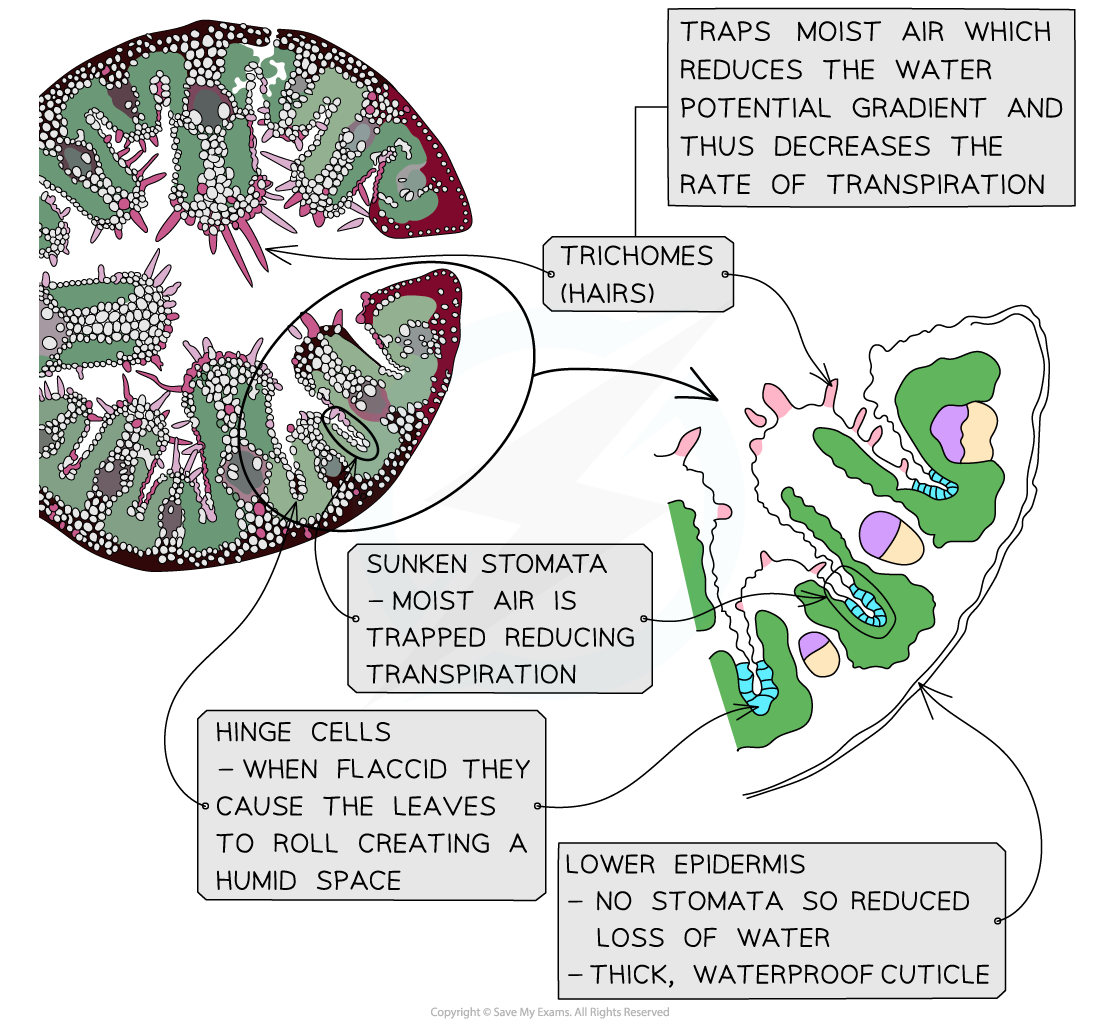
In the next section of the article, we will discuss how assimilates dissolved in water, such as sucrose and amino acids, move from sources to sinks in phloem sieve tubes.
Movement in the Phloem
Translocation refers to the movement from one place to another. From its literal meaning, it could be assumed that it means the transport of substances in the xylem and phloem. However, generally, it is associated with the transport of assimilates in the phloem tissue. Hence, we can define the translocation within the phloem tissue like this:
Transport of assimilates from source to sink which needs the input of metabolic energy (ATP)
The phloem sap refers to the liquid that is being transported. This liquid is present inside the phloem sieve tubes. The phloem sap not only contains sugars (generally sucrose), but also water and other dissolved substances like amino acids, minerals, and hormones.
The source of the assimilates can be:
- Green stem and green leaves (photosynthesis generates glucose which is moved as sucrose because sucrose has less osmotic effect as compared to glucose.
- Storage organs like tap roots and tubers unload their stored substances at the start of the growth period.
- Food stores are present in seeds that are undergoing germination.
The sinks where assimilates are needed can be:
- Meristems (lateral to apical that are dividing actively
- Roots that are growing and/or absorbing minerals actively
- Any component of the plant where assimilates are being stored. For instance, fruits, developing seeds, or storage organs.
The process of loading and unloading sucrose from the source to the phloem, and from the phloem to the sink is an active one. High temperatures or respiratory inhibitors can slow down or even stop this process. Scientists are yet trying to understand the translocation of assimilates fully. The scientists have the current information from the following studies:
- On plants whose sap clots so it is still possible to assemble and study the sap. The example includes castor oil plants
- Collecting sap by using the aphids. When an aphid inserts its stylet, i.e., a tubular mouthpart, the scientists remove the aphids head and assemble the sap that flows continuously
- Employing radioactively labelled metabolites. For instance, carbon-14 labelled sugars can be traced while translocation.
- Advancements in microscopes that have enabled the observation of companion cells adaptations
- Observations regarding the significance of mitochondria in the process of translocation
Summarise with AI:
Did you like this article? Rate it!


 Loading...