In this article, we will discuss some of the important terms in genetics. We will especially explain the terminologies which include gene, allele, locus, dominant, recessive, codominant, linkage, test cross, F1, F2, genotype, phenotype homozygous, and heterozygous. So, let us get started.


Genes and Alleles
Chromosomes contain DNA which is critical for the survival of the cell. Every chromosome has a long DNA molecule that codes for many different proteins. Let us see what genes, locus, and alleles are.
- Gene: A gene refers to a length of DNA that codes for one polypeptide or protein.
- Locus: A locus refers to a position of a gene on a chromosome
- Alleles: Each gene can be present in two or more distinct forms, referred to as alleles. Although, the nucleotide sequence of different alleles of the gene differ, however, they still have the same position (locus) on the chromosome.
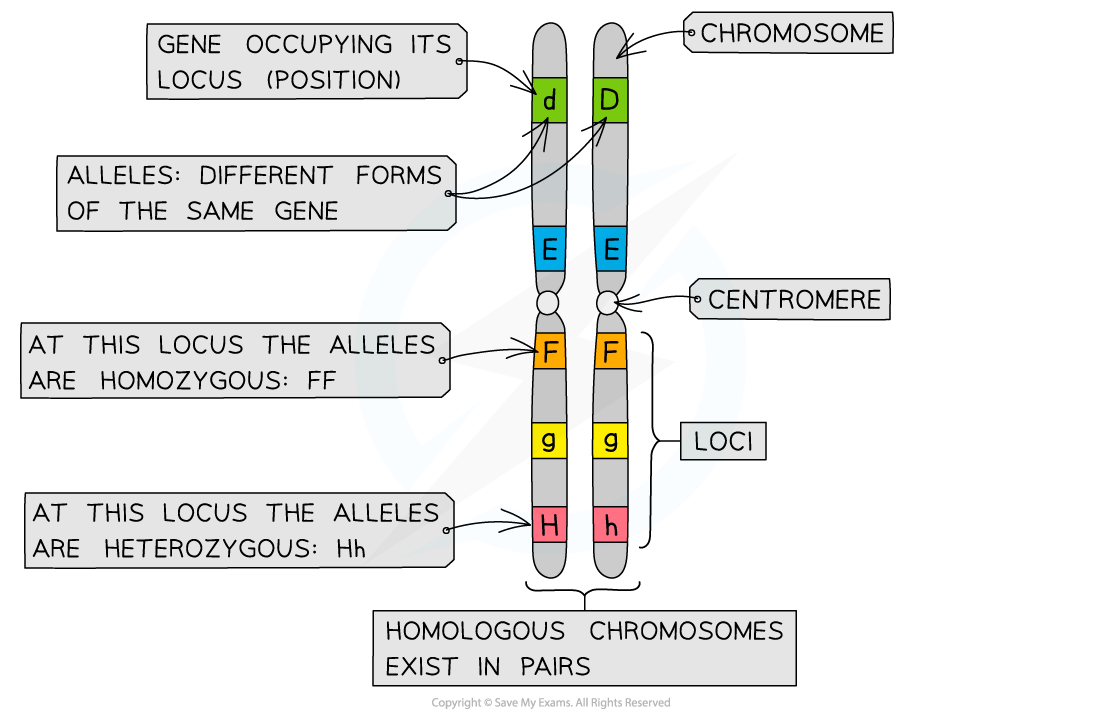
Alleles Example
Agouti is one of the genes in horses for the colour of the coat. This gene for coat colour is present in the same position on the same chromosome in every horse. Theoretically, two different forms, i.e. alleles: A and a of this gene are present in horses.
Both alleles produce different coat colours in the horses. For instance:
- Allele A produces a black coat colour
- Allele produces chestnut coat colour
Genotype and Phenotype
The chromosomes of eukaryotic cells are present in homologous pairs which means that there are two copies of each chromosome. Consequently, they have two copies of every gene. Because of the presence of two copies of a gene, different allele combinations can be found in an individual. Now, let us see what is meant by the terms genotype, homozygous, heterozygous, and phenotype.
- Genotype: The alleles of the gene possessed by an individual are referred to as the genotype of an organism. We use small and capital letters to represent different alleles of the same gene.
- Homozygous: if two copies of the alleles are identical in an individual, then they are referred to as homozygous.
- Heterozygous: If two copies of the alleles are different in an individual, then they are referred to as heterozygous.
- Phenotype: A phenotype refers to the observable characteristics (features) of an organism. The phenotype is affected by the genotype of an individual.
Example of Phenotype and Genotype
Each horse contains two copies of coat colour genes in all of its cells. A horse containing two black coat alleles A has the genotype AA and is referred to as homozygous. The phenotype of this horse will be a black coat.
On the other hand, the genotype of the horse that contains one black coat allele A and one chestnut coat allele a will be Aa and it will be heterozygous.
Dominance
Not all alleles have the same influence on the phenotype. Some alleles are dominant, while others are recessive.
- Dominant Allele: The dominant allele is always expressed in the phenotype which implies that they are expressed in homozygous as well as heterozygous individuals.
- Recessive Allele: The recessive allele is expressed in phenotype only when no dominant allele is found. It implies that it is only expressed when found in a homozygous individual rather than a heterozygous one.
Dominance Example
The phenotypes and genotypes below can take place if in the horses the allele A is dominant for a black coat and the allele a for chestnut is recessive:
- Genotype AA → black coat
- Genotype Aa → black coat
- Genotype aa → chestnut coat
Codominance
Codominance is when both alleles can be expressed in the phenotype at the same time. A heterozygous individual will express both alleles in their phenotype. While writing the genotype for codominance, we symbolize genes using capital letters and alleles with various superscript letters. For instance, IA.
Codominance Example
Human blood types have a very good example of codominance. I represent the gene for blood types in the genotype and A, B, and O represent the three alleles for human blood types.
Allele A leads to blood type A (IAIA or IAIO) and allele B leads to blood type B (IBIB or IBIO). If in a heterozygous individual, both alleles A and B are found, then they will have a blood type AB (IAIB). The blood type O (IOIO) is recessive to the alleles of both groups A and B.
F1, F2 & Test Crosses
- F1 generation: If a homozygous dominant individual crosses with a homozygous recessive individual, then the offspring are referred to as the F1 generation. Remember that all of the F1 generations are heterozygous.
- F2 generation: If two individuals from the F1 generation cross, then they produce offspring, referred to as the F2 generation
- Test Cross: We can employ a test cross to try and deuce a genotype of an unknown individual that expresses a dominant phenotype. This individual is crossed with an individual that expresses a recessive phenotype. As a result, the phenotypes of the offspring offer enough information to suggest the genotype of an unknown individual. If any offspring expresses the recessive phenotype, then the genotypes of an unknown individual must be heterozygous.
Linkage
In genetics, there are two kinds of linkages: sex linkage and autosomal linkage.
Sex Linkage
- X and Y are two sex chromosomes
- Women contain two copies of X chromosomes (XX). On the other hand, men have one X chromosome and one shorter Y chromosome (XY)
- Some genes are present on an area of the sex chromosome that is not found on the other sex chromosome
- Because the inheritance of these genes is influenced by the sex of the individual, hence they are referred to as sex-linked genes.
- The majority of the sex-linked genes are present on the longer X chromosome
- One of the popular examples of a sex-linked disease is haemophilia
- In the genotype, we represent the sex-linked genes by writing the alleles as a superscript next to the sex chromosome. For instance, a specific gene that is present on the X chromosome only has two alleles G and g. We will write the genotype of a heterozygous female as XGXg. We will write a male genotype as XGY.
Autosomal Linkage
Autosomal linkage takes place on the autosomes which refer to any chromosome that is not a sex chromosome. During meiosis, two or more genes on the same chromosome do not assort independently. These genes are not only linked, but they also remain together in the original parental combination.
Summarise with AI:
Did you like this article? Rate it!

 Loading...