In this article, we will discuss how the information in DNA (Deoxyribonucleic acid) is employed during transcription and translation to construct polypeptides. We will also discuss the roles of RNA polymerase, messenger RNA (mRNA), codons, transfer RNA (tRNA), anticodons, and ribosomes. Besides this, we will also discuss transcribed and non-transcribed strands. So, let us get started.


Transcription and Translation to Construct Polypeptides
A gene is defined as:
A sequence of nucleotide bases in a DNA molecule that ciphers for the production of a particular sequence of amino acids, that in turn creates a particular polypeptide, i.e. protein is referred to as a gene.
Stages of protein synthesis
The synthesis of protein is carried out in the following two stages:
- Transcription: At this stage, DNA is transcribed, and mRNA (messenger RNA) molecule is produced
- Translation: This stage of protein synthesis involves the translation of messenger RNA (mRNA) and the production of amino acid sequence
In the next section of the article, we will discuss the transcription stage of protein synthesis in detail.
Transcription
- This stage of protein synthesis takes place in the cell’s nucleus
- It involves the unwinding of the component of a DNA molecule (there is a breakdown of the hydrogen bonds between the complementary base pairs)
- As a result, the gene to be transcribed gets exposed. The gene to be transcribed is a gene from which a specific polypeptide will be produced.
- A complimentary copy from the gene is created by constructing a single-stranded nucleic acid molecule referred to as messenger RNA (mRNA)
- Through hydrogen binds, free activated RNA nucleotides pair up with their exposed complementary bases on a single strand, i.e. a template strand of the unzipped DNA molecule
- The enzyme is known as RNA polymerase then bonds together the sugar-phosphate groups of these RNA nucleotides to create a sugar-phosphate backbone of the messenger RNA (mRNA) molecule
- The hydrogen bonds between mRNA and DNA break after the gene is transcribed, i.e. when the mRNA molecule is complete. Besides this, there is a re-formation of the double-stranded DNA molecule
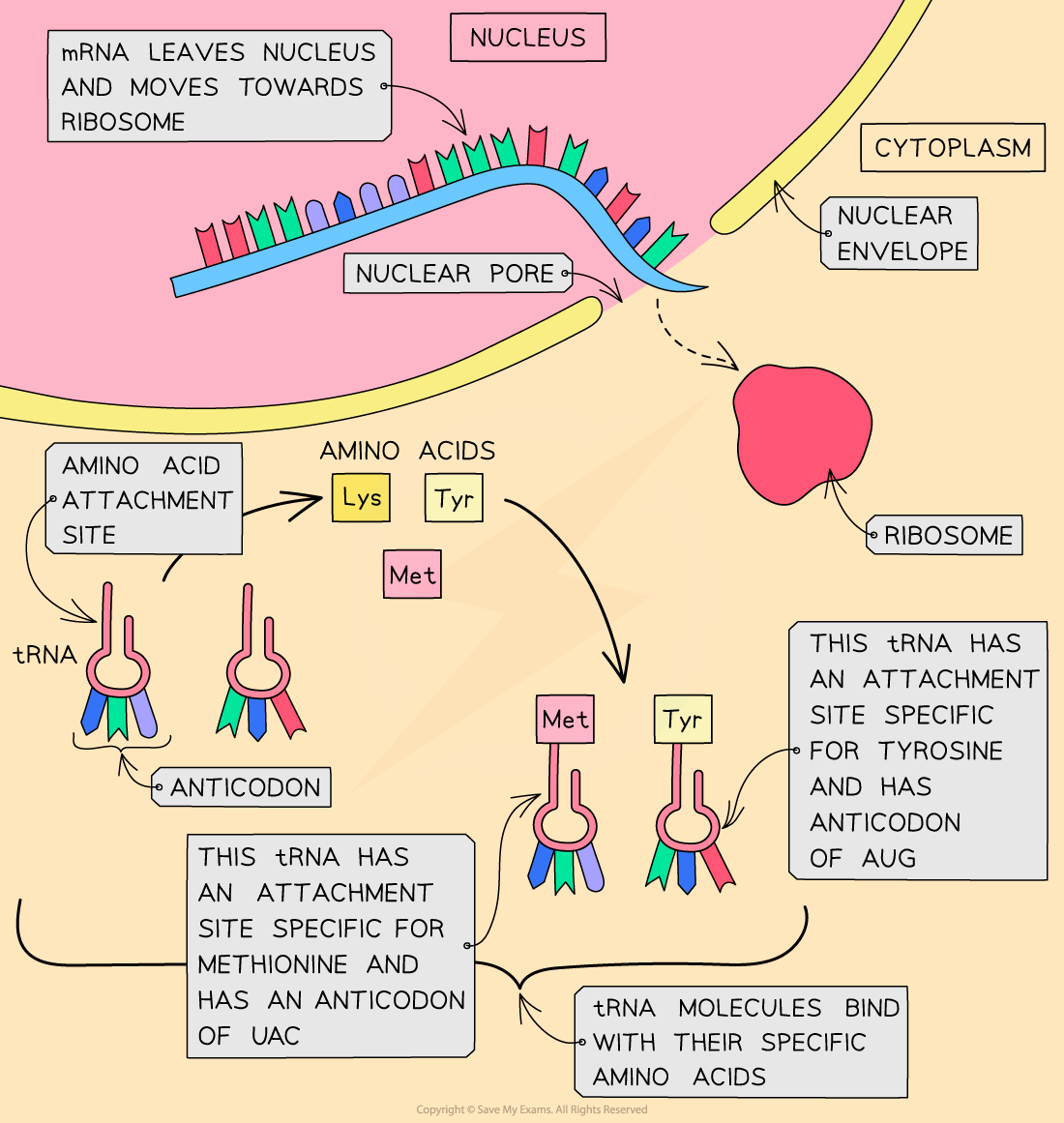
- The mRNA molecule then exits the nucleus through a pore in the nuclear envelope
The following figure shows the transcription stage of protein synthesis in which transcription of DNA and production of mRNA molecule takes place:
In the next section of the article, we will discuss the translation stage of protein synthesis in detail.
Translation
- This stage of the protein synthesis takes place in the cell’s cytoplasm
- The mRNA molecule attaches to a ribosome after it exits the nucleus
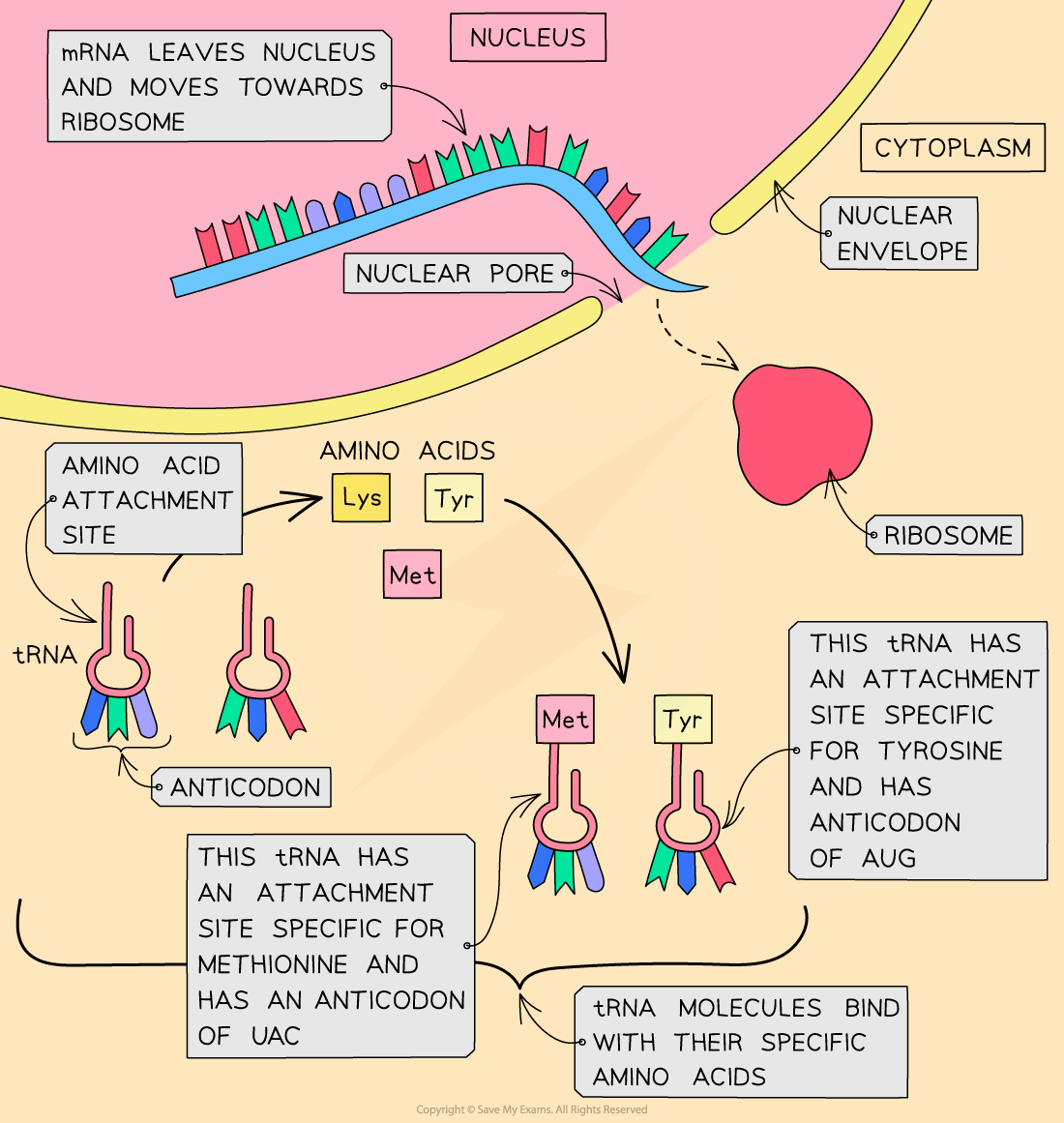
- There are free molecules of transfer RNA, i.e., tRNA in the cytoplasm which contains a triplet of unpaired bases at one end referred to as anticodon and an area where a particular amino acid can attach at the other
- There are a minimum of 20 distinct tRNA molecules. Each tRNA molecule has a particular anticodon and a specific amino acid binding site
- The binding of tRNA molecules with their specific amino acids takes place in the cytoplasm. The tRNA molecules bring these amino acids to the mRNA molecule on the ribosome
- After that, the triplet of bases, i.e. the anticodon on each tRNA molecule pairs with the complementary triplet, i.e. a codon on the mRNA molecule
- Two tRNA molecules fit onto the ribosomes at any one time and bring the amino acids they are carrying side by side
- After that, a peptide bond is created between the two amino acids
- This process goes on until a “stop” codon on the mRNA molecule arrives. The stop codon plays a role in the signal for translation to stop and at this point, the amino acid chain encoded by the mRNA molecule is completed
- A final peptide is then created by this amino acid chain
The following figure shows the translation stage of the protein synthesis in which the binding of tRNA molecules with specific amino acids takes place:
In the next section of the article, we will discuss the template and non-template strands in detail.
Template and Non-Template Strands
- The part of the DNA molecule where the gene is present, i.e., a gene encoded for a specific polypeptide, unwinds in the transcription stage of the protein synthesis. The two strands of DNA unzip when the hydrogen bonds between the complementary base pairs break down.
- After that, the free activated RNA nucleotides pair up with the exposed bases on the DNA molecule. Remember that this pairing occurs only with those bases on one strand of the DNA molecule
- This strand of DNA molecule is referred to as a template strand or transcribed strand
- This is a strand that is transcribed to create the mRNA molecule (the RNA polymerase enzyme binds the RNA nucleotides together to form the sugar-phosphate backbone of the mRNA molecule. This mRNA molecule is then translated into an amino acid chain.
- The DNA molecule strand that is not transcribed is known as a non-template strand or non-transcribed strand.
In the next section of the article, we will discuss non-transcriptional modification.
Post-Transcriptional Modification
- There are both coding as well as non-coding sequences of DNA within the eukaryotic genes
- The coding sequences are referred to as exons. Exons are the sequences that will be eventually translated into the amino acids that will create the final polypeptide
- The non-coding sequences are referred to as introns and they are not translated, i.e. they do not encode for any amino acids
- Both exons and introns are transcribed when the transcription of a gene takes place
- This implies that an RNA molecule is created which is referred to as a primary transcript. It also contains exons and introns
- The introns should be eliminated from the RNA molecule because they are not to be translated
- After that, the exons are joined together to create a continuous RNA molecule known as mature mRNA that is ready for translation
- Sometimes, this process is known as splicing. It is the part of the process of post-transcriptional modification which refers to the modification of the RNA molecule after transcription but before the occurrence of translation
Summarise with AI:
Did you like this article? Rate it!


 Loading...