In calculus and mathematical modelling, we often want to find the absolute best or absolute worst outcome of a scenario. An engineer designing a bridge wants to identify the point of maximum structural stress; an economist wants to determine the exact production level that minimises manufacturing costs.
To solve these problems, we use the concepts of maxima (peaks) and minima (troughs), collectively referred to as extrema.
However, there is a vital distinction between a peak that is simply higher than the ground immediately surrounding it, and the single highest peak on the entire map. In mathematics, we categorise these as relative (local) and absolute (global) extrema. Understanding how these differ, and how to calculate them, is a core objective of your A-Level Calculus syllabus.


Defining Local vs. Global Extrema
To make sense of these terms, think of a mountain range.
- A relative (local) maximum is like the summit of an individual hill. It is the highest point relative to its immediate surroundings.
- The absolute (global) maximum is like the peak of Mount Everest. It is the single highest point across the entire domain of the function.
Let's define these mathematically:
Relative (Local) Extrema
A function has a relative maximum at if for all in a small open interval surrounding .
Conversely, it has a relative minimum if for all in that immediate neighborhood.
- Note: Relative extrema can only occur at turning points (where the gradient ) or where the derivative is undefined.
Absolute (Global) Extrema
A function has an absolute maximum at if for every in the entire domain of the function.
It has an absolute minimum if for every across the entire domain.
Visualising Extrema on Bounded Intervals
When we look at functions restricted to a specific interval—written as [a, b]—the boundaries can completely change which points are considered absolute maxima or minima.
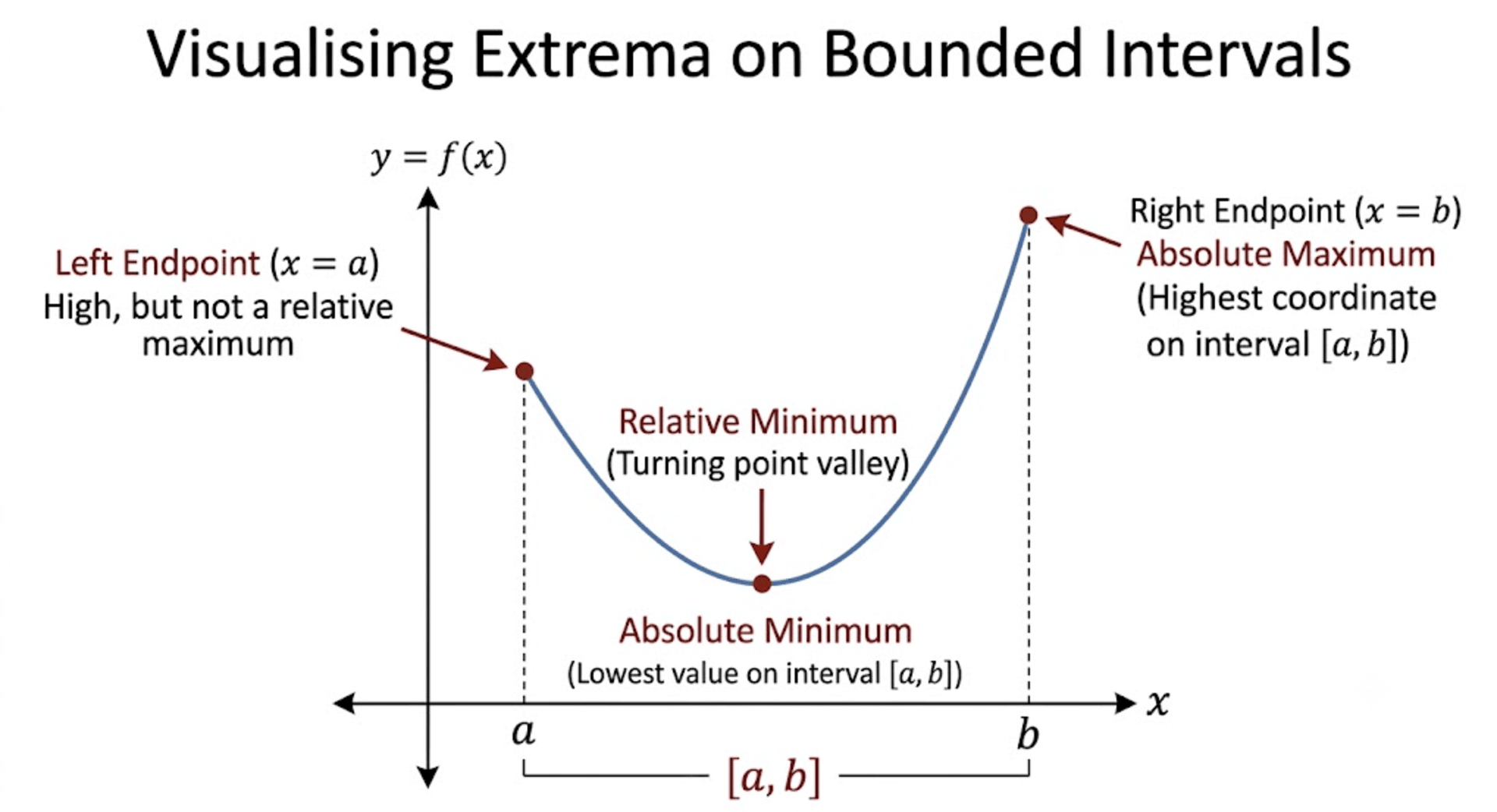
Key Observations from the Graph:
- The Endpoint Rule: Notice the point at the left boundary, x = a. It is high up, but it is not a relative maximum. Why? Because a relative extremum requires you to look at a small interval on both sides of the point. Since the graph stops at a, you cannot check the left side.
- Absolute at the Boundary: Even though the endpoint at x = b cannot be a relative maximum, it actually reaches the highest vertical coordinate on the entire graph. This makes it the absolute maximum of the function on this interval.
- The Double Label: The lowest trough in the middle of the curve is both a relative minimum (it is a turning point valley) and the absolute minimum (no other point on the entire curve goes lower).
How to Find Absolute Extrema (The Interval Method)
To calculate the absolute maximum and minimum values of a continuous function on a closed interval [a, b], you cannot just set the derivative to zero. You must check the turning points and the boundaries.
Use this systematic checklist for your exams:
| Step | Action | Mathematical Expression |
|---|---|---|
| 1 | Differentiate the function | Find f'(x) |
| 2 | Locate stationary points | Set f'(x) = 0 and solve for x |
| 3 | Filter the stationary points | Keep only the x-values that fall inside your interval [a, b] |
| 4 | Evaluate the function at critical points | Calculate f(x) for each valid stationary point |
| 5 | Evaluate the function at the boundaries | Calculate the endpoint values f(a) and f(b) |
| 6 | Compare and declare | The largest result is the absolute maximum; the smallest is the absolute minimum |
Exam-Style Worked Examples
Example 1: Pure Algebraic Absolute Extrema
Question: Find the absolute maximum and absolute minimum values of the cubic function:
on the closed interval [-1, 4].
Step-by-Step Solution:
Differentiate the function:
Set the first derivative to zero to find the stationary points:
This gives critical coordinates at x = 0 and x = 2.
Check if these points lie within our interval [-1, 4]:
- x = 0 is inside the interval. (Keep)
- x = 2 is inside the interval. (Keep)
Evaluate the function at these stationary points:
- At :
- At :
Evaluate the function at the boundary endpoints (x = -1 and x = 4):
- At the left boundary :
- At the right boundary :
Compare all of your calculated values:
| Coordinate Tested | Type of Point | Function Output f(x) |
|---|---|---|
| x = -1 | Left Endpoint | -3 |
| ]x = 0 | Turning Point (Local Max) | 1 |
| x = 2 | Turning Point (Local Min) | -3 |
| x = 4 | Right Endpoint | 17 |
Absolute Maximum: The largest value is 17, which occurs at the boundary x = 4.
Absolute Minimum: The smallest value is -3. This minimum occurs at two locations: the turning point x = 2 and the boundary x = -1.
Example 2: Applied Optimisation with Boundaries
Question: A farmer wants to construct a rectangular vegetable patch against a straight stone wall, using of fencing for the other three sides. The area A of the patch is given by , where x represents the width of the patch in metres. Given that physical limitations restrict the width such that , find the absolute maximum and minimum area of the vegetable patch.
Step-by-Step Solution:
Expand the function and find the derivative:
Find the stationary points:
The width x = 10m lies safely within our restricted domain [5, 15].
Evaluate the area at this stationary point:
Evaluate the area at the domain boundaries (x = 5 and x = 15):
- At the lower boundary :
- At the upper boundary :
Compare the results:
- The absolute maximum area is when the width is .
- The absolute minimum area is which occurs at both boundary limits, and .
Examiner Tips & Common Pitfalls
Critical Exam Warning: When asked to classify relative extrema, many students mistakenly think that finding automatically proves a point of inflexion. Remember, if your second derivative is zero, the test is inconclusive! You must construct a sign table (the First Derivative Test) to check the gradient's behaviour slightly to the left and right of your turning point.
Additionally, always read the question's wording carefully. If an exam asks for "the coordinates of the absolute maximum," you must write your answer as an (x, y) coordinate pair. If it asks for "the absolute maximum value of the function," it is strictly asking for the output y-value.
Practice Questions & Answers
Find the absolute maximum and absolute minimum values of the quadratic function:
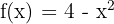
on the closed interval [-3, 1].
Differentiate:
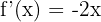
Find stationary points:
 .
.
This point is inside [-3, 1].
Evaluate at critical point:
 .
.
Evaluate at boundaries:


Compare: The absolute maximum value is 4 (at x = 0), and the absolute minimum value is -5 (at x = -3).
A curve has the equation:
 .
.
Find the coordinates of all relative (local) extrema and classify their nature.
Differentiate:

Find stationary points:
 .
.
Determine nature using the second derivative:

For x = 1:
 .
.
Since -6 is less than <0, the point (1, 5) is a relative maximum.
For x = 2:
 .
.
Since 6 is greater than 0, the point (2, 4) is a relative minimum.
Find matching y-coordinates:


Determine the absolute maximum and minimum values of:
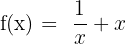
on the interval [0.5, 4].
Differentiate:

Find stationary points:

(we ignore the negative root x = -1 as it lies outside our domain [0.5, 4]).
Evaluate at critical point:
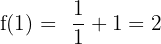 .
.
Evaluate at boundaries:

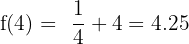
Compare: The absolute maximum value is 4.25 (at x = 4), and the absolute minimum value is 2 (at the local minimum turning point x = 1).
Summarise with AI:
Did you like this article? Rate it!


 Loading...
I get it somehow, there are others who are unfamiliar and I have a hard time with it but it’s okay that I get it.
Thanks for sharing your thoughts! It’s completely normal to find some parts unfamiliar or more difficult than others. The important thing is that you’re making progress and understanding more as you practise. Keep going! 😊
At least I understood some of it, but there are others that I’m confused about and have a hard time understanding, but I get it.
Thanks for sharing! It’s great that you’ve understood some of it already. Don’t worry if a few parts are still confusing — keep practising and take your time with the trickier sections. You’ll get there! 😊
The lesson was a little difficult for me, especially the word problems, but the examples helped me understand it better.
Thanks for your feedback! Word problems can definitely be tricky, so we’re glad the examples helped make the lesson clearer. Keep practising — it gets easier with time! 😊
Thankyouuu po