When sketching and analysing complex functions in A-Level Mathematics, understanding a curve's limiting behaviour at its spatial boundaries is crucial. An asymptote is a straight line that a curve approaches indefinitely but never actually meets or intersects as it heads towards infinity.
Think of an asymptote as a guiding track that shapes the profile of a graph. As your coordinate values stretch towards infinity, the distance between the actual curve and this invisible boundary line shrinks closer and closer to zero.
There are three distinct classifications of asymptotes you must master for your exams:
- Vertical Asymptotes: Vertical tracks parallel to the y-axis where a function breaks down.
- Horizontal Asymptotes: Horizontal lines parallel to the x-axis that show the long-term settling value of a function.
- Oblique (Slant) Asymptotes: Diagonal boundary lines of the linear form .


Vertical Asymptotes
The Rule
A vertical asymptote occurs at specific coordinate positions where a function is mathematically undefined, causing the output values to shoot upwards towards or drop towards . For any rational fraction function, a vertical asymptote is found by identifying the real roots that make the denominator equal to zero (provided those roots do not also make the numerator zero).
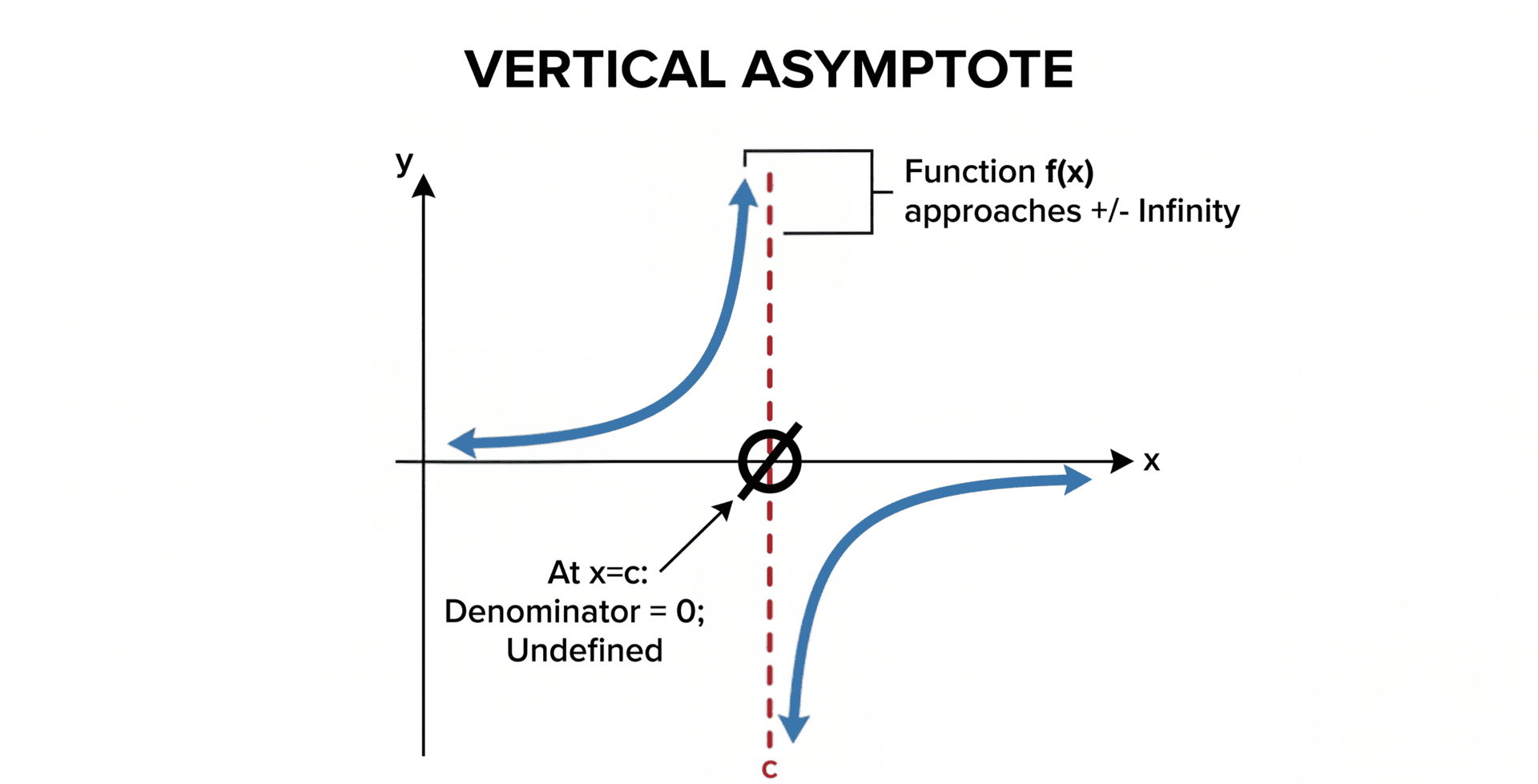
If the denominator equals zero at x = a, then the equation of the vertical asymptote is simply:
Worked Example
Find the vertical asymptote of the rational function:
To find the break path, isolate the denominator and set it equal to zero:
Interpretation
The line x = 3 is the vertical asymptote. If you choose an x-value slightly larger than 3 (like 3.001), the denominator becomes a tiny positive decimal, causing f(x) to spike to a massive positive value. If you approach 3 from the left (like 2.999), the denominator becomes a tiny negative decimal, driving the graph down towards negative infinity. The value x = 3 is strictly excluded from the function's domain.
Horizontal Asymptotes
The Rule
A horizontal asymptote outlines the flat structural boundary that a curve settles onto as the input variable  grows infinitely large in either the positive or negative direction ().
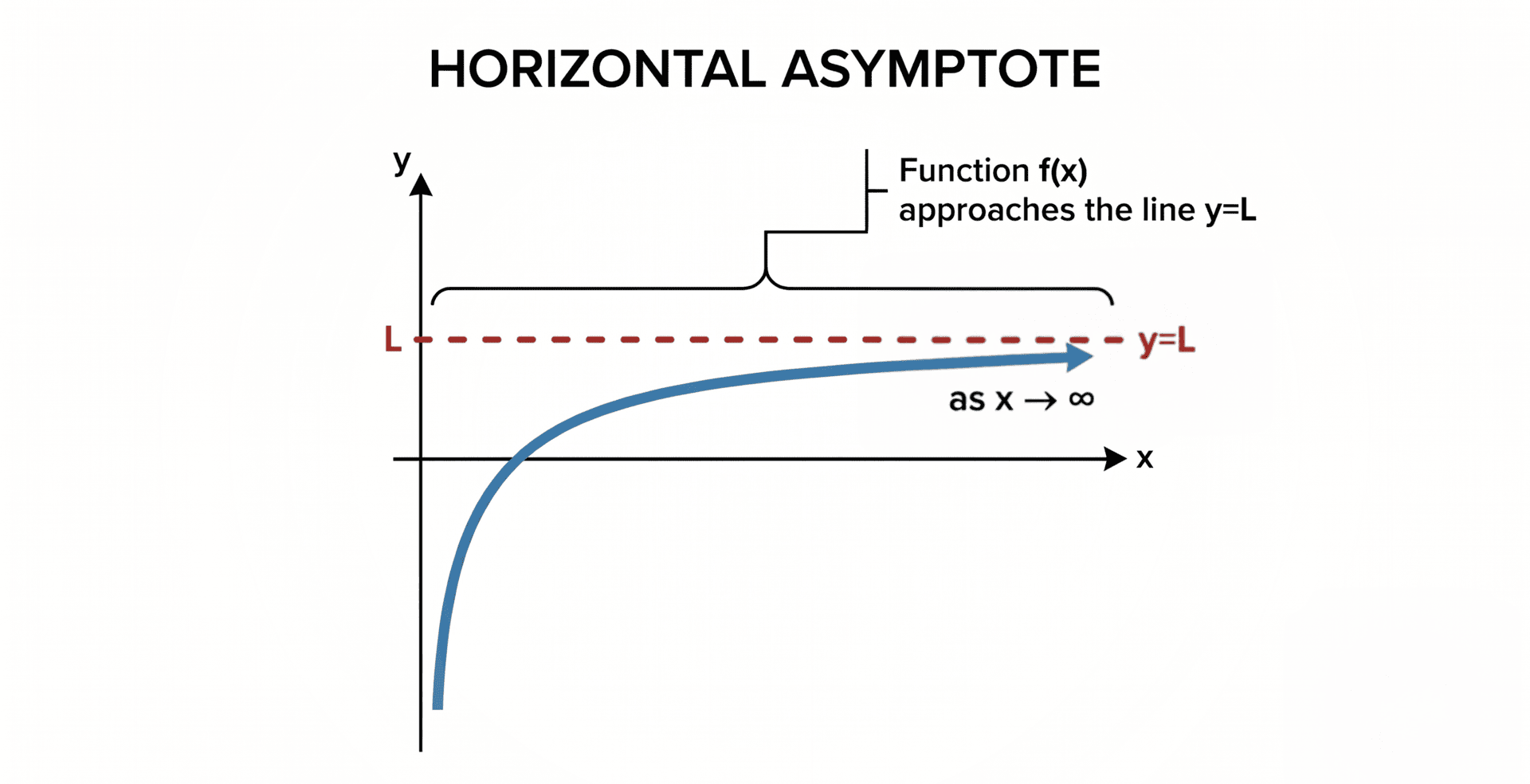
To find a horizontal asymptote for a rational function , compare the highest power (degree) of x in the numerator against the highest power in the denominator:
| Degree Condition | Asymptote Behavior | Resulting Equation |
|---|---|---|
| Numerator degree is less than denominator degree | The denominator grows significantly faster than the numerator | y = 0 (The x-axis) |
| Numerator degree equals denominator degree | The long-term value settles on the ratio of the leading coefficients | 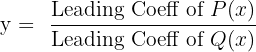 |
| Numerator degree is greater than denominator degree | The curve grows infinitely without flattening out | No horizontal asymptote exists |
Worked Example
Find the horizontal asymptote of the function:
The highest power in both the numerator and denominator is . Because the degrees match, divide the leading coefficients:
Interpretation
The line y = 3 is the horizontal asymptote. As you substitute exceptionally large positive or negative values of x into the equation, the constant adjustments (-4 and +5) become entirely insignificant. The function simplifies effectively to , meaning the curve flattens out and pulls tightly along the horizontal line y = 3 at the far left and right wings of the grid.
Oblique (Slant) Asymptotes
The Rule
An oblique asymptote is a diagonal boundary line that takes the linear shape . This specific configuration occurs only when the highest degree of the numerator is exactly one higher than the degree of the denominator.
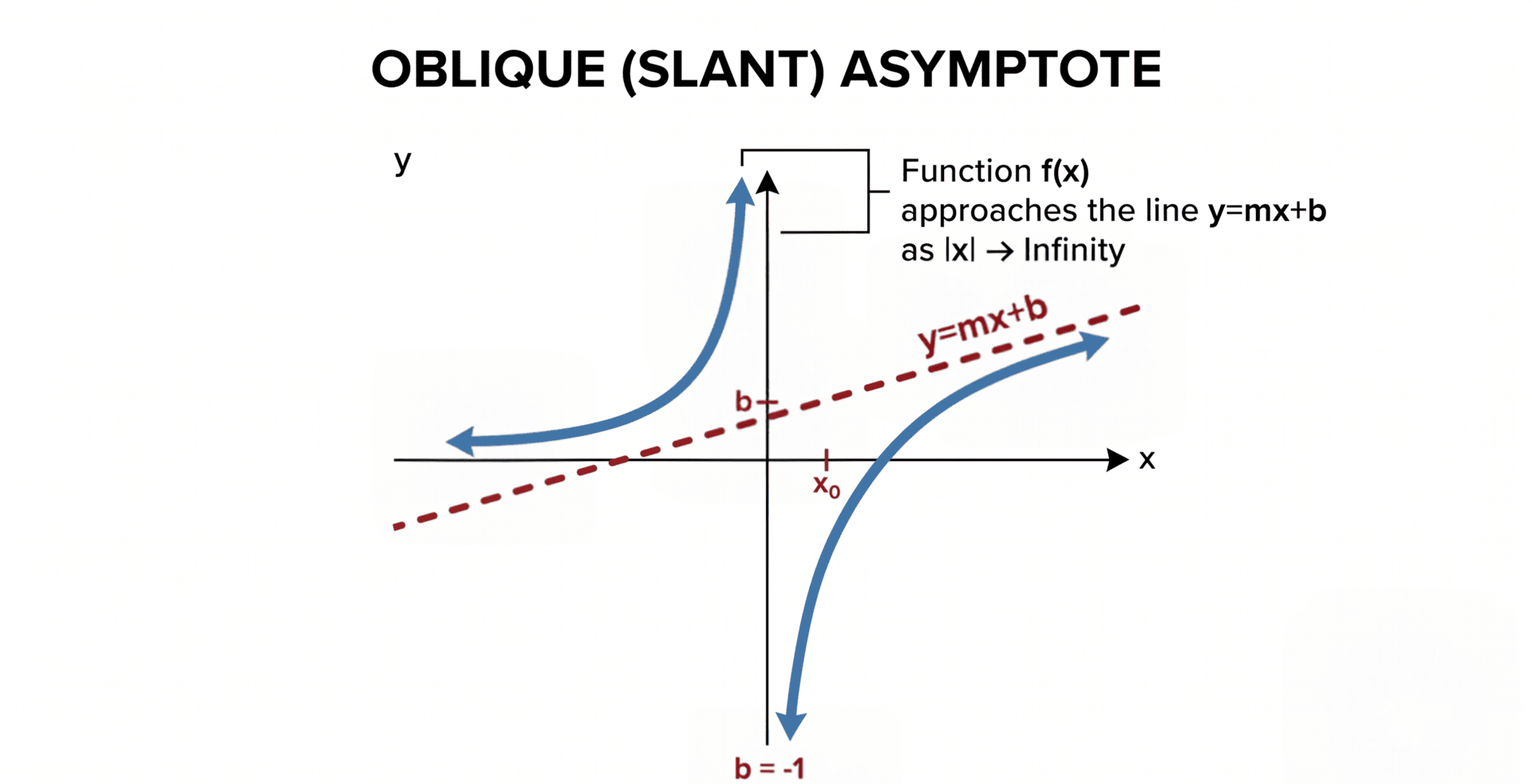
Because a function cannot flatten out horizontally while expanding diagonally, a graph can never possess both a horizontal asymptote and an oblique asymptote simultaneously. To find the equation of a slant path, you must execute algebraic long division to resolve the fraction into a linear component plus a remaining proper remainder fraction:
Worked Example
Find the equation of the oblique asymptote for the function:
Perform algebraic long division by dividing by :
Interpretation
As x approaches , the proper fraction remainder component shrinks rapidly towards zero. Consequently, the long-term spatial journey of the overall curve becomes completely identical to the remaining linear expression. Therefore, the diagonal line is established as the oblique asymptote.
Practice Questions & Solutions
Find the equations of all asymptotes for the curve given by the formula:
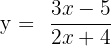
Identify where the function breaks down by setting the denominator to zero:

Horizontal Asymptote: Compare the degrees of the polynomials. The highest power in both the numerator and the denominator is  . Because the degrees match, divide the leading coefficients:

Final Answer: The vertical asymptote is x = -2 and the horizontal asymptote is:
.
Determine the equations of all vertical and horizontal asymptotes for the function:
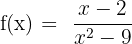
Locate the roots that cause the denominator to collapse to zero:

(Note: Since neither root makes the numerator zero, both are verified as true vertical asymptotes). * Horizontal Asymptote: The degree of the numerator is 1, while the degree of the denominator is 2. Because the denominator has a higher structural power, as  , the fraction's overall value collapses tightly to zero.
Final Answer: The curve has two vertical asymptotes at x = 3] and x = -3, and a horizontal asymptote along the line y = 0.
A curve has the algebraic equation:
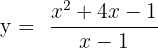
Find the exact linear equation of its diagonal oblique asymptote.
The degree of the numerator is 2 and the degree of the denominator is 1. Because the numerator's power is exactly one higher, you must use algebraic long division to find the slant path.
Division Step: Divide the polynomial expressions:

Limiting Analysis: As x grows infinitely large (), the proper fraction remainder  shrinks directly to 0. The long-term journey of the curve pulls along the remaining linear component.
Final Answer: The equation of the oblique asymptote is:
 .
.
Explain why the rational function:
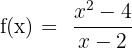
does not possess a vertical asymptote at x = 2, and describe the actual geometric behaviour of the graph at this coordinate position.
Factorise the quadratic expression in the numerator:

This allows you to rewrite the function as:
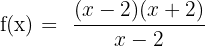
Behaviour Interpretation: For every coordinate value where  , the common linear factor cancels out perfectly, simplifying the equation to
  . At the exact point x = 2, the expression yields an indeterminate form of
  . This creates a removable discontinuity (a missing point hole) rather than a vertical asymptote.
Final Answer: The graph behaves entirely like a continuous straight line  but features a single coordinate hole located precisely at (2, 4).
Find the equation of the horizontal asymptote for the exponential curve:

as
 .
.
To determine the long-term horizontal settling path, analyse the behaviour of the exponential term as goes to positive infinity:

As , the denominator  grows infinitely large, which means the fraction
  drops directly to 0.
Substitution: Substitute this limiting baseline back into the full function:

Final Answer: The horizontal asymptote for this exponential curve is y = 5.
Summarise with AI:
Did you like this article? Rate it!


 Loading...
I get it somehow, there are others who are unfamiliar and I have a hard time with it but it’s okay that I get it.
Thanks for sharing your thoughts! It’s completely normal to find some parts unfamiliar or more difficult than others. The important thing is that you’re making progress and understanding more as you practise. Keep going! 😊
At least I understood some of it, but there are others that I’m confused about and have a hard time understanding, but I get it.
Thanks for sharing! It’s great that you’ve understood some of it already. Don’t worry if a few parts are still confusing — keep practising and take your time with the trickier sections. You’ll get there! 😊
The lesson was a little difficult for me, especially the word problems, but the examples helped me understand it better.
Thanks for your feedback! Word problems can definitely be tricky, so we’re glad the examples helped make the lesson clearer. Keep practising — it gets easier with time! 😊
Thankyouuu po