From predicting the trajectory of a kicked football to designing satellite dishes and calculating maximum profit in business economics, quadratic functions are among the most essential mathematical models in algebra and calculus.
A quadratic function is a polynomial function of degree 2. When plotted on a Cartesian coordinate grid, its graph creates a distinctive curved U-shaped line known as a parabola.
Understanding how to analyse, factorise, and sketch quadratic functions is a foundational topic across all GCSE and A-Level Mathematics specifications.


What Defines a Quadratic Function?
The word quadratic originates from the Latin word quadratum, meaning "square." An algebraic function is classified as quadratic if the highest exponent (power) of the independent variable x is exactly 2.
The standard form of a quadratic function is written as:
Where:
- a, b, and c are real constant numbers.
- (if , the term disappears, leaving a linear function ).
- a is the leading coefficient, b is the linear coefficient, and c is the constant term.
Identifying Quadratic Equations
To determine whether an equation represents a true quadratic function, expand all brackets, collect like terms, and check the highest power of x2:
| Equation | Is it Quadratic? | Reason |
|---|---|---|
 | Yes | Highest power of  is 2. is 2. |
 | No | Degree is 4 due to the  term. term. |
 | No | Linear function (degree 1). |
 | Yes | Expands to degree 2 polynomial. |
 | No | The  terms cancel out, leaving a constant term (degree 0). terms cancel out, leaving a constant term (degree 0). |
Sketching Parabola Graphs
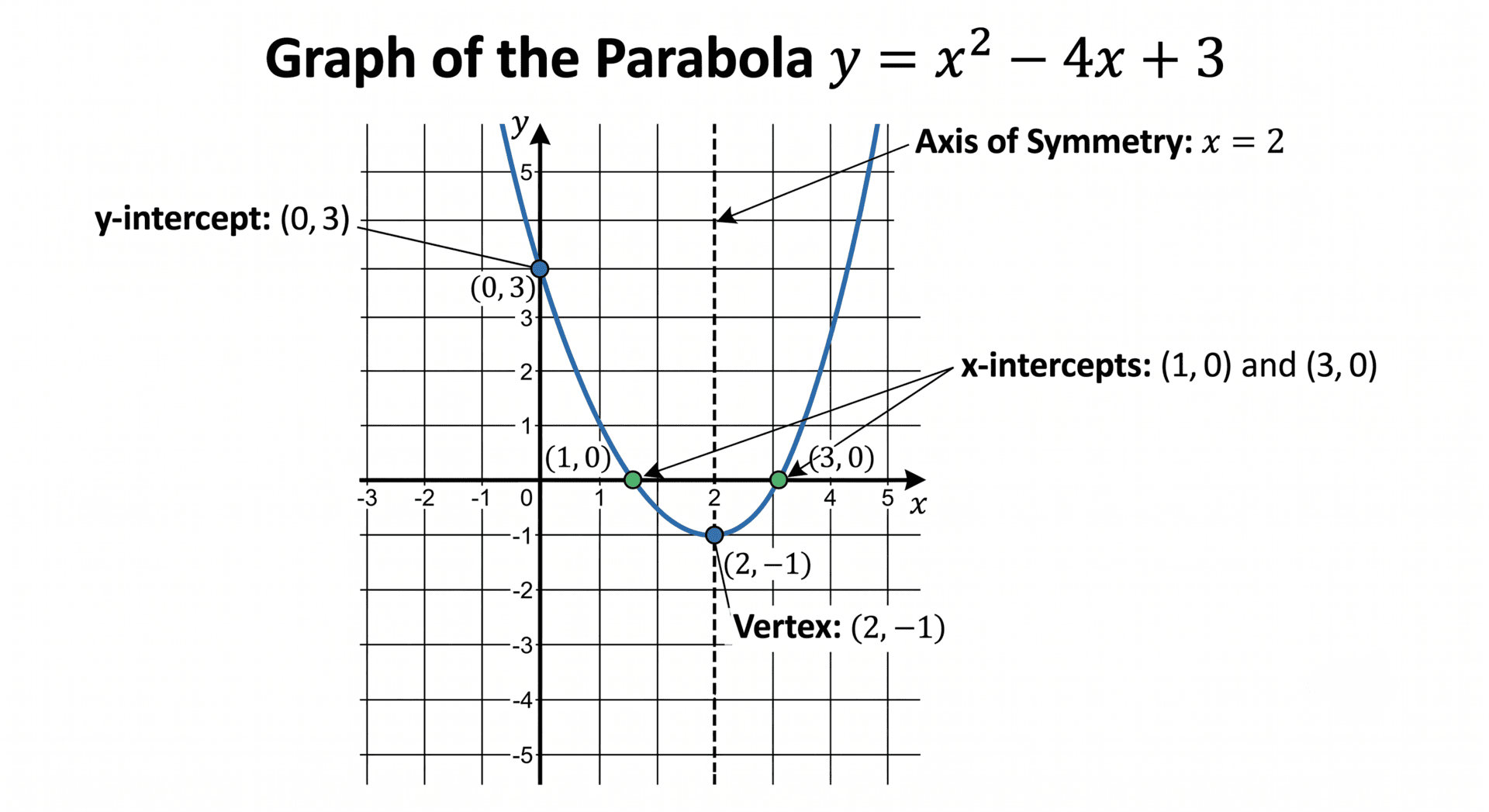
Every quadratic function produces a symmetric curve called a parabola. To sketch a parabola accurately, you need to identify four key geometric features:
Direction of Opening
The sign of the leading coefficient a determines the orientation of the parabola:
- If a > 0 (positive): The parabola opens upwards (, forming a "u-shape." The vertex represents the absolute minimum point of the curve.
- If a < 0 (negative): The parabola opens downwards (), forming an "n-shape." The vertex represents the absolute maximum point of the curve.
Vertex (Turning Point)
The vertex is the central peak or trough where the parabola changes direction.
- The x-coordinate of the vertex is given by the formula:
- The y-coordinate is found by evaluating f(x) at :
Axis of Symmetry
A parabola is perfectly symmetrical. The axis of symmetry is a vertical line that passes directly through the vertex, dividing the curve into two identical mirror halves:
Intercepts with the Axes
- y-intercept: The point where the curve crosses the vertical y-axis (where x = 0). For , the y-intercept is always (0, c).
- x-intercepts (Roots or Zeros): The points where the curve crosses the horizontal x-axis (where y = 0). Found by solving .
The number of x-intercepts is governed by the discriminant ():
- : Two distinct real roots (the curve crosses the x-axis twice).
- : Exactly one real root (the vertex sits directly on the x-axis).
- : No real roots (the curve floats entirely above or below the x-axis).
Step-by-Step Graphing Method
To graph any quadratic function , follow these five steps:
- Determine direction: Check the sign of a to see if the parabola opens upwards or downwards.
- Calculate the vertex: Find and evaluate .
- Find the y-intercept: Set .
- Find the x-intercepts: Set and solve using factorisation, completing the square, or the quadratic formula:
- Plot and sketch: Mark all calculated points on a grid and draw a smooth, continuous U-shaped curve.
Worked Example
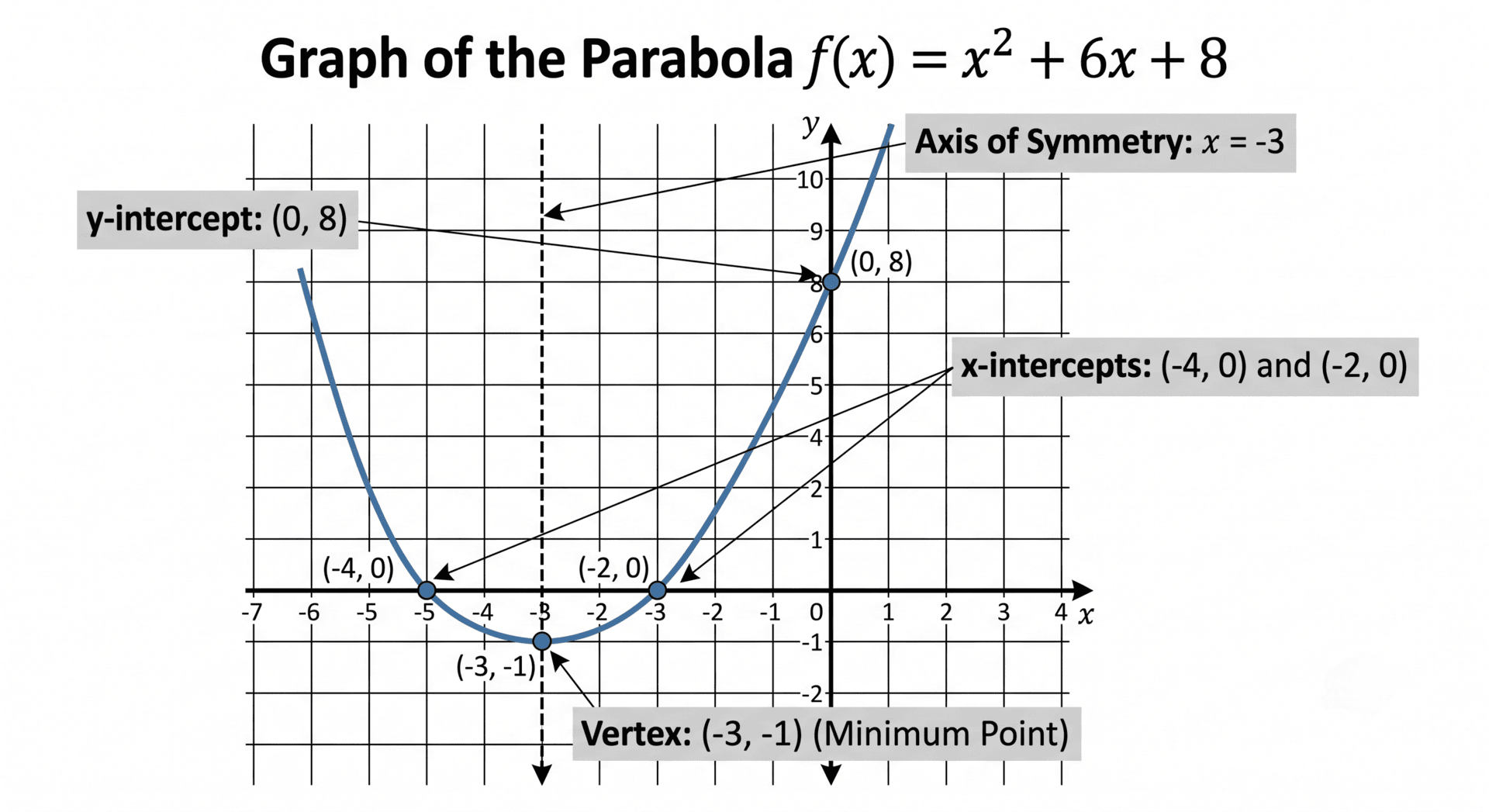
Problem: Sketch the graph of the quadratic function
Step-by-Step Solution:
- Step 1: Determine orientation: Here a = 1, b = 6, and c = 8. Since a = 1 > 0, the parabola opens upwards ().
- Step 2: Find the vertex: Calculate the x-coordinate:
Calculate the y-coordinate by substituting x = -3 into f(x):
The vertex is at (-3, -1) and the axis of symmetry is the line x = -3.
- Step 3: Find the y-intercept: Set x = 0:
- Step 4: Find the x-intercepts: Set f(x) = 0:
Factorise the quadratic expression:
Solve for x:
The x-intercepts are at (-2, 0) and (-4, 0).
- Step 5: Plot the graph:
Practice Questions & Answers
For the quadratic function 
a) State whether the parabola opens upwards or downwards.
b) Calculate the equation of the axis of symmetry.
a) The leading coefficient is a = -2. Because a <0, the parabola opens downwards.
b) The axis of symmetry formula is

Substituting a = -2 and b = 8:
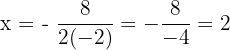
The axis of symmetry is x = 2.
Use the discriminant  to determine the number of real x-intercepts for the quadratic curve:

Identify the coefficients: a = 2, b = -4, c = 5.
Calculate the discriminant 

Since:
Delta = -24 <0
the quadratic function has zero real x-intercepts (the curve floats entirely above the x-axis).
A projectile is fired upwards from ground level. Its height h in metres after t seconds is modelled by the quadratic function:

Calculate the maximum height reached by the projectile and the time taken to reach this peak height.
Identify the peak coordinates: The maximum height occurs at the vertex of the quadratic function

Calculate time t at peak:

Calculate maximum height h(3):

Final Answer: The projectile reaches its maximum height of 47 metres after 3 seconds.
Summarise with AI:
Did you like this article? Rate it!

 Loading...
I get it somehow, there are others who are unfamiliar and I have a hard time with it but it’s okay that I get it.
Thanks for sharing your thoughts! It’s completely normal to find some parts unfamiliar or more difficult than others. The important thing is that you’re making progress and understanding more as you practise. Keep going! 😊
At least I understood some of it, but there are others that I’m confused about and have a hard time understanding, but I get it.
Thanks for sharing! It’s great that you’ve understood some of it already. Don’t worry if a few parts are still confusing — keep practising and take your time with the trickier sections. You’ll get there! 😊
The lesson was a little difficult for me, especially the word problems, but the examples helped me understand it better.
Thanks for your feedback! Word problems can definitely be tricky, so we’re glad the examples helped make the lesson clearer. Keep practising — it gets easier with time! 😊
Thankyouuu po