Calculus is essentially the study of change, and at the heart of calculus lies the concept of limits. Whether you are finding the gradient of a curve or the area under a graph, you are using limits. Understanding the Properties of Limits, often called Limit Laws, allows us to break down complex algebraic expressions into manageable parts, making it significantly easier to evaluate the behaviour of functions as they approach specific values.


Theory
To work effectively with limits, we assume that the limits of two individual functions, f(x) and g(x), both exist as x approaches a value a. Let c be a constant. The following rules are the fundamental tools used in A-Level calculus.
The Fundamental Limit Laws
- Sum Rule - The limit of a sum is the sum of the limits:
- Difference Rule - The limit of a difference is the difference of the limits:
- Constant Multiple Rule - A constant can be moved outside the limit:
- Product Rule - The limit of a product is the product of the limits:
- Quotient Rule - The limit of a quotient is the quotient of the limits, provided the denominator is not zero:
- Power Rule - The limit of a function raised to a power is the limit of that function, all raised to that power:
- Root Rule - The limit of a root of a function is the root of the limit of the function:
Direct Substitution and Continuity
If a function is continuous at a point a, we can find the limit simply by substituting the value into the function. This is known as Direct Substitution.
However, if direct substitution results in an indeterminate form such as 0÷0, we must use algebraic manipulation (like factoring) or specific limit properties to find the solution.
| Method | When to Use | Action |
|---|---|---|
| Direct Substitution | Continuous functions | Plug the value in directly |
| Factoring | Polynomial fractions | Cancel out common terms causing 0/0 |
| Rationalisation | Functions with roots | Multiply by the conjugate |
Worked Example
Evaluate the following limit by applying the limit properties:
Step 1: Apply the Quotient Rule - We treat the numerator and denominator as separate functions:
Step 2: Apply the Sum and Difference Rules - Break down the terms within the numerator and denominator:
Step 3: Apply Constant Multiple Rule and Power Rule:
Step 4: Substitute the value x = 2:
Practice Questions & Solutions
Given that

and

find the value of

Applying the Sum and Constant Multiple Rules:
Substitute the given values:
Evaluate the following limit:
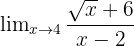
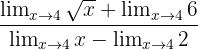
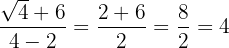
Apply the Quotient Rule and evaluate:
Find the limit of the constant function:

The limit of a constant is always the constant itself:

Evaluate the limit using the Product Rule:

Distribute the limit across the product:



Solve the following limit where direct substitution is possible:
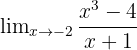
Apply the Quotient Rule:


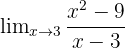
Evaluate the following limit:
Direct substitution yields:
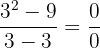
which is an indeterminate form.
Factorise the numerator:

Simplify the expression for  :
:

Apply Direct Substitution:

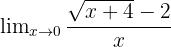
Evaluate the following limit:
Direct substitution yields
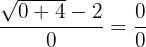
Multiply the numerator and denominator by the conjugate 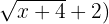

Expand the numerator using:


Cancel x from the numerator and denominator:
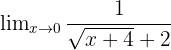
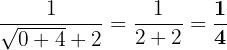
Substitute x = 0:
Given that

and

Evaluate:
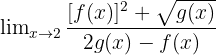
Apply the Quotient, Sum, Power, and Root rules individually.
Evaluate the numerator limit:

Evaluate the denominator limit:

Combine results:
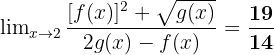
Evaluate the following trigonometric limit:
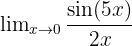
Recall the standard limit:
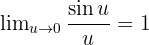
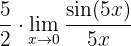
Adjust the expression to isolate


Apply the Constant Multiple Rule:
Substitute the standard limit value:

Evaluate the following limit as x approaches infinity:
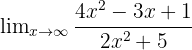
Direct evaluation leads to

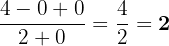
Divide every term by the highest power of $x$ in the denominator 
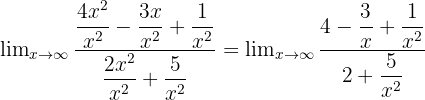
Apply the rule
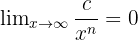
for any n > 0:
Summarise with AI:
Did you like this article? Rate it!


 Loading...
I get it somehow, there are others who are unfamiliar and I have a hard time with it but it’s okay that I get it.
Thanks for sharing your thoughts! It’s completely normal to find some parts unfamiliar or more difficult than others. The important thing is that you’re making progress and understanding more as you practise. Keep going! 😊
At least I understood some of it, but there are others that I’m confused about and have a hard time understanding, but I get it.
Thanks for sharing! It’s great that you’ve understood some of it already. Don’t worry if a few parts are still confusing — keep practising and take your time with the trickier sections. You’ll get there! 😊
The lesson was a little difficult for me, especially the word problems, but the examples helped me understand it better.
Thanks for your feedback! Word problems can definitely be tricky, so we’re glad the examples helped make the lesson clearer. Keep practising — it gets easier with time! 😊
Thankyouuu po