A linear function is an algebraic relationship between an independent variable (the input, x) and a dependent variable (the output, y or f(x)) characterised by a constant rate of change. When plotted on a Cartesian coordinate plane, a linear function always generates a straight line.
In formal function notation, a linear function is written as:
Where:
- x represents the input variable (the domain value).
- f(x) represents the output variable (often labelled y).
- m represents the constant rate of change, known as the gradient or slope.
- c represents the y-intercept, the point where the line crosses the vertical axis.


Standard Algebraic Forms of Linear Equations
UK exam boards require familiarity with three distinct representations of a linear equation:
A. Gradient-Intercept Form:
- Ideal when the gradient and the y-intercept are directly known or easily read from a graph.
- If c = 0, the equation simplifies to y = mx, which represents direct proportion through the origin (0, 0).
B. Point-Gradient Form:
- Standard for A-Level coordinate geometry and GCSE Higher questions.
- Most efficient when finding the equation of a line given a known gradient m and any single passing point
C. General Form:
- Here, a, b, and c are typically integers (), and .
- Avoids fractions and is frequently requested in exam mark schemes as the required final form.
The Gradient (m): Rate of Change
The gradient measures both the steepness and the direction of the line.
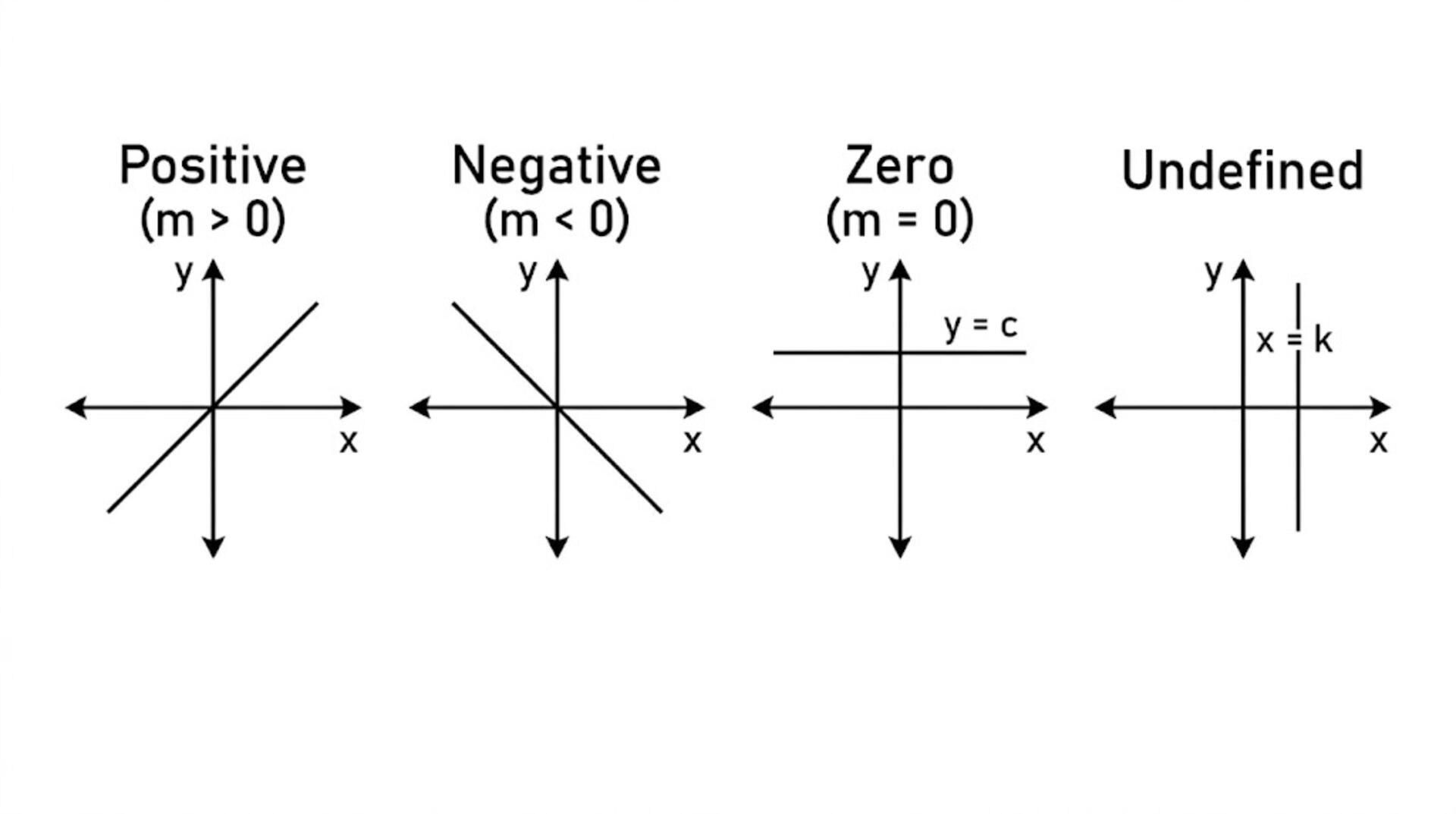
Gradient Classifications:
- Positive Gradient (m > 0): The line rises from left to right (). As x increases, y increases.
- Negative Gradient (m < 0): The line falls from left to right (). As x increases, y decreases.
- Zero Gradient (m = 0): A horizontal line with equation y = c. Outputs remain constant regardless of input.
- Undefined Gradient: A vertical line with equation x = k. The denominator , making the gradient division by zero. (Note: Vertical lines are relations, not functions, because a single input maps to infinite outputs).
Parallel and Perpendicular Lines
Parallel Lines
Two non-vertical lines are parallel if and only if their gradients are identical:
Parallel lines never intersect and remain equidistant along their entire length.
Perpendicular Lines
Two lines are perpendicular if they intersect at a right angle (). Their gradients are negative reciprocals of each other:
Perpendicular Rule Example:
If line has a gradient of , any perpendicular line must have a gradient of:
Intercepts and Coordinate Points
- y-intercept: Occurs where the line crosses the y-axis. Set x = 0 and solve for y:
- x-intercept: Occurs where the line crosses the x-axis. Set y = 0 and solve for x:
Graphical Transformations of Linear Functions
Modifying the parameters in f(x) = mx + c transforms the line geometrically:
- Changing c(Vertical Translation):
- Replacing c with c + k translates the line vertically by vector .
- The line shifts upwards by k units if k > 0, or downwards if k < 0. The gradient remains unchanged.
- Changing the sign of m (Reflection):
- Changing y = mx + c to y = -mx + c reflects the line in the vertical line x = 0 (y-axis).
- Changing the magnitude of m (Steepness):
- Increasing rotates the line closer to the vertical axis, increasing steepness.
- Decreasing flattens the line closer to the horizontal axis.
Practice Questions & Solutions
Line L1 passes through the points (1, 4) and (5, 12).
Line L2 is parallel to L1 and passes through the point (-3, 2).
Find the equation of L2 in the form ax + by + c = 0, where

Select points (-1, -5) and (2, 1):

Use point (2, 1) with y = mx + c:

y = 2x - 3
For the x-intercept, set y = 0:

Coordinates of the x-intercept:

or (1.5, 0)
Points A(3, 8) and B(7, 2) define a line segment AB.
(a) Calculate the gradient of AB.
(b) Find the coordinates of the midpoint of AB.
(c) Find the equation of the perpendicular bisector of AB in the form y = mx + c.
Gradient of AB:

Midpoint M:

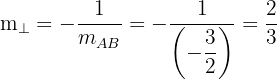
The perpendicular bisector has gradient:
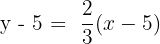
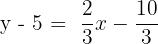
Using point M(5, 5):
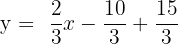
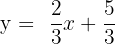
Two lines are defined by the equations:


Find the exact coordinates of the point where  and
and  intersect.
Gradient of AB:
Midpoint M:
The perpendicular bisector has gradient:
Using point M(5, 5):
Summarise with AI:
Did you like this article? Rate it!

 Loading...
I get it somehow, there are others who are unfamiliar and I have a hard time with it but it’s okay that I get it.
Thanks for sharing your thoughts! It’s completely normal to find some parts unfamiliar or more difficult than others. The important thing is that you’re making progress and understanding more as you practise. Keep going! 😊
At least I understood some of it, but there are others that I’m confused about and have a hard time understanding, but I get it.
Thanks for sharing! It’s great that you’ve understood some of it already. Don’t worry if a few parts are still confusing — keep practising and take your time with the trickier sections. You’ll get there! 😊
The lesson was a little difficult for me, especially the word problems, but the examples helped me understand it better.
Thanks for your feedback! Word problems can definitely be tricky, so we’re glad the examples helped make the lesson clearer. Keep practising — it gets easier with time! 😊
Thankyouuu po