


What is a Plane?
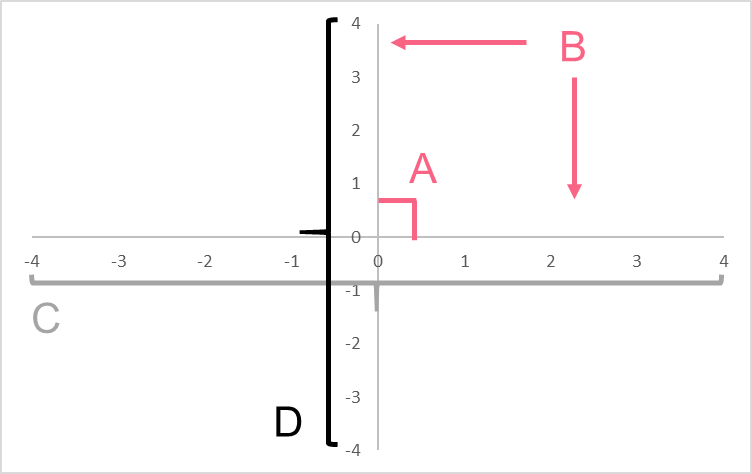
| Property | Example | ||
| A | Two perpendicular lines | Two lines at 90 degrees from each other | X-axis and y axis |
| B | Axes | Axes that have numbers on them | Think of two number lines intersecting each other |
| C | X-axis | Holds x coordinates | For point (3,4), the x coordinate is 3 |
| D | Y-axis | Holds y coordinates | For point (3,4), the y coordinate is 4 |
The Cartesian plane is named after Rene Descartes, a French mathematician. The Cartesian plane is simply referred to as an axis, graph or plot.
Coordinates
The reason we have a graph is to be able to visualize coordinates. You may have heard the word coordinates to describe the physical location of something on earth. For example, global positioning systems, or GPS, use coordinates to locate various things. Coordinates in math follow the same idea. Let’s start with a simple example: coordinates on a real number line. This is also referred to as a one dimensional coordinate system. As you can see, a number line can, a number line can include any range of real numbers. A coordinate on a number line is simply one number. Let’s plot three numbers on a number line: 
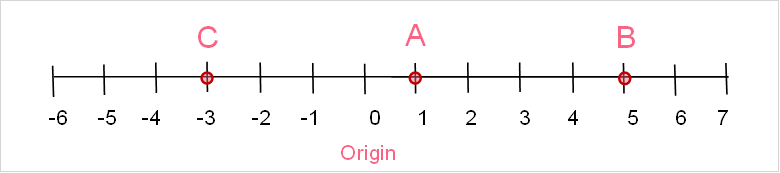
| A | 1 |
| B | 5 |
| C | -3 |
When we talk about coordinates on a Cartesian plane, we are referring to a two-dimensional coordinate system. This means we have two points to graph: an x and a y coordinate. 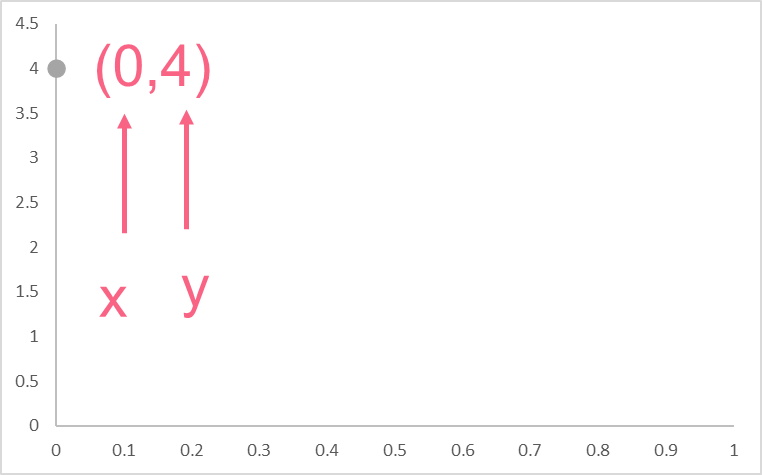
| A | (4,5) |
| B | (-3,2) |
| C | (0,0) |

Quadrants
Another important property of a graph is that it has 4 quadrants. Take a look below for a definition of what these quadrants mean: 
| x | y | |
| Quadrant1 | 4 | 5 |
| Quadrant2 | -3 | 2 |
| Quadrant 3 | -4 | -3 |
| Quadrant4 | 2 | -4 |
The table above gives us the value for each point in the quadrant in the graph. Do you notice any pattern here? Depending on the quadrant, the x and y coordinates will always be either positive or negative. Take a look at the table below.
| x | y | (x,y) | Example | |
| Quadrant 1 | + | + | (+,+) | (4,5) |
| Quadrant 2 | - | + | (-,+) | (-3,2) |
| Quadrant 3 | - | - | (-,-) | (-4,-3) |
| Quadrant 4 | + | - | (+,-) | (2,-4) |
Origin
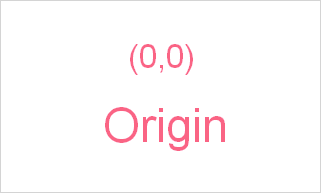
The origin of a graph is located at the very centre of the plane. Let’s take a look at the origin on the graph. 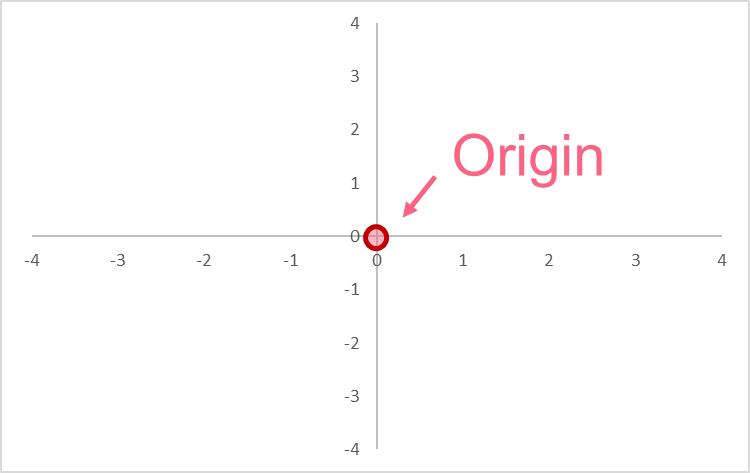

Horizontal Axis
The x axis is also called the horizontal axis. This is because it lies horizontally on the Cartesian plane. The horizontal axis touches all four quadrants, however it only goes in two directions. Let’s take a look at two examples. 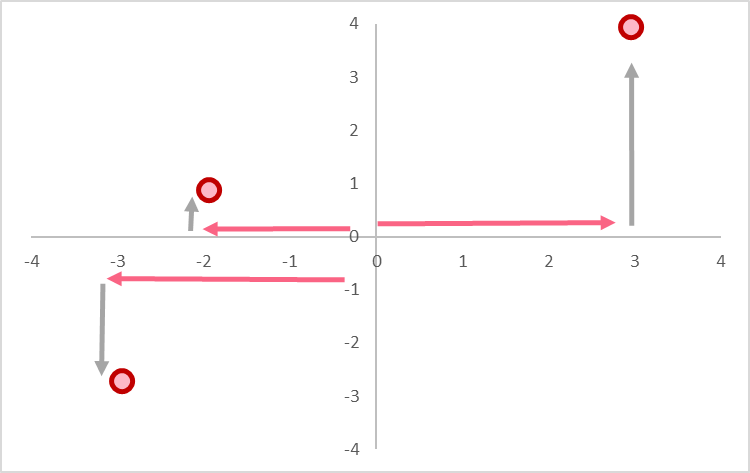
| A | (3,4) | Right 3 |
| B | (-2,1) | Left 2 |
| C | (-3,-3) | Left 3 |
The x coordinate tells us how many places to the left or to the right we have to go.
Vertical Axis
The y axis is also called the vertical axis. This is because it lies vertically on the Cartesian plane. The vertical axis touches all four quadrants, however it only goes in two directions. Let’s take a look at two examples. 
| A | (3,4) | Up 4 |
| B | (-2,1) | Up 1 |
| C | (-5,-4) | Down 4 |
The y coordinate tells us how many places up or down we have to go.
Constant
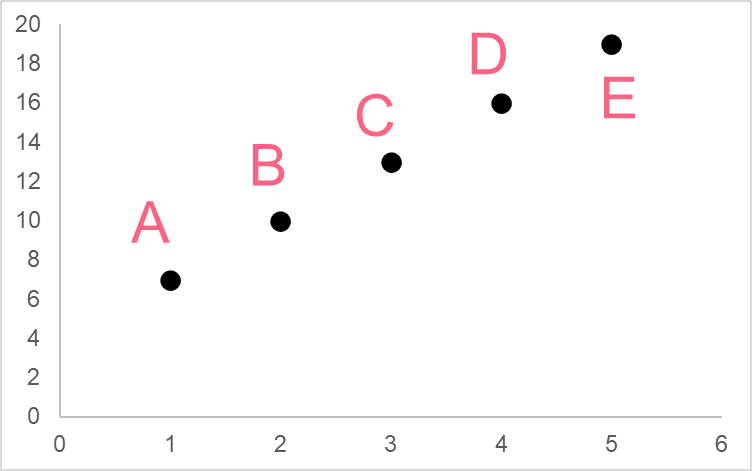
While there are many different types of functions we can graph on a plane, the most common one is a linear function. A linear function involves any straight line relationship, whose standard form is written as follows: 
| x | y | |
| A | 1 | 7 |
| B | 2 | 10 |
| C | 3 | 13 |
| D | 4 | 16 |
| E | 5 | 19 |
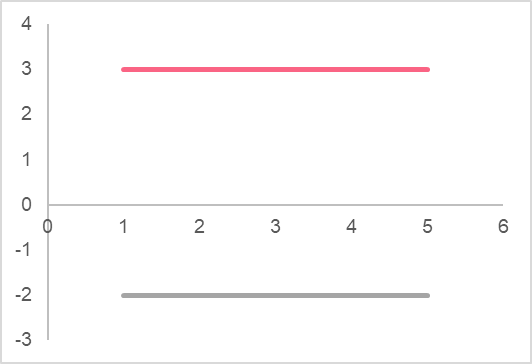
| A | B |
| y = 3 | y = -2 |
Example 1
Let’s test our knowledge on quadrants. Looking at the quadrant specified below, can you give a list of coordinates that would belong to this quadrant? 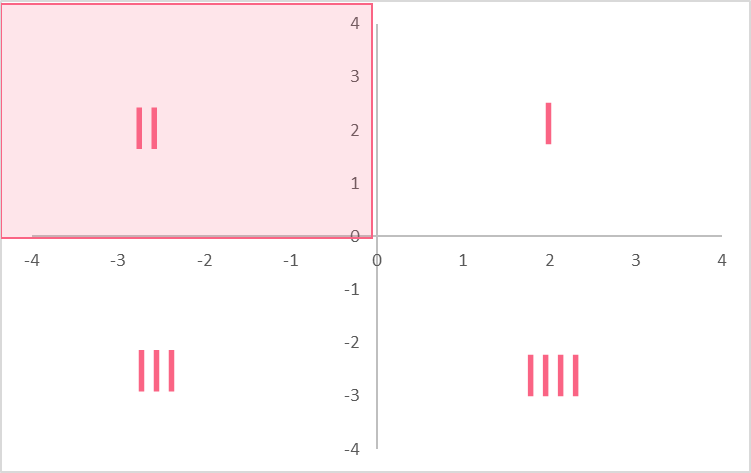
- (-5,3)
- (-2, 10)
- (-7,8)
Example 2
- (-5, -5)
- (-2, -1)
- (-6, -3)
Because both the x and y values have a negative value, we are looking at the 3rd quadrant.
Example 3
Constants can sometimes be tricky. Graph the following constants:
| A | B | C |
| y = 2 | x = 3 | y = -5 |
Because x and y are constants here, we draw horizontal and vertical lines. 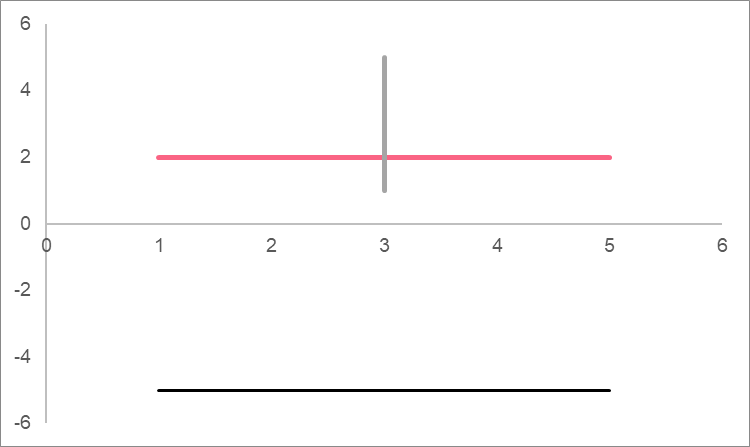
Example 4
Let’s plot the coordinates to the following equation. \[ y = 3x + 5 \] Here is the graph: 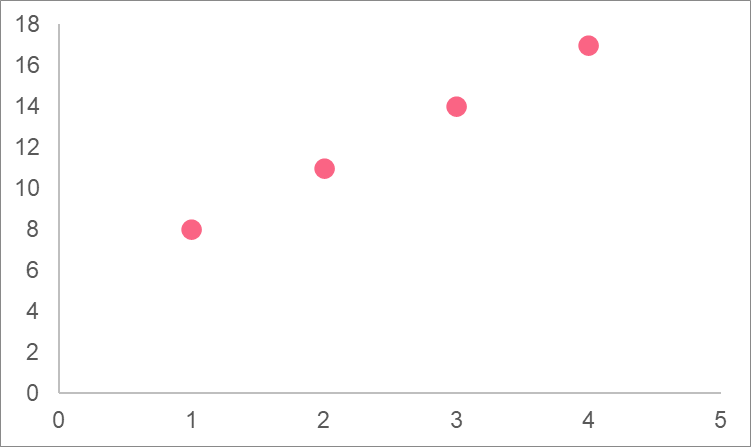
Summarise with AI:
Did you like this article? Rate it!


 Loading...
I get it somehow, there are others who are unfamiliar and I have a hard time with it but it’s okay that I get it.
Thanks for sharing your thoughts! It’s completely normal to find some parts unfamiliar or more difficult than others. The important thing is that you’re making progress and understanding more as you practise. Keep going! 😊
At least I understood some of it, but there are others that I’m confused about and have a hard time understanding, but I get it.
Thanks for sharing! It’s great that you’ve understood some of it already. Don’t worry if a few parts are still confusing — keep practising and take your time with the trickier sections. You’ll get there! 😊
The lesson was a little difficult for me, especially the word problems, but the examples helped me understand it better.
Thanks for your feedback! Word problems can definitely be tricky, so we’re glad the examples helped make the lesson clearer. Keep practising — it gets easier with time! 😊
Thankyouuu po