To understand inflection points, you need to understand what are reasons behind inflection points? For every power of a variable, there is a specific term, for example, linear equations will always have a variable that has a power of

. For quadratic equations, the power of the variable will always be

, it might have a variable with a power of
as well but that isn't our main concern, if a variable has a power of
, we will call it quadratic equation. On the other hand, if the power of the variable exceeds
then we will call it a polynomial equation. The word poly means "many" and the word nominal means "term". In short, polynomial means more than one term. We usually use this word, polynomial, when we are dealing with equations that have more than
term, however, in this lesson, we will be dealing with cubic equations only below are some examples of cubic equations:




The graph of every equation is different but some of them will have a similar pattern. For example, the graph of the quadratic equation will be similar, although, the constants will affect the graph, however, you can predict the pattern of the graph. On the other hand, if you try to compare the graph of quadratic equation with a straight line equation, you can't even say they are similar, you can only say they are similar within the category (which was quadratic in the above case). The same concept is also applied to the cubic equation, there graph would be something like this: 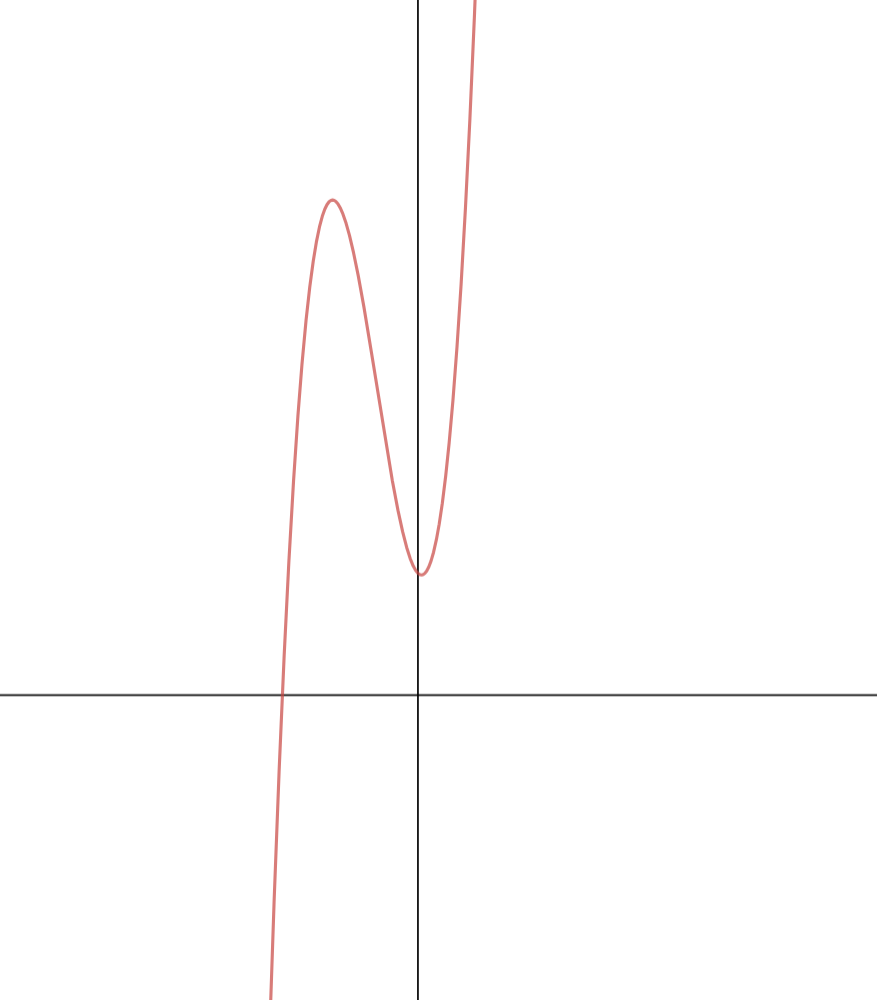

:

The answer
is the slope of the equation
, let's prove whether it is correct or not. To prove that, we will compare the above equation with

:
Rearranging the equation:

We found that

Our point of interest is in gradient which is represented by

and the value of
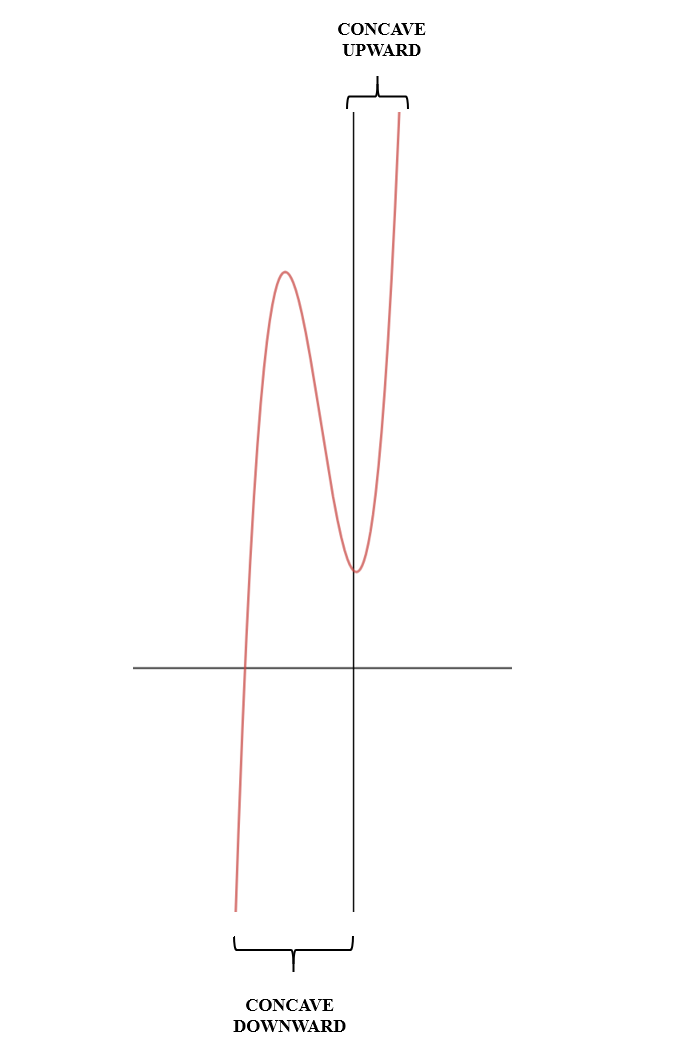
is one hence it is proved. What if we differentiate an equation two times? The result will tell us the maximum and minimum point of the equation and if you equate it to zero, the value of the variable will tell you the point of inflection.
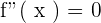 where x is the point of the inflection
One thing is clear the point of inflection exists on the cubic equation (meaning that one of the terms of the equation should have a variable that has power equal to 3).


Calculation of the Points of Inflection
Calculate the inflection points of:

To find the inflection points, follow these steps:
1. Find the second derivative and calculate its roots.

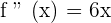
Equating

to find the inflection point.


2. Determine the 3rd derivative and calculate the sign that the zeros take from the second derivative and if:

There is an inflection point

It is an inflection point. 3. Calculate the image (in the function) of the point of inflection.


Inflection point: (0, 2)
Example
Calculate the points of inflection of the function:

Domain:
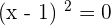





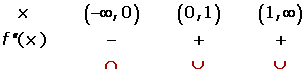
There is an inflection point at , since the function changes from concave to convex.

Inflection point =

Summarise with AI:
Did you like this article? Rate it!


 Loading...
I get it somehow, there are others who are unfamiliar and I have a hard time with it but it’s okay that I get it.
Thanks for sharing your thoughts! It’s completely normal to find some parts unfamiliar or more difficult than others. The important thing is that you’re making progress and understanding more as you practise. Keep going! 😊
At least I understood some of it, but there are others that I’m confused about and have a hard time understanding, but I get it.
Thanks for sharing! It’s great that you’ve understood some of it already. Don’t worry if a few parts are still confusing — keep practising and take your time with the trickier sections. You’ll get there! 😊
The lesson was a little difficult for me, especially the word problems, but the examples helped me understand it better.
Thanks for your feedback! Word problems can definitely be tricky, so we’re glad the examples helped make the lesson clearer. Keep practising — it gets easier with time! 😊
Thankyouuu po