Imagine a mathematical conveyor belt. You feed an input into a function, the function performs a set of operations, and it spits out an output. Now, imagine you want to run the conveyor belt in reverse—to take that output, feed it backwards through the system, and recover your original input.
This "undo" mechanism is exactly what an inverse function does. It acts as the mathematical reverse gear, completely undoing the operations of the original function.
In the real world, inverse functions are everywhere. If you have a function that converts temperature from Celsius to Fahrenheit, its inverse function is the formula that converts Fahrenheit back to Celsius. In cryptography, if a function encrypts a private password into a secure string of code, the inverse function is the decryption key that recovers the original password.


Core Principles of Inverse Functions
To write mathematical definitions for exams, we use the superscript notation to represent the inverse of a function .
The superscript "" in is NOT an exponent.
It does NOT mean .
represents the inverse function (the undo rule).
represents the reciprocal, which is 1 / f(x).
The Domain and Range Swap
Because an inverse function reverses inputs and outputs:
- The domain (allowable inputs) of is exactly equal to the range (possible outputs) of the original function .
- The range of is exactly equal to the domain of .
The Identity Composition Rule
If you apply a function and then immediately apply its inverse (or vice versa), they cancel each other out completely, leaving you with your original input :
Graphical Symmetry
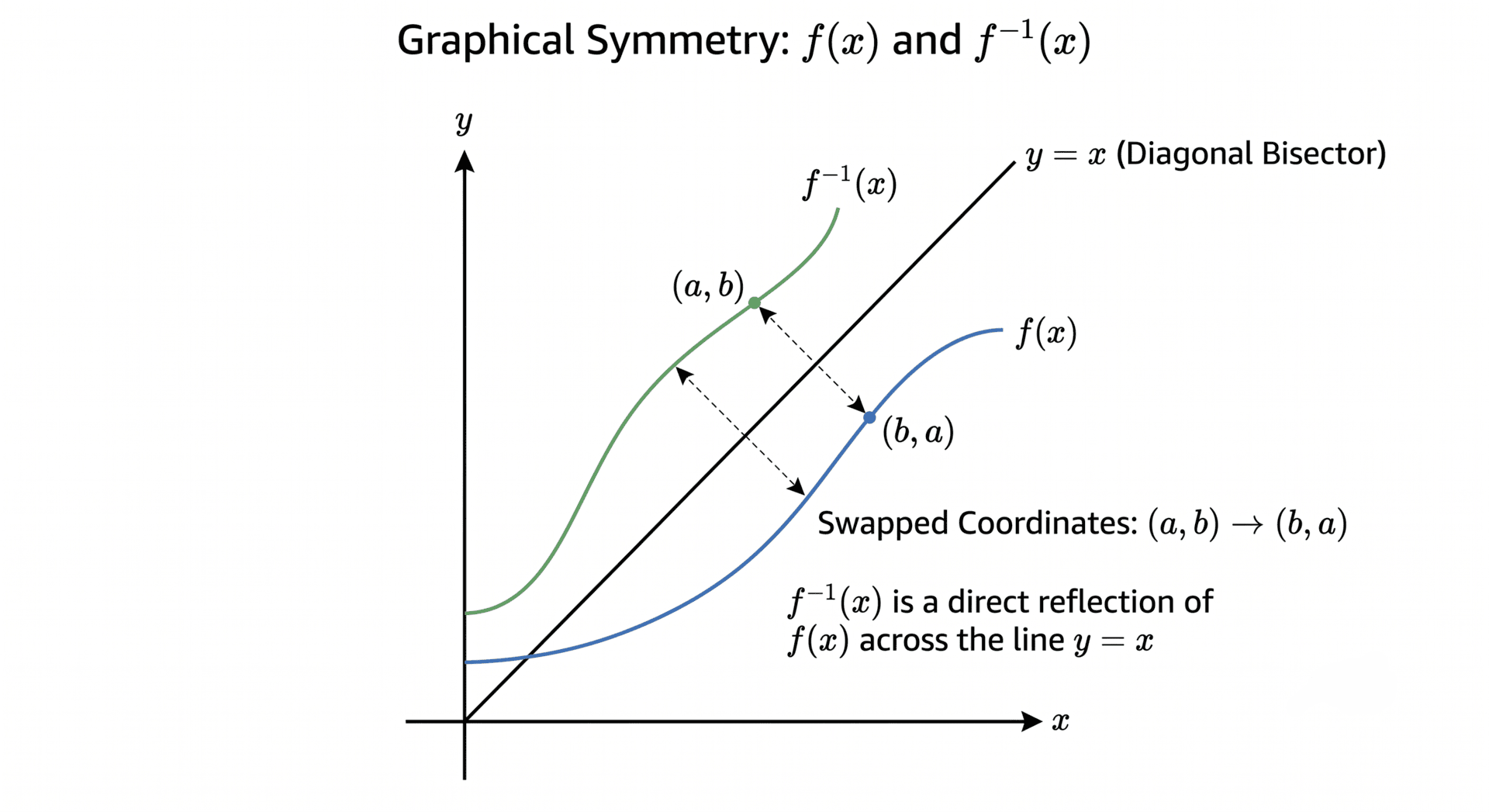
If you plot and on the same coordinate grid, their curves are perfectly symmetrical to each other. One is a direct reflection of the other across the diagonal bisector line . This is because the process of finding an inverse swaps every coordinate on the original curve to on the inverse curve.
The One-to-One (Bijective) Requirement
Before you can calculate the inverse of a function, you must first check if an inverse is mathematically allowed to exist.
An inverse function can only exist if the original function is one-to-one (injective). This means that for every unique output y, there is exactly one unique input x.
If a function is many-to-one (for example, the quadratic curve , where both and give the output , a true inverse cannot exist over its entire domain. If you tried to inverse it, the input would point to two different outputs ( and ), violating the fundamental definition of a function.
To find the inverse of a many-to-one function, you must first restrict its domain (for example, restricting to only positive values, to make it one-to-one.
Step-by-Step Method to Calculate the Inverse
To find the algebraic rule for , follow this reliable four-step method:
| Step | Action | Example: f(x) = 2x + 3 |
|---|---|---|
| 1 | Replace f(x) with y |  |
| 2 | Rearrange the equation to isolate x |  |
| 3 | Swap the variables: replace x with  and y with x and y with x | 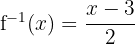 |
| 4 | Verify your inverse using composition (Optional) |  |
Exam-Style Worked Examples
Let's look at three standard exam-style problems, starting from basic linear expressions up to complex rational equations and domain restrictions.
Example 1: Linear Function Inverse
Question: Find the inverse of the function , and evaluate .
Step-by-step Solution:
- Replace f(x) with y:
Rearrange to make x the subject:
Swap variables to find the inverse function:
Evaluate at x = 5:
Example 2: Rational Function Inverse (Standard A-Level Template)
Question: The function is defined by:
Find an expression for and state the value of x for which is undefined.
Step-by-step Solution:
- Replace with :
Multiply both sides by the denominator to clear the fraction:
Group all terms containing on one side and the rest on the other:
Factorise out to isolate it:
Swap variables to write the inverse function:
Identify where the inverse is undefined: An algebraic fraction is undefined when its denominator equals zero.
Therefore, is undefined at (the domain of the inverse is , which is the range of the original function ).
Examiner Tips & Common Pitfalls
Examiner Tip: When finding the inverse of a rational function (like in Example 2), students often make algebraic mistakes when factorising out x. Always group your x-terms on one side of the equals sign before attempting to factorise. If you have , you cannot divide by y or 2 individually; you must write first.
Additionally, always double-check if your calculated domain of the inverse function is mathematically valid for your expression. For instance, if your inverse contains a square root , your domain must restrict to keep the root real.
Practice Questions & Solutions
The function f(x) is defined by:
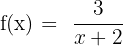
for
 .
.
Find
and state its domain.
Step 1:
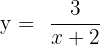
Step 2: Multiply out:

Step 3: Rearrange to isolate x:

Step 4: Swap variables:
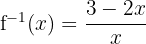
Step 5: Determine the domain. The denominator cannot be zero, so the domain of the inverse is:

(which is also the range of the original function f(x) because a fraction with a constant numerator 3 can never equal zero).
The function g(x) is defined as:

for
x greater than 3.
Find the expression for

and state its range.
Step 1:

Step 2: Rearrange to isolate x by converting the logarithmic form to exponential form:

Step 3: Swap variables:

Step 4: State the range. The range of the inverse function is identical to the domain of the original function. Since g(x) is defined for x > 3, the range of the inverse is: 
(which matches the output of  because
  for all real values of x).
A function is defined as:

for
 .
.
Find
by completing the square first.
Step 1: Complete the square on the original quadratic:

Step 2: Set equal to y:

Step 3: Rearrange to isolate x:

(Note: We select the positive root because the domain restriction is ).
Step 4: Swap variables:

Summarise with AI:
Did you like this article? Rate it!


 Loading...
I get it somehow, there are others who are unfamiliar and I have a hard time with it but it’s okay that I get it.
Thanks for sharing your thoughts! It’s completely normal to find some parts unfamiliar or more difficult than others. The important thing is that you’re making progress and understanding more as you practise. Keep going! 😊
At least I understood some of it, but there are others that I’m confused about and have a hard time understanding, but I get it.
Thanks for sharing! It’s great that you’ve understood some of it already. Don’t worry if a few parts are still confusing — keep practising and take your time with the trickier sections. You’ll get there! 😊
The lesson was a little difficult for me, especially the word problems, but the examples helped me understand it better.
Thanks for your feedback! Word problems can definitely be tricky, so we’re glad the examples helped make the lesson clearer. Keep practising — it gets easier with time! 😊
Thankyouuu po