When sketching, analysing, or modelling mathematical functions on a Cartesian grid, we need key reference coordinates to anchor our curves. Two of the most critical structural features of any graph are the points where it crosses the grid lines. These are known as the x-intercept and the y-intercept.
In real-world applications, these intercepts carry profound physical meaning. In finance, a y-intercept represents the "initial setup cost" or starting capital of a business venture before any time passes. In physics, the x-intercept of a projectile's flight path tells us the exact moment or distance at which an object hits the ground.
By mastering the algebraic techniques to calculate these points, you can rapidly sketch complex functions without relying on a calculator or plotting dozens of individual coordinate pairs.
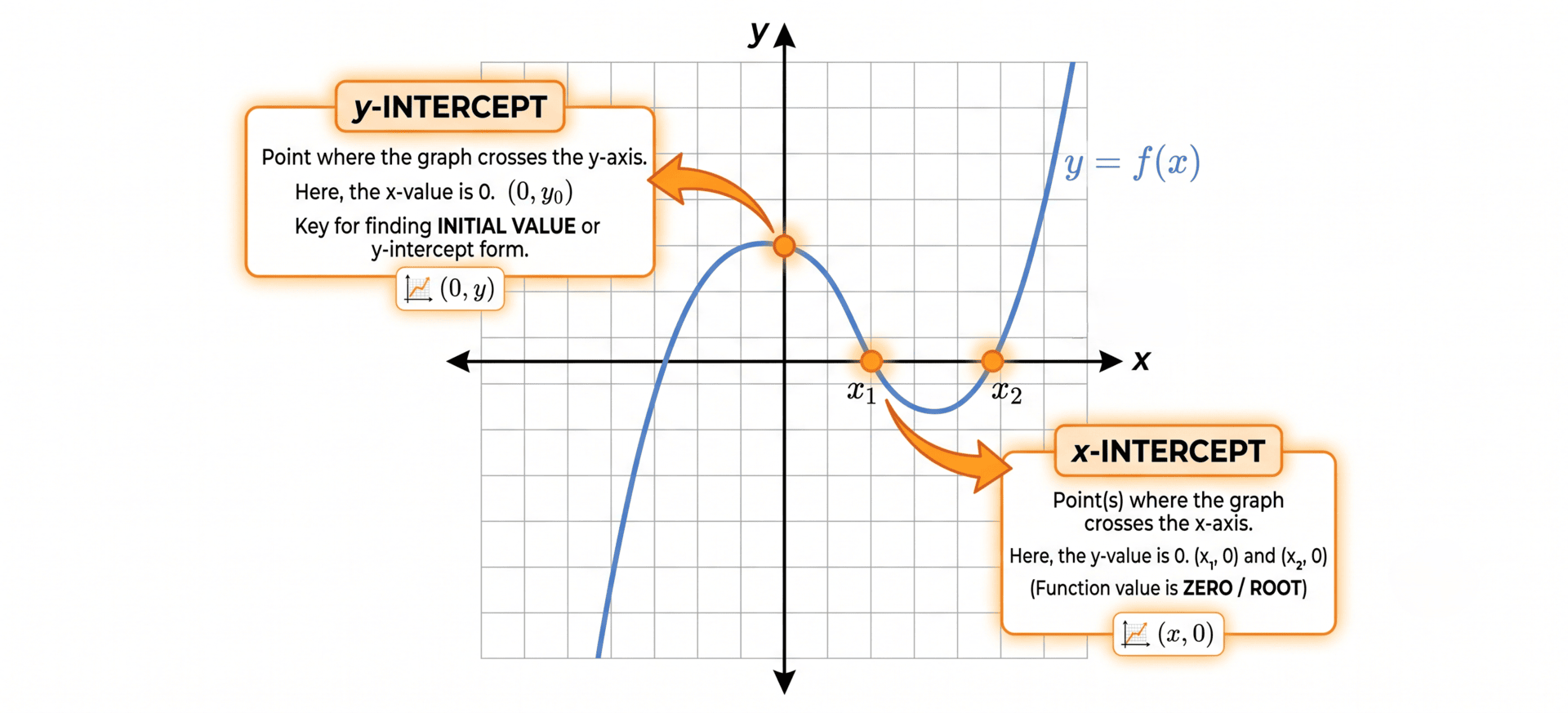


What Are Intercepts?
The Cartesian coordinate system is defined by two perpendicular axes: the horizontal x-axis (the abscissa) and the vertical y-axis (the ordinate).
- The x-intercept: This is the exact point where a line or curve crosses the horizontal x-axis. At any point along the x-axis, the vertical position is zero. Therefore, the y-coordinate of any x-intercept is always strictly equal to zero. Its coordinate is written in the form (x, 0).
- The y-intercept: This is the exact point where a line or curve crosses the vertical y-axis. At any point along the y-axis, the horizontal position is zero. Therefore, the x-coordinate of any y-intercept is always strictly equal to zero. Its coordinate is written in the form (0, y).
The Fundamental Golden Rule: To find an x-intercept, substitute y = 0 into your equation and solve for x. To find a y-intercept, substitute x = 0 into your equation and solve for y.
Finding the x-Intercept (Step-by-Step)
Because finding the x-intercept requires setting y = 0, you are essentially finding the roots or solutions of the equation f(x) = 0. The complexity of this step depends entirely on the degree of the function.
Step-by-Step Method:
- Write down your function y = f(x).
- Replace the variable y with 0, resulting in the equation 0 = f(x).
- Solve the remaining algebraic equation for x.
- Write your final answer as a coordinate pair: (x, 0).
Linear Example
Problem: Find the x-intercept of the line
- Set
- Rearrange to isolate
- Coordinate:
Quadratic Example
Problem: Find the x-intercepts of the curve
- Set
- Factorise the quadratic expression:
- Solve for the roots:
- Coordinates:
Finding the y-Intercept (Step-by-Step)
Finding the y-intercept is usually much more straightforward than finding the x-intercept. This is because you do not need to solve a complex equation by factorising or rearranging; instead, you simply evaluate the function at x = 0.
Step-by-Step Method:
- Write down your function y = f(x).
- Replace all instances of the variable x with 0.
- Simplify the arithmetic to find the resulting value of y.
- Write your final answer as a coordinate pair: (0, y).
Linear Example
Problem: Find the y-intercept of the line
- Set
- Simplify:
- Coordinate:
Quadratic Example
Problem: Find the y-intercept of the curve
- Set
- Simplify:
- Coordinate:
Special Behaviours and Unique Cases
While most standard algebraic functions follow the steps above, there are three unique geometric behaviours you must look out for in exams:
Case 1: The Origin Crossing
If a curve passes directly through the origin (0, 0), both its x-intercept and its y-intercept will be exactly zero. Consider the basic quadratic parent function :
- Setting
- Setting
In this scenario, the curve touches both axes simultaneously at a single point: (0, 0).
Case 2: Functions with No Intercepts
Some functions are bounded by mathematical boundaries called asymptotes, meaning they never touch or cross a specific axis.
- For the reciprocal function , setting x = 0 is mathematically impossible because you cannot divide by zero. Thus, there is no y-intercept. Similarly, setting y = 0 yields , which has no real solutions. Thus, there is no x-intercept.
- For the exponential curve , the output can never be zero or negative. It has a horizontal asymptote along the line y = 0, meaning it has no x-intercept.
Case 3: The Single y-Intercept Limit
A key structural rule of mathematical functions is that a single-valued function y = f(x) can have at most one y-intercept. If a graph crossed the vertical axis in two separate places, it would fail the vertical line test, meaning it would not be classified as a function.
However, a function can have infinite x-intercepts (such as the trigonometric wave y = sin(x), which crosses the x-axis repeatedly at every multiple of pi).
GCSE & A-Level Exam Tips
Exam Tip: When an exam paper asks you to state the intercepts, always read the formatting requirements carefully. If the question asks for the "coordinates of the intersection with the axis," you must write your answer as a full coordinate pair with brackets (e.g., (3, 0) or (0, -9)). Simply writing "the x-intercept is 3" may result in lost marks.
Additionally, when dealing with rational algebraic fractions such as , remember that a fraction can only equal zero if its numerator is equal to zero. To find the x-intercept of a rational fraction, you can completely ignore the denominator and simply set the top expression equal to zero: .
Practice Problems & Answers
Find the coordinates of the points where the linear line:

crosses both the x-axis and the y-axis.
x-intercept calculation:
Set y = 0:

Coordinate: (4, 0)
y-intercept calculation:
Set x = 0:

Coordinate: (0, -3)
Determine the coordinates of the intercepts for the quadratic curve:
x-intercepts calculation:
Set y = 0

Factorise the quadratic expression:

Solve for the roots:


Coordinates: (-4, 0) and (2, 0)
y-intercept calculation:
Set x = 0:

Coordinate: (0, -8)
Analyse the rational function:
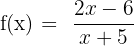
Calculate the exact coordinate pairs for any x- and y-intercepts.
x-intercept calculation:
Set y = 0:
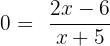
For a fraction to equal zero, its numerator must equal zero:

Coordinate: (3, 0)
y-intercept calculation:
Set x = 0

Coordinate: (0, -1.2)
Summarise with AI:
Did you like this article? Rate it!

 Loading...
I get it somehow, there are others who are unfamiliar and I have a hard time with it but it’s okay that I get it.
Thanks for sharing your thoughts! It’s completely normal to find some parts unfamiliar or more difficult than others. The important thing is that you’re making progress and understanding more as you practise. Keep going! 😊
At least I understood some of it, but there are others that I’m confused about and have a hard time understanding, but I get it.
Thanks for sharing! It’s great that you’ve understood some of it already. Don’t worry if a few parts are still confusing — keep practising and take your time with the trickier sections. You’ll get there! 😊
The lesson was a little difficult for me, especially the word problems, but the examples helped me understand it better.
Thanks for your feedback! Word problems can definitely be tricky, so we’re glad the examples helped make the lesson clearer. Keep practising — it gets easier with time! 😊
Thankyouuu po